
What is TMJ?
TMJ is the common term for the temporomandibular joint. TMJ disorder usually requires a TMJ dentist to treat as it encompasses multifactorial aetiology and symptoms. It is not a straightforward treatment. Understanding the Causes of TMJ Disorder
If you’re experiencing persistent jaw pain, clicking or locking of the jaw, or difficulty chewing, you may be dealing with a condition known as TMJ Disorder. TMJ stands for the temporomandibular joint, which connects your jawbone to your skull. This joint plays a vital role in everyday functions such as speaking, eating, and swallowing.
TMJ pain can be complex and often involves more than one underlying cause. Factors such as teeth grinding (bruxism), jaw misalignment, stress-related muscle tension, or trauma to the jaw can all contribute to TMJ disorder. Because of this, treatment is not one-size-fits-all.
A TMJ dentist is a general dentist who has undergone training to assess and manage symptoms related to TMJ conditions. While not classified as a specialist, a dentist for jaw pain may use a range of techniques to help relieve discomfort, improve jaw function, and support long-term recovery. Dr. Lisa Chong is a general dentist with a clinical focus in the assessment and non-surgical management of temporomandibular joint (TMJ) dysfunction, jaw pain, teeth grinding, and related facial muscle disorders.
With extensive training in neuromuscular dentistry, splint therapy, and craniofacial development, Dr. Chong takes a holistic approach to treating TMJ disorders — integrating dental, muscular, and postural considerations.
She collaborates with physiotherapists, myofunctional therapists, and bodywork practitioners to help patients manage symptoms such as jaw clicking, clenching, migraines, and neck tension. Dr. Chong also provides airway-focused assessments and is experienced in treating tongue ties and bite-related complications.
If you’re seeking help with TMJ pain, consult a dentist with experience in treating jaw-related concerns. Early assessment and individualised care can help reduce symptoms and prevent the condition from worsening over time.
TMJ Disorder is a complex condition that can result from a range of contributing factors. The temporomandibular joint (TMJ) plays an essential role in speaking, chewing, and swallowing.
Common causes of TMJ pain include excessive teeth grinding or clenching during sleep (bruxism), as well as underlying airway issues such as sleep apnoea, nasal blockages, enlarged tonsils, or other oropharyngeal obstructions. These factors may place undue stress on the TMJ, leading to tension headaches, jaw stiffness, or sharp jaw pain.
A thorough examination by a dentist for jaw pain, often including imaging and sleep-related assessments, is important to accurately identify and manage the root causes of TMJ disorder.
Incorrectly Shaped Teeth
How Dental Alignment Can Cause TMJ Disorder and Jaw Pain
One of the most common yet overlooked causes of TMJ disorder is incorrectly shaped or misaligned teeth. These dental issues can lead to an imbalanced bite, putting strain on the temporomandibular joint (TMJ) and contributing to jaw pain, tension, and clicking or locking of the jaw.
Key dental factors that may contribute to TMJ pain include:
Poorly Fitted Fillings or Crowns – Dental fillings that do not align properly with your natural bite can disrupt jaw function.
Naturally Misshaped Teeth – Irregularly shaped teeth can alter how the upper and lower teeth meet, affecting the TMJ.
Missing Teeth – Gaps in your bite can cause your jaw to overcompensate, increasing stress on the joint.
Deep Bite – A condition where the upper teeth excessively overlap the lower teeth, potentially trapping the jaw and limiting natural movement.
If you're experiencing jaw discomfort or symptoms of TMJ disorder, a consultation with a TMJ dentist or dentist for jaw pain can help identify the cause and recommend appropriate treatment options.
Developmental Issues
Several developmental issues can contribute to TMJ disorder, including:
Discrepancy with Jaw Length: When the upper and lower jaws are not the same length, it can cause misalignment.
Tongue Tie: A condition where the tongue is tethered to the floor of the mouth, restricting movement. Adult tongue tie release may assist tongue restriction and headache, migraine, neck pain, but it does not expand the palate. TMJ assessment is required to assist any other issues.
Narrow Palate: A narrow upper jaw can lead to misalignment and bite issues, mouth breathing, cervical neck pain.
Understanding Narrow Palate: Symptoms, Problems & Treatment with a Palatal Expander
A healthy smile isn't just about straight teeth — it's also about how your jaw and palate (roof of the mouth) develop. One often overlooked condition that can cause a variety of dental and health issues is a narrow palate. If left untreated, it can affect everything from breathing to bite alignment and even facial symmetry.
What Is a Narrow Palate?
A narrow palate (also known as a high-arched palate) occurs when the roof of the mouth is too narrow or tall, limiting the space available in the upper jaw. This can lead to crowding of the teeth, misalignment of the bite, and airway problems.
Narrow palates are typically caused by genetics, prolonged thumb sucking or pacifier use, or improper tongue posture during childhood. It's more common than many realize and is best addressed early, though adults can still benefit from treatment.
Symptoms of a Narrow Palate
While the condition may go unnoticed without a dental exam, there are several common signs and symptoms:
Crowded or misaligned teeth
Crossbite (upper teeth sit inside the lower teeth when biting)
Difficulty breathing through the nose
Mouth breathing
Snoring or sleep-disordered breathing
Speech difficulties or lisp
Frequent sinus infections
Visible high-arched roof of the mouth
neck pain related to low tongue position as narrow palate is unable to house the tongue.
Cervical pain due to the forward head posture from the low tongue positioning.
In children, early signs may include delayed loss of baby teeth, difficulty chewing, or a narrow facial appearance.
Problems Caused by a Narrow Palate
A narrow palate doesn't just impact your smile — it can affect overall health and quality of life. Here’s how:
1. Dental Crowding
With limited space in the upper jaw, teeth can grow in crooked or overlap, making brushing and flossing harder — increasing the risk of cavities and gum disease.
2. Improper Bite
Misalignment like crossbites or open bites can cause uneven wear on teeth and jaw strain, leading to TMJ disorders or chronic jaw pain.
3. Airway and Breathing Issues
A narrow upper jaw often leads to a smaller nasal airway, making breathing through the nose more difficult. This can contribute to snoring, sleep apnea, and poor sleep quality.
4. Facial Development
In growing children, a narrow palate can influence the shape of the face, often resulting in a long, narrow facial appearance with sunken cheeks.
Treatment: How a Palatal Expander Helps
The most common and effective treatment for a narrow palate, especially in children and teens, is the palatal expander.
What Is a Palatal Expander?
A palatal expander is a custom orthotic device that fits along the roof of the mouth and gently widens the upper jaw over time. It works by applying gradual pressure to the two halves of the palate, which are not yet fused in children and adolescents. As the expander is adjusted (usually daily), the palate slowly expands, creating more space in the mouth.
Benefits of Palatal Expansion:
✅ Corrects crossbites and crowding
✅ Improves nasal breathing
✅ Reduces risk of impacted teeth
✅ Enhances facial balance and symmetry
✅ Prepares the mouth for future orthodontic treatment (like braces)
✅ May help reduce snoring and sleep-disordered breathing
What to Expect During Treatment
The expander is typically worn for several months, with the active expansion phase lasting a few months.
Most patients report only mild discomfort or pressure during adjustments.
After expansion, a retention period allows new bone to form and stabilize the wider jaw.
Consider Myofunctional appliances like Myobrace.
Is It Too Late for Adults?
While palatal expansion is most effective before the mid-palatal suture fuses (around age 14–16), there are adult treatment options as well. These may include:
Surgically Assisted Rapid Palatal Expansion, MARPE.
other appliances
An evaluation is the best way to determine the right approach. We provide a comprehensive 1 hr consultation assessment and CBCT scan along with Facial 5D scanning to assist in accurate treatment planning.
Final Thoughts
A narrow palate might seem like a small issue, but it can have wide-ranging effects on your dental health and overall well-being. The good news? With timely treatment — especially with a palatal expander — many of these issues can be corrected or even prevented entirely.
If you or your child are experiencing symptoms of a narrow palate, don’t wait. Schedule a consultation with us to explore your options and take the first step toward a healthier, more confident smile.
Have questions or think a palatal expander might be right for you or your child? Contact our office today — we’re here to help you breathe better, sleep better, and smile brighter.
Orthodontic Factors
Orthodontic treatments and related issues can also impact TMJ health:
Teeth Movements: Shifting teeth can change how the upper and lower jaws meet.
Extractions: Removing teeth can lead to a lack of space for the tongue, affecting the bite.
Multiple Teeth Extractions: This can create a narrow mouth, complicating the jaw alignment.
Accidents and Whiplash
Injuries can play a significant role in developing TMJ disorder:
Cervical Pain: Neck injuries can affect how your teeth come into contact, leading to TMJ issues.
Accidents and Whiplash: Trauma to the head and neck can cause or exacerbate TMJ disorders.
Habits and Behavioral Factors
Certain habits and behaviours can contribute to TMJ problems:
Thumb Sucking: Prolonged thumb sucking can affect jaw development.
Nail Biting: This habit can put stress on the jaw.
Jaw Dislocating as Entertainment Tricks: Intentionally dislocating the jaw for entertainment can cause severe damage and misalignment.
TMJ disorder is a multifaceted condition that can arise from various causes. Whether it’s due to dental issues, developmental problems, injuries, or certain habits, understanding these factors is essential for effective treatment and management. At Pain Free Dentist Sydney, we specialize in creating personalized treatment plans to address the unique needs of each patient suffering from TMJ disorder. If you’re experiencing symptoms, reach out to us for a comprehensive assessment and tailored treatment approach.
There is no single formula for TMJ treatment, as each individual's causes of TMJ pain differ. At Pain Free Dentist Sydney, we create a personalized treatment plan for managing TMJ disorder. We provide correct diagnoses, and support, and treat the patient as a whole rather than just addressing the teeth. Our treatment is gentle, and changes will translate to a gradual realignment of your bite.
Experienced TMJ Dentist in Sydney – Comprehensive TMJ Treatment for Jaw Pain and Dysfunction
As a trusted TMJ dentist in Sydney, we understand that TMJ disorder involves complex, multifactorial causes and symptoms. Effective TMJ treatment often requires a multidisciplinary approach, collaborating closely with specialist and allied health professionals to provide comprehensive care. The temporomandibular joint (TMJ), located on both sides of the head where the jawbone meets the skull, plays a vital role in daily activities such as talking, eating, and swallowing. When this joint becomes misaligned or overworked, it can lead to severe jaw pain, sharp discomfort, and tension headaches, neck pain, back pain. Our tailored TMJ therapies aim to restore jaw function and relieve pain for lasting results.
Methods of Treatment:
TMJ Botox: This is our number 1 request for treatment. If your TMJ disorder is due to muscular hyperactivity, Botox treatment is effective. We use Xeomin, a pure Incobotulinum toxin that does not produce any antibody resistance. We have found this product to be superior to other Botulinum toxin products.
Splint Treatment: When jaw misalignment is caused by underlying skeletal or bite issues, TMJ splint therapy can play a crucial role in restoring proper function and relieving discomfort. A splint for jaw pain helps realign the temporomandibular joint (TMJ), reducing tension and improving bite coordination.
At our clinic, Dr. Lisa Chong provides custom-designed splints tailored to each patient’s unique needs. Her approach ensures the splint fits comfortably and targets the root cause of the TMJ disorder, offering effective and lasting relief. Many patients have found this TMJ treatment to significantly improve symptoms such as jaw tension, clicking, and facial pain.
If you're experiencing ongoing TMJ pain or bite issues, a consultation with a dentist for jaw alignment like Dr. Lisa can help guide your recovery with a personalised treatment plan.
Composite Bonding for Bite Correction and Jaw Alignment
A properly aligned bite is essential for long-term dental health and jaw function. When teeth are worn down, misshaped, or unevenly positioned, composite build-ups can help restore the correct bite relationship between the upper and lower jaw. This process supports jaw alignment, improves chewing efficiency, and helps prevent unnecessary strain on individual teeth.
By carefully rebuilding worn or damaged teeth with tooth-coloured composite material, a dentist for bite adjustment can ensure even contact across your bite. When teeth don’t bite evenly, excess pressure on a single tooth can lead to discomfort, jaw pain, or even trigger TMJ disorder symptoms.
Composite bonding treatment not only enhances function but also contributes to a more balanced and natural-looking smile. If you're experiencing signs of an uneven bite or jaw tension, this minimally invasive solution may offer lasting relief..
TMJ Physiotherapy: TMJ pain and body alignment require allied health support. We have physiotherapists (MAPA accreditation) and osteopaths (craniosacral work) as part of our integral treatment team.
At Pain Free Dentist Sydney, we create a personalized treatment plan for managing TMJ disorder. We provide a comprehensive one-hour consultation to assess your TMJ dysfunction, and we ask that you take this time to look after your health.
We are committed to supporting you throughout this journey. If you have any questions or concerns, please feel free to reach out to our TMJ clinic near you. Whether you need TMJ Botox, TMJ physiotherapist services, further TMJ assessment, or are seeking a TMJ clinic near you, we are here to help.
Email: info@painfreedentistsydney.com.au for more information. As a TMJ dentist in Sydney, we understand that TMJ treatment encompasses a multifactorial etiology and symptoms. TMJ disorder usually requires a TMJ dentist to treat it effectively, as it is not a straightforward process. TMJ disorder can affect the neurological aspect ie TMJ pain, and musculature which requires TMJ physiotherapy, emotional support ie Psychological stress from prolonged chronic pain, and gastrointestinal issues from protracted use of anti-inflammatories.
We are committed to supporting you throughout this journey. If you have any questions or concerns, please feel free to reach out to our TMJ clinic near you. Whether you need TMJ Botox, TMJ physiotherapist services, or further TMJ assessment, or seeking a TMJ clinic near you we are here to help. Call 9558 8988
Signs and Symptoms of TMJ Dysfunction

Headaches/ Migraines affected by TMJ dysfunction
Jaw clicking
Dislocating jaw
Jaw pain
Tiredness from sleeping apnea
Earache, tinnitus or hearing problems
Headache (in temporal region) or migraines
Whiplash
Bite is off
Can’t open mouth to eat a burger
Posture issues
Narrow palate
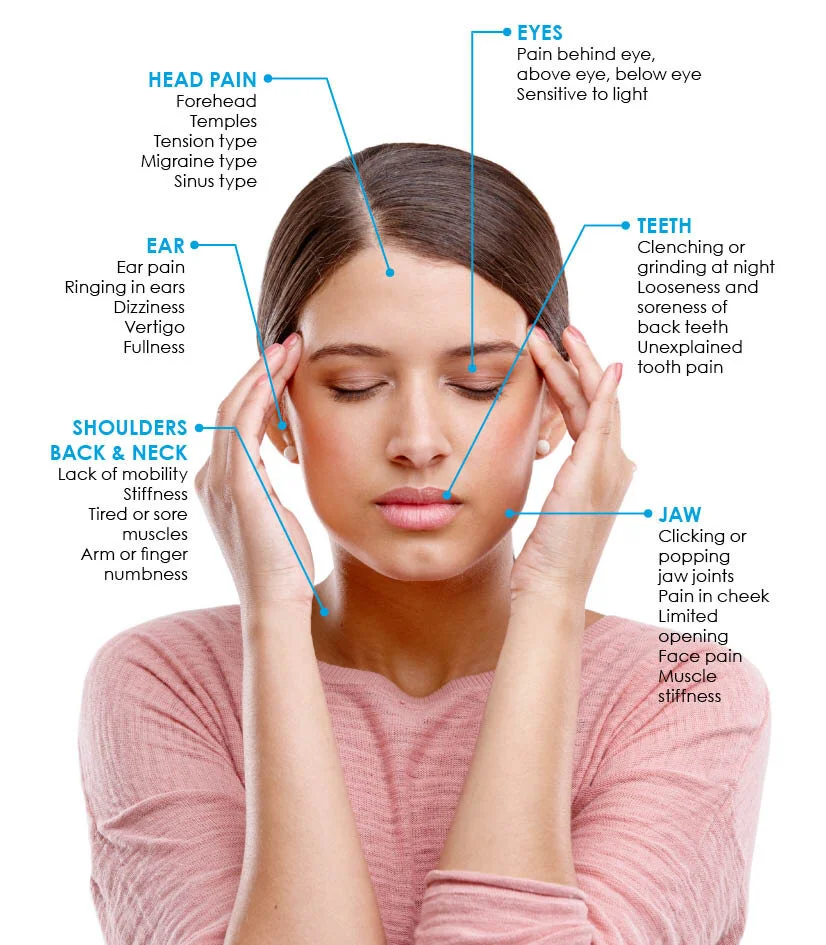
Neck pain, Ear pain, eye pain, jaw pain, jaw clicking, teeth grinding
Can’t open mouth without clicking or dislocating jaw
Scalp tenderness
Myalgia (muscle pain)
Arthralgia (joint pain)
Neuromuscular pain
Difficult swallowing
Vision issues
Can’t chew food properly
Neck and shoulder pain
Swollen face
Lethargy
Tried many splints and does not help
Seen physiotherapist without prolong relief
taking SSRI or SNRI
orthodontic treatment
wisdom teeth
facial asymmetry
Causes of TMJ PAIN
Bruxism
Teeth Clenching
Teeth Grinding
Bite issue from orthodontics or missing teeth
Trauma
Arthritis (Osteoarthritis and Rheumatoid Arthritis)
TMJ Disorder Jaw Pain Treatment Options
TMJ Jaw Pain can be caused by missing or misshaped teeth, fillings or crowns, and grinding or clenching teeth. Pain Free Dentist Sydney offers a range of TMJ treatments.
Because TMJ pain can be diverse in diagnoses, getting the correct diagnoses is essential to lead to the path of treatment.
Sometimes, multiple issues can contribute to TMJ pain, a qualified TMJ dentist will look into your history, doing some test, X-RAYS to provide an initial diagnosis. If the pain continues, the TMJ dentist will look into other areas to investigate the issues involved.
It is not as simple as drilling a tooth and eliminating dental pain.
TMJ dentist will determine the likely cause of the problem to lead to solutions.
TMJ treatment can be as simple as Botox into the tight muscles. An occlusal splint or appliance is required to provide some relief to keep the teeth apart whilst the jaw finds its equilibrium.
If there are issues with the bite correction of the bite is required. Re-building of the teeth or as complex as full mouth rehabilitation with crowns and implants to replace missing teeth.
Or even orthodontic treatment if the bite cannot be corrected with the simple rebuilding of the teeth.
Sometimes, the issue is musculoskeletal, a Physiotherapist or Osteopath is essential in assisting patients with postural problems.
Non-Surgical TMJ Treatment Only
At our practice, we focus exclusively on non-surgical treatments for TMJ disorder. If imaging or diagnosis reveals arthritis in the TMJ condyles, this may require specialist intervention. In such cases, we will refer you to an oral and maxillofacial surgeon who can assess the need for procedures such as arthroscopy or arthrocentesis—both of which involve surgical management of the jaw joint (TMJ condyle surgery).
We believe in a conservative, evidence-based approach, offering non-invasive TMJ therapies to manage jaw pain, bite imbalances, and related discomfort wherever possible. Should surgery be required, we’ll ensure you are supported with the appropriate referral for expert care.
TMJ Diagnosis and Treatment can range from:
Bite analysis and X-rays
Neuromuscular analysis and working on posture
Sleep Study
Muscle relaxant for clenching and grinding
Splint or orthotics
Rebuilding of correct bite
Maintenance of correct bite and long lasting solution
Occlusion splint therapy to relieve pressure off the joint/teeth
Modified diet to only eat soft food and do not favour on one side of the mouth
Avoid extreme jaw movement such as yawning
Physiotherapy
Stress management
Medication
Orthodontic treatment to correct your bite
Anti-wrinkle injections to stop clenching and relax jaw muscle
Other non-surgical intervention
Surgery management with Oral Maxillofacial surgeon, ENT.
Treatment may also require all or a combination of the above, a consultation with the dentist is required to assist your pain management. Call us for a consultation on 9558 8988.
*

BEFORE BOTOX
*

DURING BOTOX
*

AFTER BOTOX
Anti-wrinkle injectables can assist in relaxing selected muscles that may cause your headaches, migraines, grinding, gummy smiles.
Injections & TMJ
Located on both sides of the head at the point where the jawbone meets the skull, the temporomandibular joint (TMJ) is used during talking, eating, swallowing, and other everyday activities. If this joint becomes displaced or is overworked through excessive teeth grinding, a person may suffer severe tension headaches, as well as sharp pain in the jaw. These injections relieves jaw tension by making muscles unable to engage in the powerful, often unconscious movement of the jaw that produces headaches and pain.
ANTI WRINKLE INJECTIONS
Muscle relaxant treatment is available at Pain Free Dentist Sydney for Jaw Tension and TMJ. Muscle relaxant therapy is used as an alternative treatment for TMJ (temporomandibular joint) disorders and associated jaw tension and pain. When injected into facial muscles afflicted with soreness and discomfort. The injection relieves TMJ and jaw tension for many patients. The injections often eliminate headaches resulting from teeth grinding, and, in cases of severe stress even minimize lock jaw.
Anti-wrinkle injections are made from a natural, purified protein in sterile laboratory conditions. Anti-wrinkle injections are strategically injected into specific wrinkle-causing muscles, creating an improved appearance. Anti-wrinkle injections relax the underlying muscles thereby smoothing overlying skin and causing lines and wrinkles to soften and prevents them from deepening and new lines developing in the treated area.
In addition to reducing wrinkles, another great benefit of injectable muscle relaxant treatments is the lift that they give to your face; taking away the appearance of tiredness and creating a more youthful, refreshed you. Headaches caused by muscle tension are relieved from these injections. Teeth clenching and grinding are also eliminated. Reducing the incidence of broken crowns and fillings from bruxism and clenching.
*
TMJ INJECTION
Non surgical procedure that is quick, straightforward and effective. Patients experience noticeable improvement within days of their first treatment
*
AFFECTED AREAS
Only the areas that are injected with the will be relaxed. Muscle relaxant treatment for TMJ therapy are localised to the specific muscle.
*
DURATION
Although dependant on the number of injections, it is reasonable for the treatment procedure to be completed within 30 minutes.
TMJ Disorder is a complex issue and the problem can range from simple to complex solutions. We find the cause of the problem, which can be incorrect bite, skeletal alignment, postural, muscular joint pathology or another cause that relates to the pain pathway that mimics TMJ pain. Each one of these causes will require proper assessments, investigation, correct treatment, therapies that could involve working with other allied health professionals. We highly recommend working with physiotherapists, chiropractors, naturopaths, osteopaths, oral surgeons, orthodontists, prosthodontists.
MUSCLE RELAXANT TREATMENT
Is the muscle relaxant Treatment Painful
TMJ Treatment procedure with muscle relaxant are likened to a "bug bite" or "prick".
What to Expect After the TMJ Treatment
After the TMJ Treatment, heavily clenched muscle will start to ease off.
There may be mild temporary bruising, numbness, or redness around the injection sites. You will not look 20 years younger, but you may find that you look more natural and feel more relaxed.
What is the Recovery from muscle relaxant Therapy for TMJ Treatment Like
Because the treatment procedure is non-surgical and non-invasive, it is highly likely that the patient can return to normal activities immediately. However, to avoid spreading the toxin to other muscles, patients should not rub or massage the area injected with this toxin and remain upright for many hours. Physical activity should also be limited for a time.
Risks, Limitations & Possible Complications of Injections for TMJ Treatment. As with any medical procedure, there are possible risks and side effects when using for TMJ treatment. Since this is a non-surgical treatment procedure, the risks and possible complications are infrequent, minimal and temporary. Muscle relaxant injection treatments should be avoided during pregnancy and lactation.
What does a treatment session involve?
During an initial consultation to assess your areas of concern accredited dentist will discuss the appropriate treatment options and the expected results. After your consultation, the injection treatment will take around 10 minutes to perform. No anaesthetic is required as this is a fine needle treatment and is virtually painless. The results will develop over the next few days and last for up to 3 months.
Patients suffering from headaches that spread from the forehead and behind the eye region will require injections in these regions: Forehead Frontalis muscles, Glabellar Frown lines and the crows’ feet eye region. Generally, the treatment takes around 10 minutes. Discomfort is very minimal, and no anaesthetic is usually required. After the injection, it takes 3-4 days for the treatment to begin taking effect. The dose recommended for the treatment of frown lines will vary depending on your individual situation and the severity of your frown lines.
Any surgical or invasive procedure carries risks. Before proceeding, you should seek a professional opinion from an appropriately qualified health practitioner.
How does muscle relaxant therapy work
Many facial wrinkles occur when we use our muscles to make repeated facial expressions. The treatments can be used to relax specific facial muscles that cause expression lines. Once the muscles are relaxed, you cannot contract them and continue to make those undesirable facial expressions. After treatment the lines gradually smooth and new lines are prevented from forming.
How long does this therapy last
The effect can last up to 4 months before lines slowly begin to return. If you have repeat treatments, the effect tends to last longer. Injectables will assist in reduction of grinding and hence reduce the jaw pain. Please consult your dentist on this, results may vary.
Does this treatment cause more wrinkles to form
This anti-wrinkle treatment will relax the facial muscles that cause expression lines. It does not cause more wrinkles to form. If you decide not to have further treatments your muscles will eventually return to normal activity and your wrinkles will gradually revert to their pre-treatment levels.
For more information on TMJ injections contact us
TMJ FAQ:
1. What qualifications have the TMJ dentist acquired?
With over 30 years of experience in Dentistry in NSW Dr. Lisa Chong is highly qualified to handle TMJ patients. Her clinic in Hurlstone Park, NSW Sydney.
2. Have they successfully treated patients with TMJ issues?
Just a few testimonies of the work of Dr. Lisa Chong:
3. What options for TMJ treatment are there?
Find above: TMJ Disorder Jaw Pain Treatment Options
4. How to choose a TMJ dentist
Some dentists may work with other therapists and that is a good indication. As TMJ issues are complex a multidisciplinary approach is required to treat TMJ pain. Treatment may also require all or a combination of the above, and a consultation is required to gauge your personal experience. Call us for a consultation on 9558 8988.