Many people think tongue tie is only a baby issue — something that affects breastfeeding and gets sorted out in infancy. But for thousands of adults in Sydney's Inner West, tongue tie is a daily reality that's never been addressed. It can affect how you speak, eat, sleep, and even how you hold your head and neck. At Pain Free Dentist Sydney in Hurlstone Park, we see adult tongue tie as far more than a visible band of tissue — it's a functional restriction that can ripple through your entire body.
What Is Adult Tongue Tie?
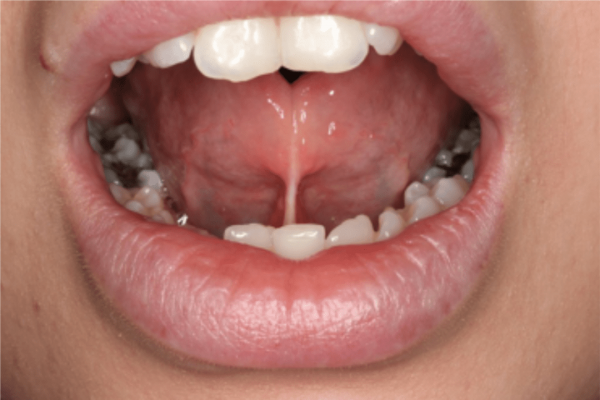
Tongue tie (medically called ankyloglossia) is present from birth. It occurs when the lingual frenulum — the band of tissue connecting the underside of your tongue to the floor of your mouth — is unusually short, tight, or attached too close to the tongue tip .
The key word is restriction. Every person has a frenulum, and not everyone with a visible band has a problem. But when that tissue limits your tongue's natural movement, it becomes a functional issue that can affect your daily life in ways you might never have connected to your tongue .
The Hidden Ways Tongue Tie Shows Up in Adults
Speech and Pronunciation
One of the most common complaints among adults with tongue tie is difficulty with certain sounds. Studies show that around half of adults with uncorrected tongue tie report speech problems . Sounds that require the tongue tip to reach the roof of the mouth — like "t," "d," "l," and "th" — can be challenging. You might have been told you "mumble" or that your speech sounds different, without ever knowing why.
Eating, Licking, and Swallowing
Simple pleasures can become frustrating. Licking an ice cream cone, cleaning food from your lips, or even kissing can feel awkward or impossible when your tongue can't reach where it needs to go . Swallowing can also be affected — when the tongue can't seal properly against the roof of your mouth, it may thrust forward instead, creating a pattern that can push against your teeth over time .
Oral Hygiene Challenges
A restricted tongue has difficulty sweeping across the teeth and gums to clear food particles. This can lead to a higher risk of plaque buildup, decay, and gum problems — not because you're not brushing, but because your tongue can't do its natural cleaning job .
Jaw Pain, Headaches, and Neck Tension
This is where the connection gets surprising. A 2025 study found that adults with tongue tie had significantly reduced cervical spine mobility and higher rates of dizziness and jaw functional limitations compared to those without . The restriction in your mouth creates tension that radiates through the hyoid bone to your neck and shoulders . If you've been living with chronic neck pain or headaches that no amount of stretching seems to fix, your tongue tie could be part of the puzzle.
TMJ Dysfunction
Research has found a significant association between tongue tie and temporomandibular disorders (TMD) in adults. A 2025 cross-sectional study of 129 adults found that mild to severe tongue tie was significantly associated with TMD . When your tongue can't rest properly against the palate, your jaw may compensate in ways that strain the TMJ over time.
Sleep and Breathing
A restricted tongue often sits lower in the mouth than it should. This low resting posture can narrow the airway and contribute to snoring, mouth breathing, and even sleep apnea . If you wake up tired, grind your teeth at night, or have been told you snore, your tongue tie could be an underlying factor.
Why This Matters for Your Overall Health
The tongue is not an isolated muscle. It's connected to a complex network of muscles, bones, and nerves that affect your posture, your breathing, and your sleep. When the tongue is tethered, the entire system compensates.
The Australian Dental Association emphasises that tongue tie should not be diagnosed from appearance alone — it requires a thorough functional assessment to determine whether the restriction is actually causing problems . Not every tongue tie needs treatment, but those that cause functional limitations deserve attention.
Signs You Might Have an Adult Tongue Tie
You may have a tongue tie if you experience:
Difficulty lifting your tongue to the roof of your mouth
A "heart-shaped" or notched tongue tip when you try to stick it out
Speech that's been described as unclear or "lazy"
Trouble licking your lips or an ice cream
Chronic neck, shoulder, or jaw tension
Snoring, mouth breathing, or waking up tired
Difficulty keeping your tongue in a resting position on the palate
Food getting stuck between your teeth and cheek more often than seems normal
What Can Be Done?
Treatment for adult tongue tie depends on how much it's affecting your daily life. The Australian Dental Association recommends non-surgical approaches as first-line treatment, including tongue mobility exercises and myofunctional therapy .
However, when conservative therapy doesn't provide enough relief, a simple surgical release may be considered. For adults, this is typically a frenuloplasty — a procedure that releases and reshapes the frenulum to restore tongue mobility. Research shows that tongue function improves significantly after release, with gains in both protrusion and elevation .
At Pain Free Dentist Sydney, Dr. Lisa Chong has extensive experience in assessing and treating tongue and lip ties in patients of all ages. We take a holistic approach, considering how your tongue function connects to your breathing, your bite, your posture, and your sleep.
A Local Clinic That Understands the Whole Picture
If any of the symptoms above sound familiar, it's worth having a professional look at your tongue function — not just at how your frenulum looks. Pain Free Dentist Sydney is located in Hurlstone Park, convenient to Dulwich Hill, Marrickville, Newtown, and across the Inner West. We offer thorough assessments and personalised treatment plans, with sedation options available for anxious patients.
Book an assessment: Call (02) 9558 8988 or book online. Let our team know you're concerned about tongue tie so we can arrange a comprehensive functional evaluation.
Pain Free Dentist Sydney
📍 The Garnet Building, Suite G1A / 570 New Canterbury Road, Hurlstone Park NSW 2193
📞 (02) 9558 8988
This article is for informational purposes only and does not constitute medical advice. Treatment plans should be determined after a professional evaluation.