
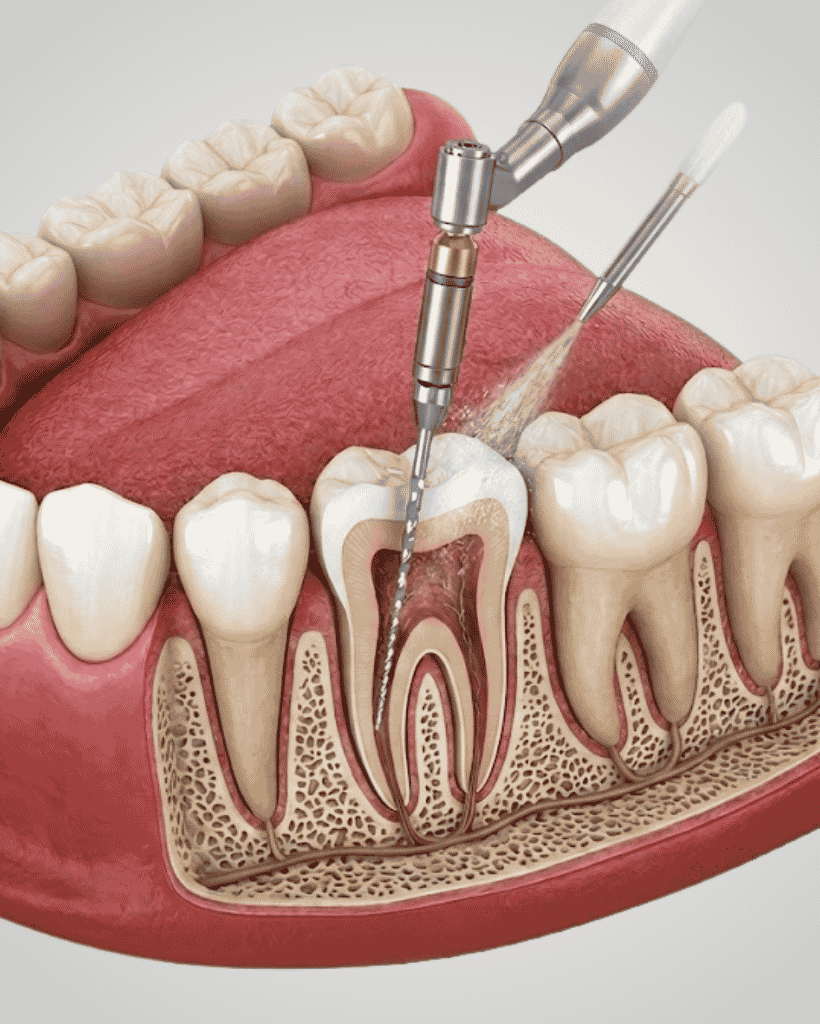
What is root canal treatment?
Root canal treatment is a dental procedure designed to treat infection or inflammation inside a tooth, helping preserve your natural tooth rather than removing it.
Inside every tooth is a space containing dental pulp, which consists of nerves, blood vessels and connective tissue. When the pulp becomes inflamed or infected due to deep decay, trauma, cracks or repeated dental procedures, it may cause significant pain and discomfort.
In many cases, root canal treatment can help save a tooth that would otherwise require extraction.
Despite its reputation, modern root canal treatment is designed to relieve pain rather than cause it. With appropriate anaesthesia and techniques, treatment can often be performed comfortably.
At Pain Free Dentist Sydney, we understand that many patients are anxious about root canal treatment. Our approach is to explain the problem, discuss the options and help patients feel as comfortable as possible throughout their dental care.
Why might you need root canal treatment?
Root canal treatment may be recommended when the dental pulp becomes irreversibly inflamed, infected or damaged.
Common causes include:
Deep tooth decay reaching the dental pulp
Cracked or fractured teeth
Dental trauma following an accident
Repeated dental procedures on the same tooth
Large or leaking fillings
Untreated tooth decay
Infection developing inside the tooth
When bacteria enter the pulp, the body's inflammatory response may cause pressure and pain within the tooth. Because the pulp is enclosed within hard tooth structures, this pressure can become particularly uncomfortable.
If the infection progresses, it may spread through the root of the tooth and into the surrounding bone, potentially resulting in an abscess.
Root canal treatment removes the damaged or infected pulp tissue, cleans and disinfects the root canal system, and seals the canals to help prevent further infection.
What are the symptoms of a tooth needing root canal treatment?
Not every tooth requiring root canal treatment causes severe pain. Some teeth may develop infection without obvious symptoms, which is why regular dental examinations are important.
Common symptoms include:
Severe or persistent toothache
Throbbing pain
Pain that wakes you during the night
Prolonged sensitivity to hot or cold
Pain when biting or chewing
Tenderness around the tooth
Swelling of the gums
A pimple-like swelling on the gum
An unpleasant taste in the mouth
Tooth discolouration
Pain that appears to come and go
Sometimes a tooth may initially be very painful but later stop hurting because the nerve inside the tooth has died. This does not necessarily mean the infection has resolved.
A tooth that has become painless following severe toothache should still be assessed.
Does root canal treatment hurt?
One of the biggest fears patients have is that root canal treatment will be painful.
Historically, root canal treatment had a reputation for being uncomfortable, particularly when patients presented with severe inflammation or infection.
Modern dentistry has significantly improved the diagnosis, anaesthesia, instruments and techniques used during root canal treatment.
The purpose of treatment is to remove the source of pain and infection. With appropriate local anaesthesia, many patients report that the procedure is much more comfortable than they anticipated.
If you are particularly anxious, have a sensitive gag reflex or have previously had difficult dental experiences, tell your dentist before treatment begins.
Your comfort should be an important part of the treatment plan.
What happens during root canal treatment?
Root canal treatment generally involves several important stages.
1. Examination and diagnosis
Your dentist will assess the tooth, your symptoms and the surrounding tissues. Dental X-rays may be taken to evaluate the roots and surrounding bone.
The diagnosis helps determine whether the tooth can be treated and whether root canal treatment is the most appropriate option.
2. Local anaesthesia
Local anaesthetic is administered to numb the tooth and surrounding tissues.
The aim is to make the procedure as comfortable as possible. Additional anaesthesia may be required in certain situations, particularly when the tooth is severely inflamed.
3. Accessing the tooth
A small opening is made through the crown of the tooth to access the pulp chamber and root canals.
4. Cleaning and disinfecting the root canals
The damaged or infected pulp tissue is removed.
The root canal system is carefully cleaned, shaped and disinfected to reduce bacterial contamination.
5. Sealing the root canals
Once the canals have been appropriately prepared, they are filled with a biocompatible material and sealed to help prevent reinfection.
6. Restoring the tooth
Following root canal treatment, the tooth needs an appropriate restoration to protect it from fracture and restore its function.
Depending on the amount of remaining tooth structure, this may involve a filling, composite restoration or dental crown.
For many posterior teeth, particularly molars that have lost substantial tooth structure, a crown may be recommended to provide additional protection against fracture.
Why does a tooth need a crown after root canal treatment?
A tooth that has undergone root canal treatment may be more vulnerable to fracture, particularly when it has already been weakened by extensive decay, large fillings or cracks.
The loss of structural tooth tissue is often a more important factor in fracture risk than the root canal procedure itself.
A dental crown may help protect the remaining tooth structure by covering and supporting the tooth.
Not every root canal-treated tooth automatically requires a crown. The recommended restoration depends on the location of the tooth, the amount of remaining tooth structure, the bite and the individual clinical situation.
Your dentist will discuss the most appropriate restoration to help preserve the treated tooth long term.
Can a root canal save a tooth that would otherwise be extracted?
In many cases, yes.
Root canal treatment can allow a tooth with an infected or damaged pulp to remain in the mouth and continue functioning.
Saving your natural tooth may help maintain:
Natural chewing function
The position of surrounding teeth
Existing bite relationships
Natural tooth structure
Bone surrounding the tooth
However, not every tooth can be saved.
If the tooth is severely fractured, has insufficient remaining structure, has advanced periodontal disease or has an unfavourable prognosis, extraction may be the more appropriate option.
Your dentist will assess whether the tooth is restorable before recommending treatment.
Root canal treatment versus tooth extraction
When a tooth becomes severely infected, patients may wonder whether it is better to remove the tooth rather than undergo root canal treatment.
Both options may be appropriate depending on the condition of the tooth.
Root canal treatment aims to preserve your natural tooth by removing the infected pulp and sealing the root canals.
Tooth extraction removes the tooth entirely. If a tooth is extracted, replacement options may include a dental implant, bridge or denture, depending on the circumstances.
Preserving a natural tooth may be preferable when the tooth has a good prognosis and can be predictably restored.
However, a tooth that cannot be restored or has a poor prognosis may be better removed.
The decision should consider the long-term prognosis, cost, function, treatment time, your overall dental health and your personal preferences.
How long does root canal treatment take?
The duration of root canal treatment depends on the tooth involved, the complexity of the root canal anatomy and the severity of infection.
Some teeth may be treated in a single appointment, while others may require multiple appointments.
Molars often have several root canals and more complex anatomy than front teeth.
If there is significant infection, persistent symptoms or complex anatomy, additional treatment time may be necessary.
Your dentist will advise you about the expected number of appointments following your assessment.
What happens after root canal treatment?
Following treatment, it is normal to experience some tenderness around the tooth, particularly when biting, for several days.
The surrounding tissues may have been inflamed before treatment, and they may take time to settle.
Following your dentist's instructions is important during recovery.
You may be advised to:
Avoid chewing hard foods on the treated tooth until it has been fully restored
Avoid biting directly on the tooth if it is temporarily filled
Maintain good oral hygiene
Take medication only as recommended
Attend your follow-up appointments
Have the final restoration completed as advised
If you experience increasing pain, significant swelling or worsening symptoms, contact your dentist for further assessment.
Can root canal treatment fail?
Root canal treatment has a high success rate, but no dental procedure can guarantee success in every case.
Persistent or recurrent infection may occur if bacteria remain within the canal system, if the tooth develops a new crack, if the restoration leaks or if the tooth becomes reinfected.
Some teeth may require additional root canal treatment, specialist endodontic treatment or extraction if the infection cannot be resolved.
Good restoration, appropriate follow-up and maintaining oral hygiene are important factors in the long-term health of the treated tooth.
Root Canal Treatment for Anxious Patients in Sydney
If you have been told you need a root canal but are delaying treatment because of fear, you are not alone.
Many patients experience dental anxiety, fear of needles, a sensitive gag reflex or concerns about pain.
At Pain Free Dentist Sydney, we understand that your experience matters just as much as the dental treatment itself.
We take the time to explain your treatment, discuss your concerns and help you understand your options.
For patients with significant dental anxiety, sedation dentistry may be an option following an assessment of suitability.
Our aim is to help you receive the dental care you need in a supportive and comfortable environment.
Root Canal Dentist in Sydney | Pain Free Dentist Sydney
If you have persistent toothache, sensitivity, swelling or have been told that you may need root canal treatment, early assessment may help prevent the problem from progressing.
At Pain Free Dentist Sydney, we provide comprehensive dental assessments and discuss appropriate treatment options to help preserve your natural teeth whenever possible.
📍 570 New Canterbury Road, Hurlstone Park NSW 2193
📞 02 9558 8988
🌐 https://painfreedentistsydney.com.au
Experiencing toothache? Contact us to arrange an assessment and discuss your treatment options.
Frequently Asked Questions About Root Canal Treatment
Is root canal treatment painful?
Root canal treatment is performed using local anaesthesia to help manage discomfort. Many patients find the procedure more comfortable than they expected, particularly compared with the pain they experienced before treatment.
How many appointments does a root canal take?
Some root canals can be completed in one appointment, while others require two or more appointments depending on the complexity of the tooth and the infection.
How long does a root canal-treated tooth last?
A root canal-treated tooth can last many years and sometimes a lifetime with appropriate restoration, maintenance and regular dental care. Its longevity depends on the remaining tooth structure, the quality of the restoration and the health of the surrounding tissues.
Does every root canal need a crown?
No. The need for a crown depends on the amount of remaining tooth structure, the location of the tooth and the risk of fracture. Many posterior teeth benefit from cuspal coverage, while some teeth may be appropriately restored with other restorations.
Is it better to extract a tooth or have a root canal?
If a tooth is restorable and has a favourable prognosis, preserving the natural tooth may be a good option. Extraction may be recommended when a tooth cannot be predictably restored or has a poor prognosis.
Can I leave an infected tooth untreated?
An infected tooth may worsen, cause increasing pain, develop an abscess or lead to spreading infection. Prompt dental assessment is recommended rather than waiting for symptoms to resolve.
Can I have root canal treatment if I am scared of the dentist?
Yes. Dental anxiety should be discussed with your dentist. Appropriate strategies, additional support and sedation options may be available for suitable patients.