
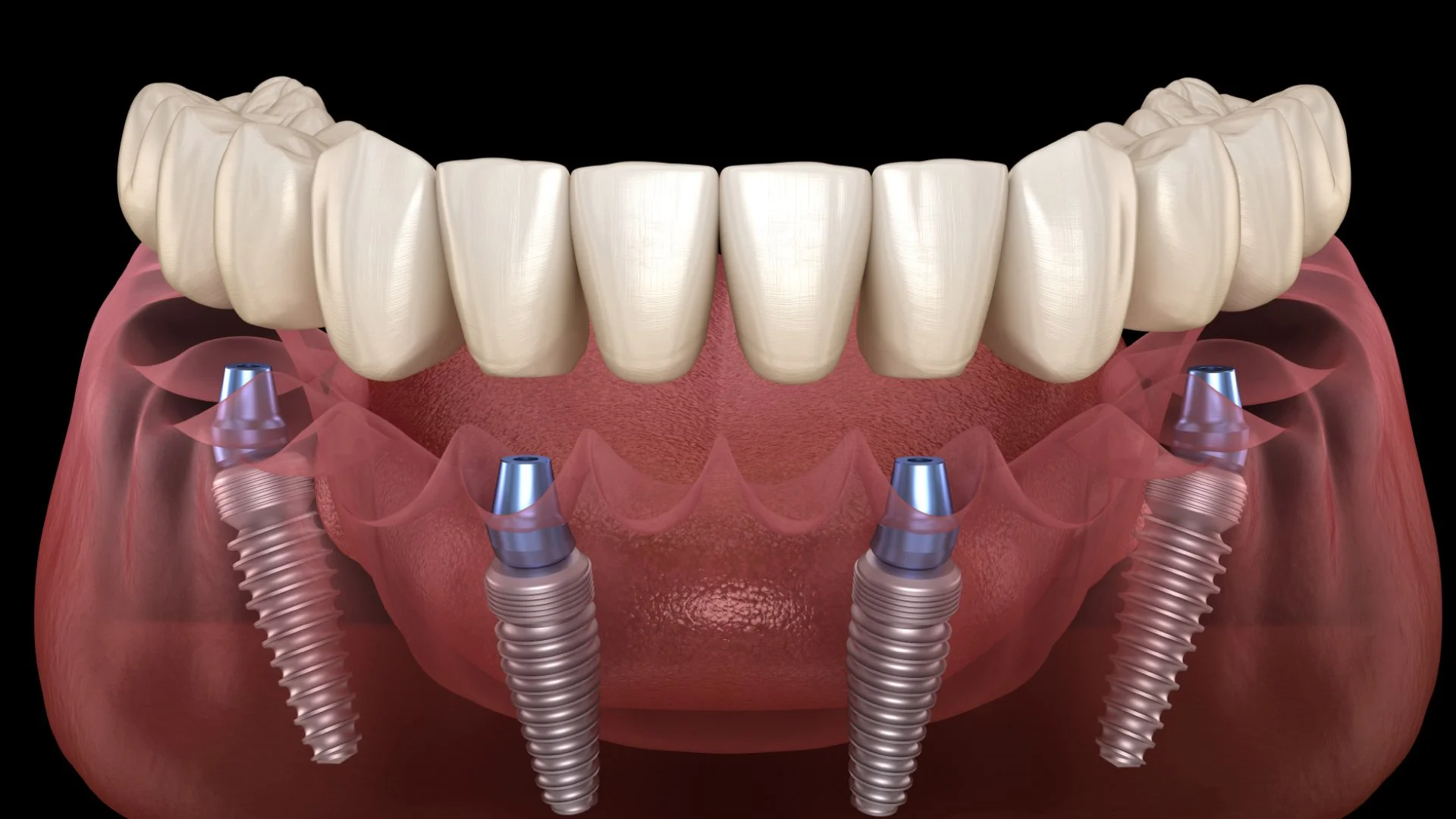
What are All-on-4 dental implants?
All-on-4 dental implants are a treatment concept designed to replace an entire arch of missing or failing teeth using four strategically positioned dental implants to support a fixed full-arch prosthesis.
Instead of replacing every missing tooth individually, four implants may be used to support a full set of replacement teeth, depending on the patient's anatomy, bone availability, bite and treatment plan.
The implants are placed into the jawbone and act as artificial tooth roots. Once healing and integration have occurred, they provide support for a fixed bridge designed to restore the appearance and function of a full arch of teeth.
For many patients who have lost most or all of their teeth, All-on-4 may offer an alternative to conventional removable dentures.
The treatment is designed to help restore:
Chewing ability
Smile aesthetics
Speech and confidence
Fixed tooth stability
Quality of life
A more natural-feeling replacement for missing teeth
At Pain Free Dentist Sydney, we understand that losing your teeth can affect much more than your smile. It can impact your confidence, ability to eat comfortably and how you feel in social situations.
How does All-on-4 dental implant treatment work?
The All-on-4 concept uses four dental implants to support a full arch of replacement teeth.
Typically, two implants are placed towards the front of the jaw, while the posterior implants may be angled to take advantage of available bone and help support the full-arch restoration.
The implant positions and angulations are planned according to the patient's anatomy, bone availability, bite and prosthetic requirements.
The treatment generally involves several stages.
1. Comprehensive dental implant assessment
Before implant treatment, a detailed assessment is required to determine whether All-on-4 is suitable for you.
This may include:
Clinical examination
Assessment of gum health
Evaluation of existing teeth
CBCT 3D imaging
Assessment of available bone
Review of medical history
Assessment of bite and jaw relationships
Discussion of aesthetic expectations
Planning the final prosthesis
A 3D CBCT scan helps evaluate the jawbone, anatomical structures and available bone for implant placement.
Treatment planning is critical because the position of the implants must be carefully coordinated with the design, function and appearance of the final teeth.
2. Removal of failing teeth where required
If you still have teeth that are severely damaged, infected, loose or have a poor prognosis, extraction may be necessary as part of the treatment plan.
In appropriate cases, implant placement may be performed during the same surgical appointment as tooth extraction.
However, not every patient is suitable for immediate implant placement or immediate loading.
3. Placement of dental implants
Dental implants are surgically placed into the jawbone.
The number, position, size and angulation of the implants are determined by the treatment plan and the patient's bone anatomy.
The goal is to achieve adequate implant stability and distribute chewing forces appropriately across the implants and prosthesis.
4. Temporary fixed teeth
In selected cases, a temporary fixed bridge may be attached to the implants during or shortly after surgery.
This is commonly referred to as immediate loading.
However, immediate loading is not suitable for every patient. It depends on factors such as:
Primary implant stability
Bone quality
Implant positioning
Bite forces
Medical health
Smoking status
Bruxism or grinding
Ability to follow dietary restrictions
The design and strength of the temporary prosthesis
Some patients may need a healing period before their implants can support a fixed prosthesis.
5. Healing and osseointegration
Following implant placement, the implants undergo a healing process known as osseointegration.
During this process, bone forms and remodels around the implant surface, helping establish a stable connection between the implant and the jawbone.
The healing period varies between patients and depends on the surgical procedure, bone quality, medical factors and implant stability.
During healing, patients are generally advised to follow a modified diet and avoid excessive loading of the implants.
6. Final full-arch teeth
Once the implants have healed sufficiently and the treatment team confirms that they are ready for definitive restoration, the final prosthesis may be fabricated and fitted.
The final teeth are designed to restore chewing function, aesthetics, speech and the patient's bite.
The material and design depend on the individual treatment plan, available space, bite forces, aesthetics and maintenance requirements.
Who is suitable for All-on-4 dental implants?
All-on-4 may be suitable for patients who:
Have lost all teeth in the upper or lower jaw
Have multiple failing teeth that may require extraction
Wear conventional dentures and want a fixed alternative
Have difficulty chewing with removable dentures
Experience discomfort or instability with dentures
Have sufficient bone for implant placement or may be suitable for an alternative implant strategy
Want to explore fixed full-arch tooth replacement
However, not everyone is automatically suitable.
Factors such as uncontrolled medical conditions, active gum disease, smoking, poor oral hygiene, severe bruxism and inadequate bone may affect treatment planning and implant success.
A comprehensive assessment is needed to determine the most appropriate treatment option.
Can All-on-4 be done if you have lost bone?
One of the advantages of the All-on-4 concept is that implant positions may be planned to utilise available bone strategically.
Angled posterior implants may help avoid certain anatomical structures and reduce the need for bone grafting in selected cases.
However, bone availability is highly individual.
Some patients may still require bone augmentation, alternative implant positions, additional implants or other surgical procedures.
CBCT imaging is important for evaluating bone volume, anatomy and implant placement possibilities.
Can you get teeth on the same day as All-on-4 surgery?
In selected cases, patients may receive a fixed temporary prosthesis on the day of implant surgery or shortly afterwards.
This is often marketed as "Teeth in a Day" or "Same-Day Teeth."
However, immediate loading is not guaranteed.
It depends on whether sufficient implant stability can be achieved and whether the patient's bone, medical health and bite conditions are suitable.
Immediate loading requires careful planning because excessive forces during early healing may compromise implant integration.
Patients may need to wear a temporary prosthesis and follow a soft-food diet while the implants heal.
The final prosthesis is generally fitted after the appropriate healing period.
All-on-4 versus traditional dentures
Traditional dentures are removable appliances that replace missing teeth and may rely on the gums, underlying bone and suction for support.
All-on-4 dental implants use implants anchored in the jawbone to support a fixed prosthesis.
Traditional dentures
Advantages may include:
Non-surgical treatment
Lower initial treatment cost
Easier removal for cleaning
Suitable for patients who cannot undergo implant surgery
Limitations may include:
Movement during chewing
Reduced chewing efficiency
Gum discomfort
Difficulty eating certain foods
Changes in fit as the jawbone remodels
Need for adhesives in some patients
Reduced confidence for some wearers
All-on-4 dental implants
Potential advantages include:
Fixed teeth rather than removable dentures
Improved stability during eating and speaking
No need to remove the prosthesis daily
Potentially improved chewing function
Reduced reliance on denture adhesives
Support from implants within the jawbone
However, implant treatment involves surgery, higher initial cost, ongoing maintenance and potential complications.
Neither treatment is universally better for everyone. The best option depends on the patient's oral health, anatomy, medical history, finances, expectations and preferences.
All-on-4 versus All-on-6 dental implants
Patients often ask whether four or six implants are better for supporting a full arch.
All-on-4 uses four implants to support the prosthesis, while All-on-6 uses six implants.
The choice is not simply determined by the number of implants.
Factors that may influence the treatment include:
Bone volume and density
Jaw anatomy
Implant distribution
Bite forces
Prosthesis length
Bruxism
Medical history
Implant stability
The design of the final bridge
Long-term maintenance considerations
In some patients, six implants may provide additional support and allow different force distribution. In others, four implants may be an appropriate treatment option.
A personalised treatment plan is necessary rather than assuming more implants are always better.
Is All-on-4 dental implant surgery painful?
Dental implant surgery is performed using appropriate anaesthesia, and sedation may be considered for suitable patients.
During surgery, the aim is to manage pain and discomfort effectively.
After surgery, it is normal to experience some degree of swelling, tenderness, bruising or discomfort. These symptoms vary depending on the extent of surgery, the number of extractions and individual healing responses.
Patients are provided with postoperative instructions and appropriate advice regarding pain management, diet and oral hygiene.
For patients who experience dental anxiety or fear of surgery, sedation dentistry may be an option following assessment.
At Pain Free Dentist Sydney, we understand that implant surgery can feel overwhelming, especially for patients who have avoided dental treatment for many years.
How long does All-on-4 dental implant treatment take?
The overall treatment timeline varies between patients.
Some patients may receive a temporary fixed prosthesis shortly after implant placement, while others may need to heal before their implants can be loaded.
The healing period is commonly measured in months rather than days.
During this period, the implants integrate with the bone. Once the treatment team confirms that healing is adequate, the final prosthesis can be planned and fitted.
The timeline depends on:
Bone quality
Implant stability
Whether extractions were required
Whether bone grafting was performed
Medical health
Healing response
The type of temporary and final prosthesis
Your dentist will explain your expected treatment timeline following your assessment.
What can you eat after All-on-4 surgery?
Diet is an important part of protecting implants during the early healing period.
Even if you receive fixed temporary teeth immediately after surgery, they are not necessarily ready to withstand normal chewing forces.
Patients are generally advised to follow a soft diet during the initial healing period and gradually progress according to their clinician's instructions.
Foods may include:
Scrambled eggs
Soft fish
Mashed vegetables
Soft pasta
Smooth soups
Yoghurt
Soft rice
Tender foods cut into small pieces
Hard, crunchy, chewy or sticky foods may need to be avoided during the healing period.
The specific dietary instructions depend on the surgical procedure, implant stability and prosthesis.
How long do All-on-4 dental implants last?
Dental implants can last many years, and some remain functional for decades.
However, the implant itself and the prosthetic teeth have different longevity considerations.
The implants may remain integrated with the bone, while the bridge or prosthetic components may require maintenance, repair or replacement over time.
Long-term success depends on:
Good oral hygiene
Regular implant maintenance
Healthy gums
Adequate bone support
Avoiding smoking
Managing grinding and clenching
Appropriate bite design
Regular professional reviews
Implants are not maintenance-free.
Patients with full-arch implant bridges need regular professional monitoring to help identify complications early and maintain the health of the tissues surrounding the implants.
What are the risks of All-on-4 dental implants?
All-on-4 is a surgical treatment, and like any surgical procedure, it carries risks.
Potential complications may include:
Failure of an implant to integrate with the bone
Infection
Bleeding
Swelling
Pain
Nerve injury
Sinus-related complications in the upper jaw
Bone loss around implants
Prosthesis fracture
Screw loosening
Difficulty cleaning around the prosthesis
Bite-related complications
Smoking, uncontrolled diabetes, poor oral hygiene, certain medical conditions and excessive bite forces may increase risk.
A thorough medical and dental assessment helps identify potential risks and determine whether implant treatment is appropriate.
All-on-4 dental implants and diabetes
Patients with diabetes may still be candidates for dental implant treatment.
However, diabetes management and glycaemic control are important considerations when planning implant surgery and healing.
Poorly controlled diabetes may increase the risk of infection and affect wound healing.
The decision regarding implant placement and immediate loading should consider the patient's medical history, glycaemic control, bone quality, implant stability and other relevant clinical factors.
A careful assessment and appropriate medical coordination may be necessary.
Diabetes does not automatically mean that dental implants are unsuitable, but the treatment plan should be individualised.
All-on-4 dental implants and grinding
Patients who grind or clench their teeth may place increased forces on their implant-supported prosthesis.
Bruxism may contribute to complications such as:
Prosthesis fracture
Screw loosening
Excessive loading
Wear of prosthetic teeth
Mechanical complications
A careful assessment of the bite and jaw function is important when planning full-arch implant treatment.
Patients with significant grinding may require additional protective measures, maintenance and monitoring.
How much do All-on-4 dental implants cost in Sydney?
The cost of All-on-4 dental implants varies considerably depending on the complexity of the case and what is included in the treatment.
Factors that may influence cost include:
Number of implants
Implant system
Extractions
Bone grafting or additional surgical procedures
Temporary prosthesis
Final prosthesis material
Laboratory costs
Sedation or anaesthesia
Complexity of treatment
Follow-up and maintenance
A comprehensive assessment is necessary to provide an accurate treatment plan and fee estimate.
Patients should understand exactly what is included, such as the surgical procedure, temporary teeth, final prosthesis, follow-up appointments and maintenance.
It is important to compare treatment plans rather than simply comparing advertised prices.
Is All-on-4 worth it?
For patients who have lost most or all of their teeth, All-on-4 may offer a significant improvement in stability, chewing function and confidence compared with conventional removable dentures.
However, implant treatment is a substantial investment and requires surgery, healing, ongoing maintenance and a commitment to oral hygiene.
The best decision is one that considers your individual needs, clinical suitability, long-term prognosis, expectations and budget.
A comprehensive consultation can help you understand whether All-on-4, All-on-6, conventional dentures or another treatment is most appropriate for you.
All-on-4 Dental Implants in Sydney | Pain Free Dentist Sydney
At Pain Free Dentist Sydney, we understand that missing teeth can affect your confidence, nutrition, speech and quality of life.
Our approach is to assess the entire situation, including your oral health, bone availability, bite, medical history and expectations, before discussing treatment options.
If you are considering full-arch dental implants, we can help you understand the process, potential benefits, limitations and whether you may be suitable for treatment.
We believe treatment planning should be based on your individual needs rather than a one-size-fits-all approach.
Book a dental implant consultation at Pain Free Dentist Sydney to discuss All-on-4 dental implants and your options for restoring your smile.
📍 570 New Canterbury Road, Hurlstone Park NSW 2193
📞 02 9558 8988
🌐 https://painfreedentistsydney.com.au
Frequently Asked Questions About All-on-4
What is All-on-4 dental implant treatment?
All-on-4 is a full-arch tooth replacement concept in which four strategically placed implants support a fixed prosthesis replacing an entire arch of teeth.
Can All-on-4 replace all my teeth?
All-on-4 is designed to replace an entire arch of missing teeth. Patients requiring treatment in both jaws may undergo upper and lower full-arch implant treatment.
Can I get permanent teeth on the same day?
Some suitable patients can receive a fixed temporary prosthesis shortly after implant surgery. The final prosthesis is generally provided after the healing and integration period.
Are All-on-4 implants better than dentures?
All-on-4 may provide greater stability and chewing function than conventional removable dentures for suitable patients. However, implants involve surgery, higher cost and ongoing maintenance, while dentures may be a more appropriate option for some patients.
How painful is All-on-4 surgery?
Surgery is performed with appropriate anaesthesia. Postoperative swelling, tenderness and discomfort may occur, but pain management and postoperative care are provided according to the patient's needs.
How long does All-on-4 take to heal?
Implant integration generally takes several months, although the healing timeline varies. Immediate temporary teeth may be possible for selected patients, depending on implant stability and other clinical factors.
Can I have All-on-4 if I have diabetes?
Some patients with diabetes can successfully undergo implant treatment. Glycaemic control, overall health, healing and infection risk need to be assessed before surgery.
How many implants are needed for a full arch?
Four implants may support a full arch in suitable patients. Other patients may benefit from six or more implants depending on bone anatomy, bite forces and prosthetic requirements.
Do All-on-4 implants require maintenance?
Yes. Regular professional reviews, cleaning and maintenance are important to protect the implants, gums and prosthesis.
Where can I get All-on-4 dental implants in Sydney?
Pain Free Dentist Sydney in Hurlstone Park provides dental implant consultations for patients considering full-arch tooth replacement. Contact our clinic to discuss your needs and arrange an assessment.