
Missing a tooth can affect more than your smile. It may make chewing uncomfortable, change the way you speak or leave you feeling less confident about your appearance.
Whether you have lost one tooth, several teeth or are considering replacing an uncomfortable denture, dental implants may offer a stable, long-term tooth replacement option.
Modern dental implants are designed to replace missing tooth roots and support natural-looking replacement teeth. For suitable patients, they can help restore chewing function, appearance and confidence.
At Pain Free Dentist Sydney, we believe that understanding your options is an important first step towards making informed decisions about your oral health.
What Are Dental Implants?
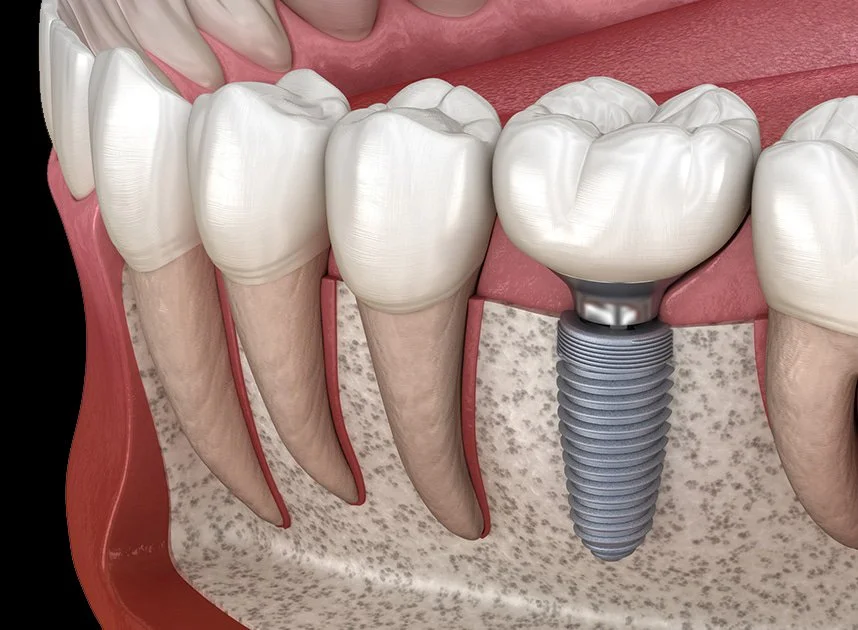
A dental implant is a small fixture, commonly made from titanium, that is placed into the jawbone to support a replacement tooth.
Once the implant has integrated with the surrounding bone, it can support a dental crown, bridge or denture, depending on the treatment plan.
A typical single-tooth implant restoration consists of three components:
Dental implant: The fixture placed in the jawbone.
Abutment: The connector between the implant and the replacement tooth.
Dental crown: The visible tooth-shaped restoration designed to restore appearance and function.
Unlike a conventional dental bridge, a single-tooth implant does not usually require the neighbouring teeth to be prepared to support the replacement tooth.
However, implant treatment involves surgery and requires appropriate planning, healing and ongoing maintenance.
Who May Benefit from Dental Implants?
Dental implants may be suitable for adults who have lost teeth because of decay, gum disease, trauma or other dental conditions.
They may be considered for patients who have:
One missing tooth
Several missing teeth
Teeth that cannot be predictably restored
Difficulty chewing with an existing removable denture
A desire for a fixed tooth replacement option
Gaps that affect the appearance of their smile
Not everyone is automatically suitable for implant treatment. Jawbone volume, gum health, medical history, smoking status and oral hygiene all influence the assessment.
A comprehensive examination helps determine whether implants are appropriate or whether another tooth replacement option would better meet your needs.
What Are the Benefits of Dental Implants?
1. A Natural-Looking Smile
Dental implant crowns are designed to resemble natural teeth in shape, colour and proportion. With careful planning, the replacement tooth can be made to blend with the surrounding teeth.
The final appearance depends on factors such as gum shape, bone support, implant position and the type of restoration used.
2. Improved Chewing Function
A well-planned implant restoration can provide stable support when chewing.
For patients who struggle with a missing tooth or an unstable denture, this may improve everyday eating comfort. The outcome depends on the condition of the remaining teeth and the overall bite.
3. Support for Jawbone Preservation
After a tooth is lost, the surrounding jawbone may gradually shrink because it no longer receives the same stimulation from the tooth root.
A dental implant transfers chewing forces to the surrounding bone and may help preserve bone locally. However, it cannot prevent all bone loss, particularly in areas affected by gum disease, infection or previous tooth extraction.
4. No Dependence on Neighbouring Teeth for a Single-Tooth Replacement
A single implant-supported crown generally does not require the adjacent teeth to be cut down, unlike a conventional tooth-supported bridge.
This can be an important consideration when the neighbouring teeth are healthy.
5. A Fixed Tooth Replacement Option
Once restored, an implant-supported crown is fixed in place and is not removed for routine cleaning.
Patients still need to clean carefully around the implant and attend regular professional reviews to maintain the health of the surrounding tissues.
What Happens During Dental Implant Treatment?
Dental implant treatment usually involves several stages.
Step 1: Consultation and Assessment
Your dentist evaluates your teeth, gums, bite and medical history. Appropriate dental imaging is used to assess the area where the implant may be placed.
A cone beam computed tomography (CBCT) scan may be recommended when three-dimensional information about the bone and nearby anatomical structures is needed.
Your dentist will discuss the proposed treatment, alternatives, risks, expected timeline and costs.
Step 2: Preparing the Implant Site
If necessary, existing gum disease, decay or infection should be managed before implant placement.
Some patients may require a tooth extraction or bone grafting if there is insufficient bone to support the planned implant.
Other patients may have enough suitable bone to proceed without additional grafting.
Step 3: Implant Placement
The implant is surgically positioned in the jawbone under local anaesthesia. Sedation may be considered for suitable patients who experience dental anxiety or require more extensive treatment.
The complexity of the procedure depends on the location of the missing tooth and the surrounding anatomy.
Step 4: Healing and Bone Integration
After placement, the implant requires time to integrate with the surrounding bone, a process known as osseointegration.
The healing period varies according to the patient's circumstances, implant location and whether additional procedures were required.
During this time, your dentist will advise you on eating, cleaning and protecting the treatment site.
Step 5: Attaching the Replacement Tooth
Once the implant is sufficiently stable and healing has progressed, the abutment and final crown can be fitted.
In selected cases, a temporary tooth may be provided earlier. However, immediate placement or loading is not suitable for every patient.
Your dentist will recommend a timeline based on the clinical findings.
How Much Do Dental Implants Cost in Sydney?
The cost of dental implants varies depending on the complexity of the case and the treatment required.
Factors that can influence the total cost include:
The number of implants needed
The type and material of the final crown or bridge
Extractions or bone grafting
The need for additional imaging
Surgical complexity
Temporary restorations
Follow-up appointments and maintenance
When comparing treatment plans, check whether the quoted price includes the implant fixture, abutment, final crown, imaging, surgery and follow-up care.
A written treatment plan can help you understand the full cost before committing to treatment.
Are Dental Implants Painful?
Implant placement is generally performed under local anaesthesia, which helps manage discomfort during the procedure.
After surgery, some swelling, bruising and tenderness are normal. These symptoms usually improve as healing progresses, although the amount of discomfort varies between individuals.
Patients who feel anxious about dental treatment should discuss their concerns before the appointment. Depending on their needs and medical suitability, additional comfort measures or sedation may be considered.
Following your dentist's post-operative instructions helps support recovery and reduces the risk of complications.
How Long Do Dental Implants Last?
Dental implants can function for many years, and some remain successful for decades. However, no implant can be guaranteed to last a lifetime.
Long-term outcomes depend on several factors, including:
The condition of the surrounding bone and gums
Oral hygiene and professional maintenance
Smoking and other lifestyle factors
Clenching or grinding
The design and condition of the restoration
General health and healing
The implant fixture and the crown have different maintenance needs. The crown may require repair or replacement over time, even when the implant itself remains stable.
Regular dental reviews help monitor the implant and identify problems early.
Who Is Not Suitable for Dental Implants?
Dental implants are not suitable for everyone in every circumstance.
Potential concerns include active periodontal disease, insufficient bone, uncontrolled diabetes, smoking, certain medications and medical conditions that affect healing.
Some of these issues can be addressed before treatment. Others may require additional precautions, a modified treatment plan or an alternative restoration.
A history of gum disease does not automatically exclude someone from implant treatment, but periodontal health must be assessed and managed carefully.
Dental Implants vs Dental Bridges vs Dentures
Choosing the right tooth replacement option depends on your oral health, preferences, budget and long-term goals.
Dental implants: Fixed restorations supported by implants placed in the jawbone. They involve surgery and a healing period.
Dental bridges: Fixed replacement teeth supported by neighbouring natural teeth or implants. A conventional bridge may require preparation of the supporting teeth.
Removable dentures: Removable appliances that replace missing teeth. They may be suitable when surgery is not preferred or is not appropriate.
There is no single best option for every patient. Your dentist can explain the advantages, limitations and maintenance requirements of each approach.
Frequently Asked Questions About Dental Implants
Can I get a dental implant immediately after tooth extraction?
In selected cases, an implant can be placed at the same appointment as the extraction. Suitability depends on infection, bone conditions, implant stability and other clinical factors. Immediate placement does not always mean the final crown can be fitted immediately.
Do dental implants look like real teeth?
Implant crowns are designed to resemble natural teeth. The final result depends on the position of the implant, gum contours, available space and restorative planning.
Can I get dental implants if I have gum disease?
Gum disease should be assessed and controlled before implant treatment. A history of periodontitis may increase the risk of complications, so ongoing periodontal maintenance is particularly important.
Can dental implants replace several missing teeth?
Yes. Depending on the number and location of missing teeth, implants can support individual crowns, bridges or full-arch restorations.
Do dental implants require special cleaning?
Implants require careful daily cleaning, including around the gumline and between teeth. Your dentist may recommend interdental brushes or other aids suited to your restoration.
Book a Dental Implant Consultation in Sydney's Inner West
If you have a missing tooth or are exploring options for replacing several teeth, a dental implant consultation can help you understand your suitability, treatment choices and expected costs.
At Pain Free Dentist Sydney, we aim to provide clear information and individualised care based on your dental health and treatment goals.
Contact Pain Free Dentist Sydney to discuss your tooth replacement options.
📍 Suite 1A, 570 New Canterbury Road, Hurlstone Park NSW 2193
📞 Phone: 02 9558 8988
🌐 Website: https://painfreedentistsydney.com.au
Disclaimer: This article provides general dental information and is not a substitute for an individual examination or treatment advice. Dental implant suitability, risks, costs and outcomes vary between patients.