Losing most or all of your teeth can affect much more than your smile. It can make eating difficult, change the way you speak and affect your confidence in everyday situations. If you are struggling with loose dentures, multiple missing teeth or severely damaged teeth, you may have heard about All-on-4 dental implants.
All-on-4 is an implant-supported treatment designed to replace an entire arch of teeth using four strategically positioned dental implants to support a fixed bridge.
For suitable patients, it can offer a stable, functional and natural-looking alternative to traditional removable dentures.
What Are All-on-4 Dental Implants?
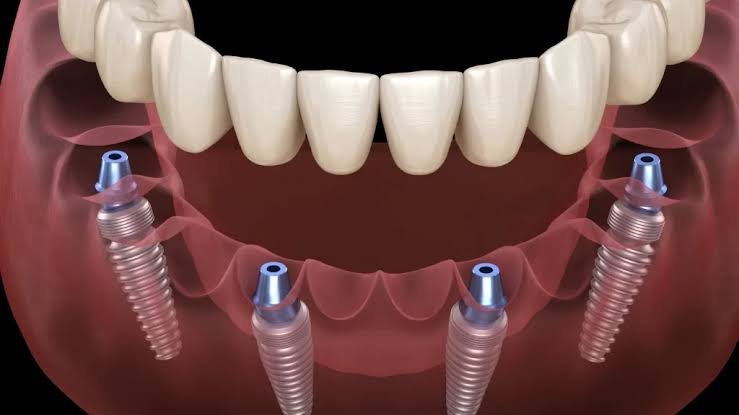
All-on-4 dental implants are a full-arch tooth replacement solution. Instead of replacing every missing tooth with an individual implant, four dental implants are strategically placed in the jawbone to support a full set of fixed replacement teeth.
The treatment generally involves:
Two implants positioned towards the front of the jaw.
Two posterior implants placed at an angle where clinically appropriate.
A fixed bridge attached to the implants.
A carefully planned bite designed to distribute chewing forces.
The angled posterior implants can help make use of available bone and may reduce the need for extensive bone grafting in selected patients. However, not everyone is suitable for this approach, and additional procedures may still be necessary.
All-on-4 can be performed in the upper jaw, lower jaw or both, depending on the patient's dental condition and treatment needs.
How Does the All-on-4 Dental Implant Procedure Work?
All-on-4 treatment requires careful assessment and planning before implant placement. Every patient's jawbone, bite, gum health and medical history are different.
1. Comprehensive Dental Assessment
The first step is to assess your existing teeth, gums, jawbone and overall oral health.
Your dentist will discuss your concerns, treatment goals and expectations. If you have remaining teeth, their condition will be evaluated to determine whether they can be preserved or whether extraction may be necessary.
2. 3D CBCT Imaging and Implant Planning
A Cone Beam Computed Tomography (CBCT) scan provides detailed three-dimensional information about the jawbone, anatomical structures and available bone volume.
This information helps with planning:
Implant positions and angulations.
Available bone height and width.
Important anatomical structures.
Implant spacing and distribution.
The relationship between the implants and the proposed bridge.
The anticipated bite and chewing forces.
Careful planning is essential because the implants must support not only the replacement teeth but also the forces generated during everyday chewing.
3. Removal of Unsalvageable Teeth
If existing teeth cannot be restored, they may need to be removed as part of the treatment.
In suitable cases, implant placement and temporary teeth may be provided during the same treatment episode. However, immediate placement and immediate loading are not appropriate for every patient.
4. Dental Implant Placement
Four dental implants are placed into the jawbone at carefully planned positions.
The posterior implants may be angled to maximise the use of available bone and improve the distribution of support along the dental arch.
Primary implant stability, bone quality, implant positioning and the overall treatment plan all influence whether a temporary fixed bridge can be attached immediately.
5. Temporary Fixed Teeth
Where sufficient stability and suitable clinical conditions are achieved, a temporary fixed bridge may be attached soon after implant surgery.
This allows patients to have replacement teeth while the implants undergo osseointegration – the biological process in which bone integrates with the implant surface.
During healing, patients are generally advised to follow a soft-food diet and avoid placing excessive forces on the implants.
6. Final Fixed Implant Bridge
Once healing and integration have been assessed, the temporary bridge can be replaced with the final restoration.
The final bridge is designed to provide appropriate appearance, speech, comfort and chewing function. Material selection depends on the individual case, bite forces, available space and restorative requirements.
Why Are Four Implants Used?
The All-on-4 concept uses four implants to support a full arch of replacement teeth.
The purpose is not simply to use fewer implants. The important consideration is how the implants are positioned to provide adequate support and distribute functional forces.
The angled posterior implants can increase the available support towards the back of the jaw and may help reduce the length of the unsupported cantilever.
However, the ideal implant number and positioning depend on the patient's anatomy, bone quality, prosthetic design and expected bite forces. Some patients may benefit from more than four implants, such as an All-on-6 approach.
What Is the Difference Between All-on-4 and All-on-6?
Both All-on-4 and All-on-6 are full-arch implant treatment concepts.
All-on-4 uses four implants to support the fixed bridge, whereas All-on-6 uses six implants.
The decision depends on several clinical considerations, including:
Available jawbone volume and quality.
Jaw anatomy and implant positioning.
Bite forces and opposing teeth.
The length and design of the bridge.
Whether additional support is desirable.
The patient's medical and dental history.
More implants do not automatically mean a better outcome. The goal is to achieve a stable, well-designed restoration with appropriate force distribution and long-term maintainability.
Do You Need Bone Grafting for All-on-4?
One of the potential advantages of All-on-4 is that the angled posterior implants may allow treatment to be performed in patients with reduced bone volume in certain areas.
This may reduce the need for extensive bone grafting in selected cases.
However, bone grafting may still be required depending on the amount and distribution of available bone, particularly where there are significant anatomical limitations.
A CBCT scan is important for determining whether the available bone can support the proposed implant positions safely and predictably.
Who Is Suitable for All-on-4 Dental Implants?
All-on-4 may be considered for patients who:
Have lost most or all of their teeth.
Have multiple teeth that are severely damaged or cannot be restored.
Are struggling with loose or uncomfortable dentures.
Want a fixed alternative to removable dentures.
Have sufficient bone for the proposed implant positions.
Are suitable candidates for implant surgery.
Certain medical conditions, smoking, uncontrolled gum disease and poor oral hygiene may affect healing and implant success.
Patients with significant teeth grinding or jaw clenching also require careful assessment because excessive forces can place additional stress on implants and the prosthetic bridge.
Is All-on-4 Dental Implant Surgery Painful?
Dental implant surgery is generally performed with appropriate local anaesthesia. Sedation may also be considered for suitable patients, depending on the complexity of the procedure, medical history and individual needs.
Some swelling, bruising, tenderness and discomfort are expected after surgery. These symptoms usually improve during the healing period.
Your dental team will provide post-operative instructions and guidance on managing discomfort, maintaining oral hygiene and protecting the implants during recovery.
How Long Do All-on-4 Dental Implants Last?
Dental implants can provide long-term tooth replacement, but they require ongoing care and regular professional monitoring.
The implants and the prosthetic bridge are different components. While the implants may remain integrated with the jawbone for many years, the bridge and its components may require maintenance, repair or replacement over time.
Long-term maintenance includes:
Brushing carefully around the bridge and gumline.
Using appropriate interdental cleaning aids.
Attending regular dental examinations.
Professional implant maintenance.
Monitoring gum health and supporting bone.
Managing excessive grinding and clenching forces.
Peri-implantitis, an inflammatory condition affecting the tissues around dental implants, can lead to bone loss if not identified and managed appropriately.
Can All-on-4 Dental Implants Fail?
Like all surgical procedures, dental implant treatment carries risks.
An implant may fail to integrate with the bone, become infected or develop complications affecting the surrounding tissues. Mechanical problems can also occur, including loose screws, fractured components or damage to the bridge.
Careful planning, appropriate surgical technique, good oral hygiene and regular maintenance all contribute to reducing risks.
Patients should understand that no dental implant procedure can guarantee a lifetime result.
Why Is Bite and Force Distribution Important?
A successful All-on-4 restoration involves more than placing four implants into the jawbone.
The relationship between implant positions, the bridge design and the patient's bite is extremely important.
The distance between the most anterior and posterior implant support points is commonly considered when assessing the available anteroposterior (AP) spread. A suitable AP spread can help reduce the unsupported cantilever and improve the mechanical design of the restoration.
The direction of implant angulation, available bone, prosthetic space and chewing forces must also be considered.
For patients who grind or clench their teeth, additional protective measures may be recommended to reduce excessive loading on the implant-supported bridge.
All-on-4 Dental Implants in Dulwich Hill, Sydney
At Pain Free Dentist Sydney – Dr Lisa Chong Clinic, we understand that replacing missing teeth is an important decision. Our approach focuses on careful assessment, detailed treatment planning and understanding each patient's functional and aesthetic needs.
Whether you are considering All-on-4, All-on-6 or another form of dental implant treatment, the first step is determining which option is suitable for your individual circumstances.
If you are tired of struggling with loose dentures, have multiple failing teeth or are exploring fixed full-mouth dental implants, we welcome you to arrange an assessment with Dr Lisa Chong.
Restore your ability to smile, speak and enjoy your food with a treatment plan designed around your dental needs.
Pain Free Dentist Sydney – Dr Lisa Chong Clinic
Dulwich Hill, NSW
Phone: 02 9558 8988
Email: info@painfreedentistsydney.com.au
Website: https://painfreedentistsydney.com.au