Have you ever avoided smiling in photographs because of a missing tooth? Do you find yourself chewing on one side of your mouth because you have lost several teeth? Or perhaps your dentures move around when you eat, talk or laugh?
Losing a tooth can affect much more than your appearance. It can change the way you chew, influence your bite, affect your confidence and even contribute to changes in your jawbone over time.
The good news is that modern dentistry offers a solution that can look, feel and function remarkably like natural teeth.
Dental implants have transformed the way we replace missing teeth, giving patients the opportunity to regain their smiles, improve chewing function and enjoy greater confidence in everyday life.
At Pain Free Dentist Sydney – Dr Lisa Chong Clinic in Dulwich Hill, we understand that every missing tooth tells a different story. Let's explore how dental implants work, who may benefit from them and what you should know before considering treatment.
What Happens When You Lose a Tooth?
Many people assume that losing one tooth is not a big problem, particularly if it is towards the back of the mouth and cannot be seen when smiling.
However, your teeth work together as a coordinated system.
When a tooth is lost, neighbouring teeth may gradually drift into the empty space. The opposing tooth may also begin to over-erupt because it no longer has a tooth to bite against.
Over time, this can affect your bite, chewing efficiency and the distribution of forces throughout your mouth.
There is another important consideration: your jawbone.
Natural tooth roots stimulate the surrounding jawbone during chewing. When a tooth is lost, this stimulation decreases, and the bone in that area may gradually shrink.
This is why replacing missing teeth is not simply about restoring your smile. It is also about maintaining oral function and supporting the long-term health of your remaining teeth.
What Exactly Is a Dental Implant?
Think of a dental implant as an artificial tooth root.
A dental implant is usually made from titanium or another suitable biocompatible material. It is surgically placed into the jawbone, where it can gradually integrate with the surrounding bone through a process known as osseointegration.
Once healing is sufficient, the implant can support a replacement tooth.
A completed dental implant restoration generally consists of three components:
Implant fixture: The part placed into the jawbone that acts as the artificial tooth root.
Abutment: The connecting component between the implant and the replacement tooth.
Dental crown: The visible replacement tooth, designed to restore appearance and chewing function.
Unlike a conventional dental bridge, an individual dental implant does not normally require the neighbouring healthy teeth to be prepared for support.
What Are Your Options? One Missing Tooth or an Entire Mouth?
Dental implants are not a one-size-fits-all treatment. Depending on how many teeth are missing and the condition of your jawbone, different treatment approaches may be considered.
1. Single Dental Implants – Replacing One Missing Tooth
Imagine losing one tooth due to an accident, severe decay or a failed root canal treatment.
Rather than preparing the neighbouring teeth for a conventional bridge, a single dental implant may provide an independent replacement.
The implant supports an individual crown designed to blend with your surrounding teeth.
This is particularly useful when the adjacent teeth are healthy and you want to preserve as much of your natural tooth structure as possible.
2. Multiple Dental Implants – Restoring Several Missing Teeth
What happens when you have lost three, four or more teeth?
Multiple implants may be used to support individual crowns or an implant-supported bridge.
The dentist carefully considers the number and positioning of implants, the available bone, the bite and the forces generated during chewing.
The aim is to create a stable restoration that works harmoniously with your remaining teeth.
3. All-on-4 Dental Implants – A New Smile with Four Implants
Have you been told that you need to remove most or all of your remaining teeth?
Are you struggling with loose dentures and looking for something more stable?
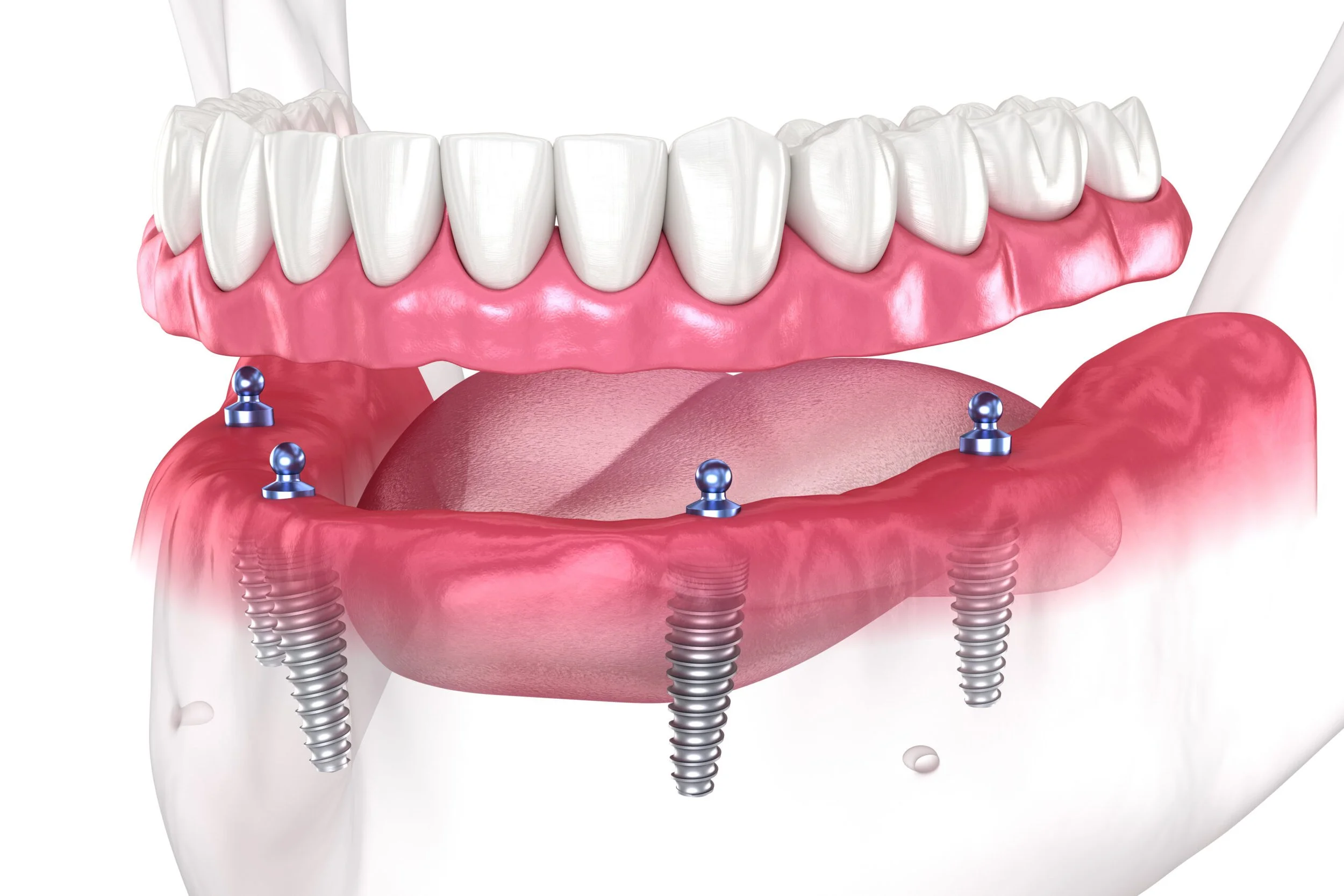
All-on-4 is a full-arch dental implant treatment concept that uses four strategically positioned implants to support a fixed full-arch prosthesis.
Some implants are positioned at an angle to make better use of available bone and may reduce the need for extensive bone grafting in selected cases.
For suitable patients, this approach can provide a fixed replacement for an entire upper or lower arch of teeth.
4. All-on-6 Dental Implants – Additional Implant Support
All-on-6 is another full-arch rehabilitation option.
As its name suggests, six implants are strategically placed to support a fixed full-arch prosthesis.
Depending on the patient's bone anatomy, bite forces, available bone and prosthetic design, six implants may provide additional support and help distribute functional forces across more implant fixtures.
However, more implants do not automatically mean a better result.
The most appropriate approach depends on careful treatment planning, the patient's anatomy and the design of the final teeth.
All-on-4 vs All-on-6: Which Is Better?
This is one of the most common questions patients ask when considering full-mouth dental implants.
The answer is that neither treatment is universally better.
All-on-4 may be appropriate when four strategically positioned implants can provide adequate support for the planned restoration.
All-on-6 may be considered when additional implant support is desirable and the patient's bone anatomy allows suitable placement.
The dentist must consider several important factors:
Jawbone volume and bone quality.
Implant positioning and angulation.
Bite forces and chewing patterns.
Teeth grinding and clenching.
The length and design of the prosthesis.
The distribution of forces across the implant framework.
Long-term cleaning and maintenance.
A well-planned implant restoration should not simply look attractive. It should also function comfortably and be designed with long-term maintenance in mind.
Do You Have Enough Bone for Dental Implants?
One of the biggest concerns patients have is whether they have sufficient jawbone to support dental implants.
Following tooth loss, the jawbone may gradually shrink. This can make implant placement more challenging, particularly when teeth have been missing for many years.
However, having reduced bone does not automatically mean that dental implants are impossible.
Depending on the clinical situation, treatment options may include:
Bone grafting.
Sinus augmentation for selected upper jaw cases.
Alternative implant positioning.
Angled implant techniques.
Other specialised implant approaches.
A CBCT scan may be recommended to assess the width, height and quality of the available bone and identify important anatomical structures.
Proper planning is essential because implant placement involves much more than finding an empty space in the jaw.
What If You Grind or Clench Your Teeth?
This is particularly important for patients who suffer from bruxism or temporomandibular joint (TMJ) disorders.
Some people unconsciously clench or grind their teeth during sleep. Others experience excessive jaw muscle activity during the day, particularly when stressed.
Over time, these habits can create significant forces on teeth and dental restorations.
Dental implants do not have the same periodontal ligament cushioning mechanism as natural teeth. Consequently, excessive loading needs to be carefully considered during implant treatment planning.
Patients with bruxism may require additional attention to:
Implant number and positioning.
Bite relationship and occlusal contacts.
Prosthetic material selection.
Implant framework design.
Night-time protective splints where appropriate.
Regular monitoring and maintenance.
For patients with a history of TMJ pain, jaw muscle tension or significant tooth wear, assessing the overall bite and jaw function is an important part of comprehensive dental planning.
Is Dental Implant Surgery Painful?
Let's address one of the biggest reasons people delay dental treatment: fear of pain.
Many patients feel anxious about the idea of having a titanium implant placed into their jawbone.
Dental implant surgery is generally performed under local anaesthesia, which numbs the treatment area. Sedation may also be considered for suitable patients who experience dental anxiety or require more extensive treatment.
Following surgery, some swelling, tenderness and discomfort can occur as part of the normal healing process.
The level of discomfort varies depending on the complexity of the procedure, the number of implants placed and whether additional procedures are required.
At Pain Free Dentist Sydney, we understand that every patient has different comfort needs. We believe in explaining the procedure, discussing appropriate comfort options and allowing patients to make informed decisions without feeling pressured.
How Long Does It Take to Complete Dental Implant Treatment?
Dental implant treatment is a biological process. The implant needs time to integrate with the surrounding bone before it can reliably support its final restoration.
The general treatment stages include:
Step 1: Comprehensive consultation
Your dentist assesses your teeth, gums, jawbone, bite and medical history.
Step 2: Diagnostic imaging and planning
Appropriate imaging, including CBCT where indicated, helps determine the ideal implant position and assess anatomical structures.
Step 3: Implant placement
The implant fixture is surgically placed into the jawbone.
Step 4: Healing and integration
The implant undergoes osseointegration, allowing the surrounding bone to establish a connection with the implant surface.
Step 5: Final teeth
Once adequate healing and stability have been established, the final crown, bridge or full-arch restoration can be fitted.
Some suitable cases may allow immediate temporary teeth, but this is not appropriate for every patient. Immediate loading depends on factors such as primary implant stability, bone quality, implant positioning and the ability to control biting forces.
Can Dental Implants Last a Lifetime?
Dental implants can provide many years of service, but no dental treatment comes with a lifetime guarantee.
The longevity of an implant depends on several factors, including:
Good oral hygiene.
Healthy gums and supporting bone.
Regular dental examinations.
Professional implant maintenance.
Smoking habits.
Medical conditions and healing capacity.
Teeth grinding and excessive bite forces.
The design and maintenance of the final restoration.
One condition patients should know about is peri-implantitis.
This is an inflammatory condition affecting the tissues around a dental implant. If left untreated, it can lead to progressive supporting bone loss and potentially implant failure.
This is why regular maintenance is just as important as the original implant surgery.
Are Dental Implants Better Than Dentures?
Traditional dentures remain a useful tooth replacement option for many patients.
However, some people find that their dentures move when speaking or eating, cause sore spots or make chewing certain foods difficult.
Dental implants may offer greater stability because they are anchored in the jawbone.
For patients who are not suitable for fixed implant restorations, implant-retained removable dentures may also provide an alternative by improving denture retention.
The best treatment depends on your oral health, bone condition, medical history, personal preferences and ability to maintain the restoration.
Why Is Choosing the Right Dental Implant Dentist Important?
Dental implant treatment is not simply about placing a screw into the jawbone.
It requires an understanding of dental anatomy, bone structure, gum health, occlusion, bite forces and restorative dentistry.
Poor planning can result in problems such as:
Incorrect implant positioning.
Difficulty cleaning around implants.
Unfavourable bite forces.
Aesthetic complications.
Prosthetic fractures or loosening.
Inflammation around implants.
A comprehensive assessment helps identify potential risks before treatment begins.
At Pain Free Dentist Sydney – Dr Lisa Chong Clinic, we believe that every implant case deserves an individualised treatment plan. Our approach considers not only the missing teeth but also the patient's overall dental health, functional needs and long-term maintenance requirements.
Ready to Restore Your Smile?
Whether you are missing one tooth, several teeth or an entire arch, dental implants may offer an opportunity to restore your smile and improve your ability to eat and function comfortably.
You do not have to make a decision immediately. The first step is understanding your dental condition and exploring the treatment options available.
Dr Lisa Chong welcomes patients seeking dental implant consultations at Pain Free Dentist Sydney in Dulwich Hill.
Contact our clinic to arrange an assessment and discuss whether dental implants, All-on-4 or All-on-6 treatment may be suitable for you.
Pain Free Dentist Sydney – Dr Lisa Chong Clinic
Dulwich Hill, NSW
Phone: 02 9558 8988
Email: info@painfreedentistsydney.com.au
Website: https://painfreedentistsydney.com.au