
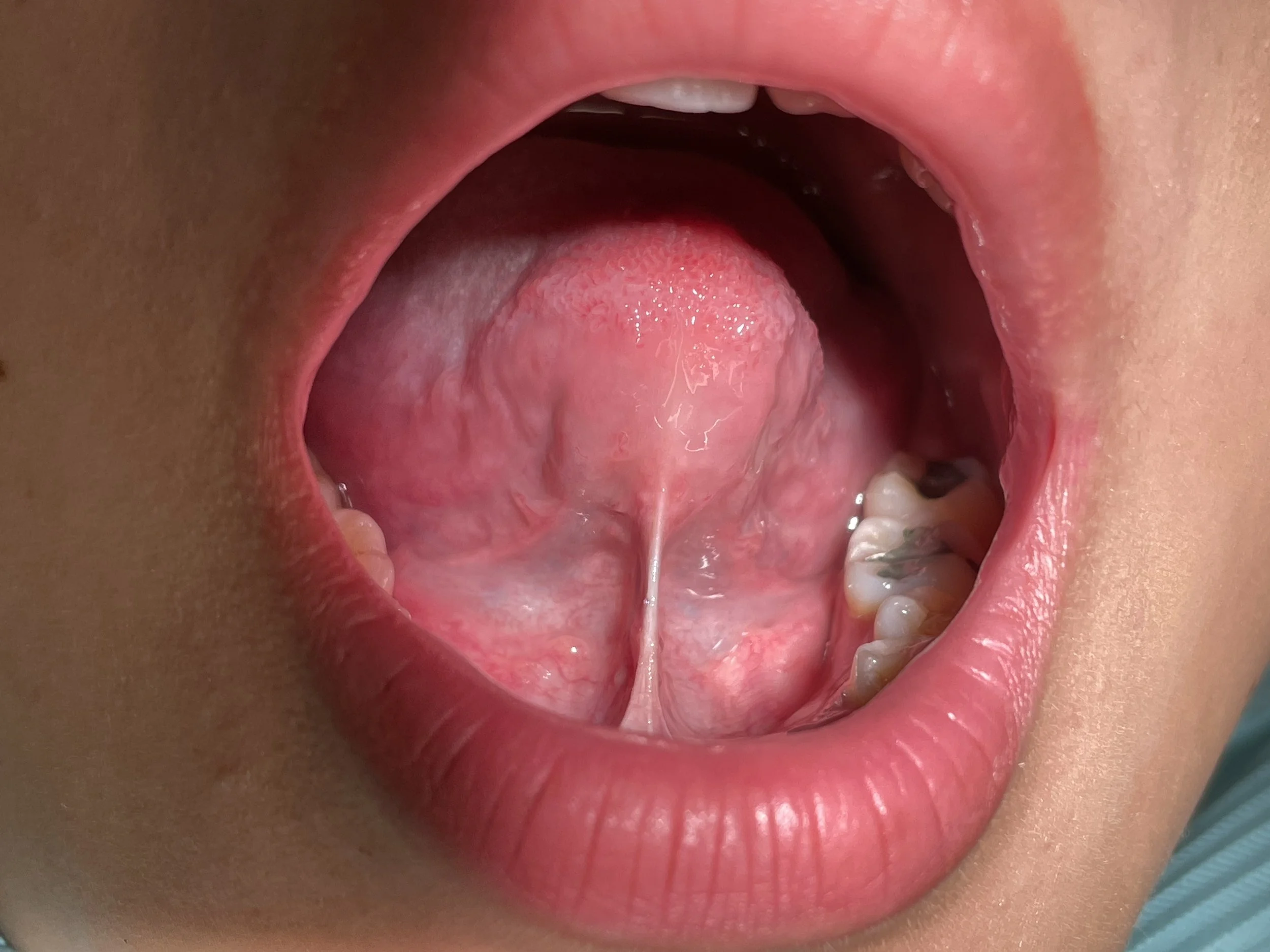
When people think about tongue-tie, they often associate it with babies who have difficulty breastfeeding. However, tongue-tie can also affect adults, sometimes without being recognised for many years.
An adult with tongue-tie, medically known as ankyloglossia, may have a restricted lingual frenulum – the small band of tissue connecting the underside of the tongue to the floor of the mouth.
While some adults experience obvious difficulty moving their tongue, others may have adapted to restricted movement over time without realising that their tongue function could be contributing to difficulties with speaking, swallowing, oral posture or jaw movement.
For some individuals, restricted tongue mobility may also be associated with compensatory muscle activity and tension around the jaw, face and neck.
Could your tongue mobility be one of the factors contributing to your ongoing muscle discomfort?
What Is Adult Tongue-Tie?
Tongue-tie occurs when the lingual frenulum restricts the normal movement of the tongue.
A normally functioning tongue should be able to move freely in different directions, including lifting towards the roof of the mouth, extending beyond the lower lip and moving from side to side.
When the frenulum is restrictive, these movements may become limited.
Adults with tongue-tie may experience:
Difficulty lifting the tongue towards the roof of the mouth.
Difficulty extending the tongue beyond the lower front teeth.
A pulling or tight sensation underneath the tongue.
Difficulty maintaining comfortable tongue posture.
Speech or articulation difficulties.
Swallowing difficulties or compensatory swallowing patterns.
Difficulty cleaning food from around the teeth.
Tension around the floor of the mouth and jaw.
Some adults may not realise they have tongue-tie because they have developed compensatory movements over many years.
How Can Tongue-Tie Be Associated With Jaw and Muscle Tension?
The tongue is not an isolated structure. It works in coordination with several muscles and anatomical structures involved in swallowing, speaking, breathing and maintaining oral posture.
The tongue, floor of the mouth, jaw and surrounding muscles work together as part of a coordinated functional system.
When tongue movement is restricted, some individuals may develop compensatory movement patterns to perform everyday functions.
For example, a person who cannot comfortably elevate the tongue may recruit other muscles to assist with swallowing or maintaining oral posture.
Over time, these altered patterns may be associated with increased muscular effort or discomfort in some individuals.
However, chronic muscle pain is multifactorial, and restricted tongue movement should not automatically be considered the cause.
5 Possible Symptoms Associated With Adult Tongue-Tie
1. Jaw Tightness and TMJ Discomfort
The tongue and jaw muscles work together during chewing, swallowing and speaking. Restricted tongue movement may contribute to altered oral function in some individuals.
People may report jaw tightness, muscle fatigue or discomfort around the temporomandibular joint (TMJ).
2. Neck and Shoulder Tension
The muscles of the tongue, floor of the mouth and neck have important anatomical and functional relationships.
Some individuals with restricted oral function may develop compensatory patterns involving the surrounding muscles.
However, neck and shoulder pain can have many other causes, including posture, cervical spine dysfunction, previous injuries and muscular conditions.
3. Frequent Headaches
Some patients with jaw muscle tension also experience headaches, particularly around the temples and sides of the head.
Bruxism, TMJ dysfunction, stress and muscular tension may all contribute to headaches.
Tongue restriction may be one aspect worth assessing when other oral functional symptoms are also present.
4. Difficulty Maintaining Proper Tongue Posture
A functional resting tongue posture generally involves the tongue resting comfortably against the palate, with the lips gently together and breathing occurring through the nose when the nasal airway is clear.
Some adults with tongue restriction find it difficult to elevate or maintain their tongue against the palate.
This may affect oral function and warrants an individual assessment.
5. Swallowing Difficulties and Oral Muscle Fatigue
Restricted tongue mobility can interfere with the coordination of swallowing.
Some individuals may compensate by moving their jaw, lips or surrounding muscles differently when swallowing.
This can result in increased muscular effort and fatigue during repeated oral movements.
The Relationship Between Tongue-Tie, TMJ Dysfunction and Bruxism
One important consideration in adult tongue-tie assessment is the relationship between tongue function, jaw movement and the temporomandibular joint.
The TMJ is a complex joint involving the jawbone, joint disc, ligaments and surrounding muscles.
TMJ dysfunction can present with:
Jaw pain or tenderness.
Clicking or popping sounds.
Restricted mouth opening.
Facial muscle discomfort.
Temple headaches.
Pain during chewing.
Bruxism, which involves clenching or grinding the teeth, can also contribute to muscular discomfort and excessive loading of the jaw.
Although tongue-tie has been discussed as a possible contributing factor in some patients with altered oral function, there is currently insufficient evidence to establish it as a direct cause of TMJ dysfunction or bruxism.
A comprehensive assessment should consider the entire functional system rather than focusing on the tongue alone.
How Is Adult Tongue-Tie Diagnosed?
A proper assessment involves more than simply looking underneath the tongue.
The clinician should assess both the anatomical appearance of the frenulum and the functional movement of the tongue.
An assessment may include:
Tongue elevation and extension.
Lateral tongue movement.
Tongue mobility and functional range.
Ability to maintain tongue posture.
Floor-of-mouth tension.
Swallowing patterns.
Jaw movement and opening.
TMJ and surrounding muscle tenderness.
Relevant breathing and oral functional history.
The severity of tongue restriction should be considered alongside the patient's symptoms and functional limitations.
Not every visible lingual frenulum requires treatment.
Can a Frenectomy Help Adults With Tongue-Tie?
A frenectomy is a procedure that releases the restrictive lingual frenulum to improve tongue mobility.
In selected adults with clinically significant tongue restriction, the procedure may help improve specific tongue movements and associated oral functions.
Potential functional improvements may include:
Greater tongue elevation.
Improved tongue mobility.
Reduced mechanical restriction.
Improved ability to perform certain tongue movements.
Better access to functional oral exercises.
However, it is important to understand that releasing the frenulum does not automatically resolve chronic headaches, TMJ dysfunction, neck pain or widespread muscular discomfort.
The outcome depends on the individual's anatomy, functional limitations, existing muscle patterns and other contributing conditions.
A frenectomy should only be recommended following an appropriate clinical assessment and discussion of expected benefits, limitations and potential risks.
Why Is a Whole-Body Approach Important?
Chronic jaw and muscle discomfort can involve several interacting factors.
These may include:
Tongue mobility and oral function.
Jaw alignment and bite relationships.
Bruxism and clenching.
Cervical spine and neck muscle function.
Postural and muscular adaptations.
Breathing patterns.
Stress and sleep quality.
For this reason, managing chronic TMJ-related discomfort may require a multidisciplinary approach.
Depending on the individual's needs, assessment and management may involve a dentist, physiotherapist, myofunctional therapist or other relevant healthcare professionals.
Addressing only one aspect of a complex functional problem may not be sufficient.
Adult Tongue-Tie Assessment at Pain Free Dentist Sydney
At Pain Free Dentist Sydney in Dulwich Hill, Dr Lisa Chong takes an individualised approach to assessing adult tongue-tie and its possible relationship with oral function, jaw discomfort and muscular tension.
We consider the tongue's mobility, surrounding oral structures, jaw function and the patient's broader clinical history.
Where appropriate, treatment options may include a lingual frenectomy using a cold-scissors technique, followed by suitable functional rehabilitation.
Our approach focuses on understanding the underlying functional concerns rather than treating the appearance of the frenulum alone.
Frequently Asked Questions
Can adults have tongue-tie without knowing it?
Yes. Some adults have lived with restricted tongue movement since childhood and may have developed compensatory habits without recognising the restriction.
Can tongue-tie cause neck pain and headaches?
There is no established direct causal relationship. However, restricted tongue movement may be associated with altered oral muscle function in some individuals. Headaches and neck pain should be assessed for other possible causes as well.
Can tongue-tie contribute to TMJ problems?
Tongue restriction may affect oral function and muscular coordination, but current evidence does not establish it as a direct cause of TMJ dysfunction.
Does every adult with tongue-tie need a frenectomy?
No. Treatment is generally considered when there is meaningful functional restriction and the potential benefits outweigh the risks.
Will a frenectomy eliminate chronic muscle pain?
Not necessarily. A frenectomy may improve tongue mobility, but chronic muscle pain is often multifactorial and may require additional assessment and treatment.
Take the First Step Towards Understanding Your Symptoms
If you experience persistent jaw tightness, headaches, neck tension or difficulty moving your tongue comfortably, an assessment may help determine whether restricted tongue mobility is one of the factors worth investigating.
At Pain Free Dentist Sydney, we believe in looking beyond individual symptoms and considering how the tongue, jaw and surrounding muscles work together.
Pain Free Dentist Sydney – Dulwich Hill
Phone: 02 9558 8988
Email: info@painfreedentistsydney.com.au
Website: https://painfreedentistsydney.com.au
Contact our clinic to arrange an assessment with Dr Lisa Chong.