Are you missing most of your teeth, struggling with uncomfortable dentures or experiencing multiple failing teeth?
Living with extensive tooth loss can affect much more than your smile. It may make chewing difficult, influence your speech, affect your confidence and change the way your jaw functions.
Modern implant dentistry offers several solutions for replacing multiple missing teeth. One option is All-on-6 dental implants, a full-arch restoration technique designed to support a fixed set of replacement teeth using six strategically positioned dental implants.
At Pain Free Dentist Sydney in Dulwich Hill, we provide individualised implant treatment planning to help patients explore suitable options for restoring their smiles and oral function.
What Are All-on-6 Dental Implants?
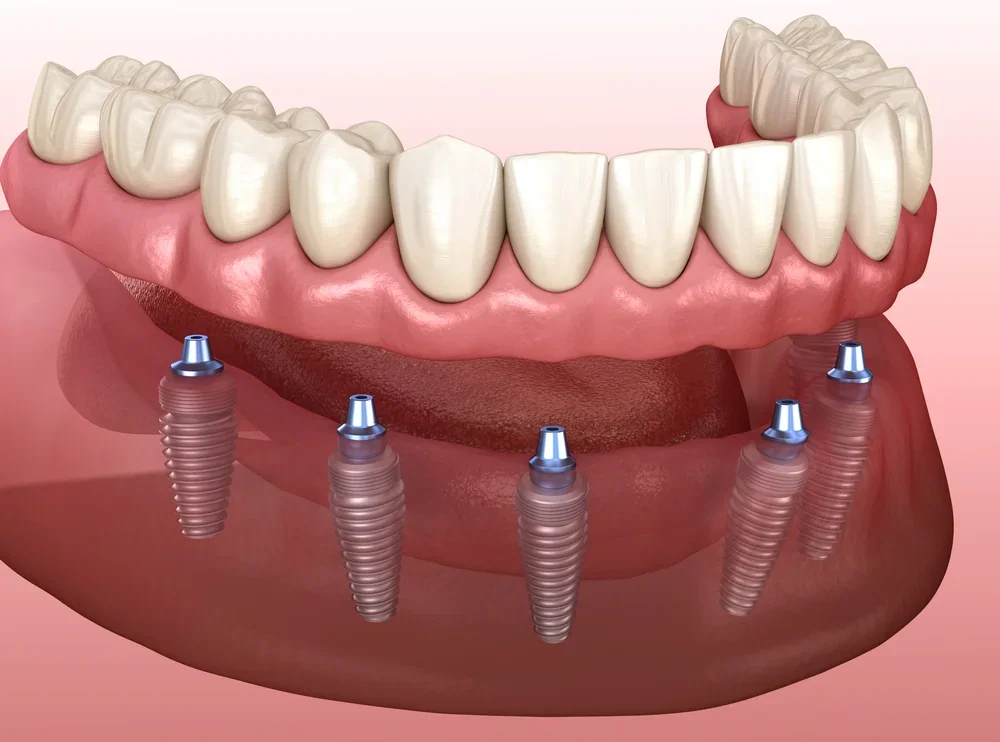
All-on-6 is a full-arch dental implant treatment that uses six dental implants to support a fixed prosthetic bridge replacing an entire upper or lower arch of teeth.
Rather than placing an individual implant for every missing tooth, six implants are strategically positioned within the jaw to support a complete set of replacement teeth.
The implants act as artificial tooth roots, providing a foundation for the fixed restoration.
The final prosthesis is designed to restore:
Chewing function.
Dental appearance.
Speech and pronunciation.
Support for the lips and facial appearance.
Confidence when smiling and eating.
Depending on the patient's clinical circumstances, All-on-6 may be suitable for the upper jaw, lower jaw or both arches.
How Does All-on-6 Differ From Traditional Dentures?
Traditional removable dentures rest on the gums and may move during speaking or eating.
All-on-6 restorations are fixed to dental implants and are not designed to be removed by the patient.
Some important differences include:
Stability: Implant-supported restorations provide a fixed foundation and are generally more stable than conventional removable dentures.
Chewing function: Fixed implant-supported teeth can help restore chewing ability and comfort.
Confidence: Patients do not need to remove their fixed teeth at night or worry about denture movement during everyday activities.
Maintenance: Although the restoration is fixed, careful cleaning and regular professional maintenance remain essential.
The most suitable option depends on the patient's oral health, expectations and individual clinical needs.
Why Are Six Implants Used?
The purpose of using six implants is to provide multiple supporting points for the full-arch restoration.
The position of each implant is carefully planned to distribute chewing forces across the supporting implants.
However, using more implants does not automatically mean a better result for every patient.
The appropriate number and positioning of implants depend on several factors, including:
Jawbone anatomy.
Bone quality and available support.
Bite relationships.
Expected chewing forces.
Implant distribution.
Opposing teeth or restorations.
The design of the final prosthesis.
For some patients, All-on-4 may be appropriate, while others may benefit from an All-on-6 approach.
A comprehensive examination is necessary to determine the most suitable treatment.
Who May Be Suitable for All-on-6 Dental Implants?
All-on-6 may be considered for adults who:
Have lost most or all teeth in one jaw.
Have several severely damaged or failing teeth.
Experience difficulty chewing with removable dentures.
Want a fixed alternative to conventional dentures.
Have extensive dental problems requiring full-arch rehabilitation.
Have suitable oral and general health for implant surgery.
Suitability is determined through a detailed clinical assessment and diagnostic imaging.
Your dentist will also consider medical history, gum health, smoking habits, oral hygiene and the ability to maintain the final restoration.
What Is the All-on-6 Dental Implant Procedure?
All-on-6 treatment involves several carefully planned stages.
Step 1: Comprehensive Consultation
The first stage involves assessing your dental condition, medical history, bite and expectations.
Your dentist will examine the remaining teeth, gums, jaw relationships and overall oral health.
If you have multiple failing teeth, the treatment plan will consider which teeth can be retained and which may require removal.
Step 2: Digital Imaging and Implant Planning
Diagnostic imaging, including a CBCT scan, may be used to assess the jawbone and important anatomical structures.
The implant positions are planned according to the available bone, prosthetic requirements and expected chewing forces.
The final tooth arrangement is an important consideration because implants should be positioned to support a functional and maintainable restoration.
Step 3: Implant Placement
The six dental implants are surgically positioned in the planned locations.
Depending on the treatment requirements, any necessary extractions may be performed during the same surgical appointment.
Local anaesthesia is used, and sedation may be discussed for suitable patients who require additional support or are undergoing extensive treatment.
Step 4: Temporary Fixed Teeth
For appropriately selected patients with sufficient implant stability, a temporary fixed restoration may be provided during the healing period.
However, immediate loading is not suitable for everyone.
The decision depends on implant stability, bone conditions, bite forces and the overall treatment plan.
Step 5: Healing and Osseointegration
Following implant placement, the implants undergo a healing process called osseointegration.
During this period, the surrounding bone integrates with the titanium implant surfaces.
Patients must follow dietary and oral hygiene instructions carefully to protect the healing implants.
Step 6: Final All-on-6 Restoration
Once healing and implant stability have been assessed, the final prosthesis can be designed and fitted.
The restoration is carefully evaluated for:
Bite alignment.
Chewing function.
Speech.
Appearance.
Comfort.
Cleaning access.
The aim is to achieve a stable, functional and natural-looking full-arch restoration.
What Is the Difference Between All-on-4 and All-on-6?
Both All-on-4 and All-on-6 are full-arch implant treatment approaches designed to support a fixed set of replacement teeth.
The main difference is the number of implants used to support the prosthesis.
All-on-4: Uses four strategically positioned implants to support a full-arch restoration.
All-on-6: Uses six strategically positioned implants to support a full-arch restoration.
The additional implants in an All-on-6 arrangement may provide more supporting points and allow different approaches to distributing chewing forces.
However, the choice should not be based on implant numbers alone.
Factors such as anatomy, implant positioning, bite forces, prosthetic design and long-term maintenance must all be considered.
Your dentist can discuss which approach is most appropriate following a comprehensive assessment.
Can All-on-6 Dental Implants Look Natural?
Yes. Modern full-arch implant restorations are designed to recreate the appearance of natural teeth.
The design process considers:
Tooth shape and size.
Tooth colour.
Smile proportions.
Lip support.
Facial appearance.
Speech and pronunciation.
Bite relationships.
The final restoration should be designed around the patient's facial features and functional requirements rather than simply replacing the missing teeth.
How Do You Look After All-on-6 Dental Implants?
Although dental implants cannot develop tooth decay, the surrounding gums and supporting tissues still require careful maintenance.
Good hygiene is essential for long-term implant health.
Recommended care includes:
Brushing carefully at least twice daily.
Cleaning underneath the implant-supported bridge.
Using suitable interdental brushes.
Using a water flosser if recommended.
Attending regular professional implant reviews.
Following dietary instructions during healing.
Reporting bleeding, swelling, discomfort or changes in the restoration.
Your dentist will recommend an individualised maintenance schedule.
How Long Do All-on-6 Dental Implants Last?
Dental implants can provide long-term tooth replacement when properly planned and maintained.
However, implant longevity depends on several factors, including:
General health.
Gum and bone health.
Oral hygiene.
Smoking.
Teeth grinding and clenching.
Bite forces.
Regular dental maintenance.
The condition of the final prosthesis.
The implant fixtures and the prosthetic teeth are separate components, and both require ongoing monitoring.
Regular professional reviews are important to identify potential problems early.
Is Sedation Available for All-on-6 Treatment?
For patients who feel anxious about dental surgery or require lengthy treatment appointments, sedation may be considered.
IV sedation can help suitable patients feel more relaxed during dental procedures.
The sedation practitioner will assess your medical history, medications and general health to determine whether sedation is appropriate.
Local anaesthesia is still generally required to numb the surgical area.
The available options should be discussed during your consultation.
All-on-6 Dental Implants at Pain Free Dentist Sydney – Dulwich Hill
Replacing an entire arch of missing or failing teeth is a significant dental decision.
At Pain Free Dentist Sydney, Dr Lisa Chong takes an individualised approach to full-mouth implant rehabilitation.
We consider more than just the number of missing teeth. Treatment planning also takes into account jaw relationships, bite function, implant positioning, prosthetic design and long-term maintenance.
Our implant services include individual dental implants, implant-supported bridges, All-on-4 and All-on-6 full-arch restorations.
We aim to help patients restore their ability to chew comfortably, improve their smile and regain confidence in their everyday lives.
Frequently Asked Questions About All-on-6 Dental Implants
1. How many teeth does All-on-6 replace?
All-on-6 is designed to replace an entire upper or lower arch of teeth using a fixed prosthesis supported by six implants. The number of teeth in the restoration depends on the individual design.
2. Is All-on-6 better than All-on-4?
Not necessarily. All-on-6 provides six supporting implants rather than four, but the best approach depends on the patient's anatomy, implant distribution, bite forces and restorative requirements.
3. Can I receive temporary teeth on the same day?
Some patients may be suitable for immediate fixed temporary teeth, provided sufficient implant stability and other clinical requirements are achieved. Others may need a different healing approach.
4. Can All-on-6 be performed on both jaws?
Yes. All-on-6 can be planned for both the upper and lower jaws. The treatment may be performed in stages depending on the patient's clinical needs.
5. Will my All-on-6 teeth feel like natural teeth?
Implant-supported teeth are designed to provide stable chewing and a natural-looking appearance. However, they will feel different from natural teeth, and patients may need an adjustment period.
6. Do All-on-6 implants require special cleaning?
Yes. The area underneath the fixed bridge needs careful daily cleaning. Your dentist will demonstrate suitable cleaning techniques and recommend professional maintenance.
Restore Your Smile with All-on-6 Dental Implants in Sydney
If you are missing most of your teeth, experiencing failing teeth or struggling with removable dentures, All-on-6 dental implants may be an option worth exploring.
A comprehensive consultation can help determine whether this treatment is suitable for your oral health and long-term dental needs.
Pain Free Dentist Sydney – Dulwich Hill
Phone: 02 9558 8988
Email: info@painfreedentistsydney.com.au
Website: https://painfreedentistsydney.com.au
Contact our team to arrange an implant consultation with Dr Lisa Chong.