Losing multiple teeth can affect much more than your appearance. Missing teeth may make chewing difficult, affect speech, change facial appearance and reduce confidence when smiling or socialising.
For patients who have lost most or all of their teeth, traditional removable dentures are not the only option.
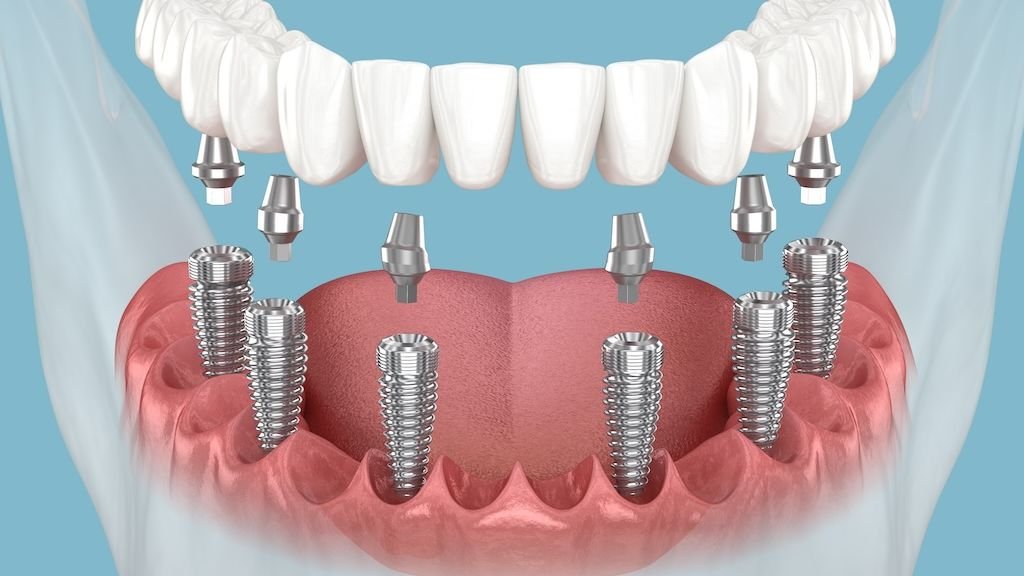
All-on-6 dental implants offer a fixed full-arch tooth replacement solution using six strategically positioned dental implants to support a full set of replacement teeth.
This treatment can help restore chewing function, improve smile aesthetics and provide a stable alternative to conventional removable dentures.
At Pain Free Dentist Sydney, we believe that replacing missing teeth involves more than simply filling gaps. It requires careful planning of the jawbone, bite, implant positions and long-term function.
What Are All-on-6 Dental Implants?
All-on-6 is a full-arch dental implant treatment designed for patients who require replacement of most or all teeth in the upper or lower jaw.
The procedure generally involves placing six dental implants into the jawbone. These implants act as artificial tooth roots and provide support for a fixed full-arch prosthesis.
Unlike conventional dentures, which rest on the gums and can move during eating or speaking, an implant-supported full-arch restoration is secured to dental implants.
The six implants are strategically positioned to distribute biting forces and support the replacement teeth.
Depending on the patient's bone anatomy, implant positioning and treatment plan, the final restoration may be made from different materials, including acrylic-based materials, reinforced prosthetic designs or zirconia.
How Does the All-on-6 Dental Implant Procedure Work?
All-on-6 treatment requires careful planning because every patient's jawbone anatomy, bite and oral health are different.
The treatment process generally involves several stages.
1. Comprehensive Dental Assessment
The first step is a detailed dental examination to determine whether All-on-6 treatment is suitable.
Your dentist may assess:
Remaining teeth and their condition.
Gum health and periodontal disease.
Jawbone volume and density.
Bite relationship and jaw position.
Facial appearance and smile proportions.
Medical history and medications.
Previous dental treatment.
Smoking habits and other healing considerations.
A CBCT scan may be required to evaluate the jawbone and identify important anatomical structures such as nerves and the maxillary sinuses.
2. Digital Implant Planning
Implant placement requires careful consideration of the position, angulation and distribution of all six implants.
Digital planning helps evaluate:
Available bone volume.
Implant length and diameter.
Implant positioning.
Anterior-posterior spread.
Relationship to nerves and sinuses.
Prosthetic space.
Bite forces and anticipated loading.
The goal is to achieve a suitable implant distribution that supports the full-arch prosthesis while considering the patient's anatomical limitations.
3. Removal of Remaining Teeth When Necessary
If the remaining teeth are severely damaged, infected or have a poor long-term prognosis, extraction may be recommended.
However, not every patient requires all remaining teeth to be removed.
The decision should be based on a comprehensive assessment of which teeth can be predictably maintained.
4. Placement of Six Dental Implants
Six implants are placed into the jawbone according to the surgical plan.
Some implants may be positioned vertically, while posterior implants may be angled when appropriate to accommodate anatomical limitations and improve implant distribution.
The final positioning depends on the patient's bone availability, prosthetic design and surgical requirements.
5. Temporary Fixed Teeth
In selected patients, a temporary fixed prosthesis may be attached soon after implant placement.
This is sometimes referred to as immediate loading.
However, immediate loading is not suitable for everyone. It depends on factors such as primary implant stability, bone quality, implant distribution, bite forces and the patient's ability to follow postoperative instructions.
Some patients may need a healing period before receiving their fixed prosthesis.
6. Final Full-Arch Restoration
After the implants have integrated with the surrounding bone, the temporary prosthesis can be replaced with the definitive restoration.
The final prosthesis is designed to provide appropriate tooth shape, bite function, aesthetics and ease of maintenance.
Regular professional reviews are important to monitor the implants, surrounding tissues and prosthesis.
Why Choose All-on-6 Instead of Traditional Dentures?
Traditional dentures can be an effective option for many patients. However, some individuals experience problems with movement, discomfort or difficulty chewing.
All-on-6 offers several potential advantages.
1. Fixed replacement teeth
The prosthesis is supported by dental implants rather than relying solely on the gums for retention.
2. Improved chewing stability
Implant-supported teeth can provide greater stability during eating compared with conventional removable dentures.
3. Improved smile aesthetics
The replacement teeth are designed to complement facial proportions, lip support and the patient's preferred smile appearance.
4. No daily removal of the prosthesis
The fixed restoration remains attached to the implants and is not removed by the patient for everyday cleaning.
5. Support for full-arch rehabilitation
All-on-6 can restore an entire upper or lower arch when multiple teeth are missing or cannot be predictably maintained.
6. Potential preservation of jawbone
Dental implants transmit functional forces to the surrounding bone and may help reduce the bone loss associated with tooth loss. However, they do not completely prevent ongoing bone changes.
All-on-4 vs All-on-6: What Is the Difference?
Both All-on-4 and All-on-6 are full-arch implant rehabilitation techniques.
The main difference is the number of implants used to support the prosthesis.
All-on-4 generally uses four strategically positioned implants, while All-on-6 uses six implants.
However, more implants do not automatically mean a better outcome.
The most appropriate treatment depends on:
Jawbone anatomy.
Bone quality and available volume.
Implant positioning and angulation.
Anterior-posterior spread.
Bite forces.
Prosthetic design.
Patient-specific medical and dental factors.
In selected cases, six implants may provide additional support and allow a different distribution of functional forces.
In other cases, four well-positioned implants may provide adequate support.
The decision should be based on individual implant planning rather than choosing a technique solely because it uses more implants.
Who Is Suitable for All-on-6 Dental Implants?
All-on-6 may be considered for patients who:
Have lost most or all teeth in one jaw.
Have multiple teeth with a poor long-term prognosis.
Have difficulty wearing conventional dentures.
Want a fixed alternative to removable dentures.
Have sufficient bone volume for appropriate implant placement.
Are medically suitable for implant surgery.
Can maintain appropriate oral hygiene and attend regular reviews.
Patients with significant bone loss may require additional assessment to determine whether alternative implant positions, bone augmentation or other treatment approaches are appropriate.
Smoking, uncontrolled medical conditions and certain medications may also affect healing and implant success.
A comprehensive assessment is essential before treatment.
Can All-on-6 Be Performed Under IV Sedation?
For patients who experience dental anxiety or require extensive implant surgery, IV sedation may be an option.
Depending on the patient's medical history and surgical requirements, sedation can help reduce anxiety and improve comfort during the procedure.
IV sedation is administered by an appropriately qualified practitioner who monitors the patient throughout treatment.
Patients should understand that IV sedation is not necessarily general anaesthesia. The level of consciousness and responsiveness depends on the sedation technique and medication used.
Suitability must be determined through an individual medical and sedation assessment.
How Long Do All-on-6 Dental Implants Last?
Dental implants can provide long-term tooth replacement, but their longevity depends on several factors.
These include:
Bone quality and healing.
Implant positioning.
Bite forces and load distribution.
Oral hygiene.
Smoking habits.
Medical conditions.
Teeth grinding and clenching.
Regular professional maintenance.
The implant fixtures and the prosthetic teeth have different maintenance requirements.
Even when implants integrate successfully with the jawbone, the prosthesis may require maintenance, repair or replacement over time.
Patients with bruxism may require additional consideration of bite forces and protective measures.
How Do You Maintain All-on-6 Dental Implants?
Good maintenance is essential for protecting the implants and surrounding tissues.
Recommended care includes:
Brushing the prosthesis and surrounding gum areas carefully.
Using appropriate interdental cleaning devices.
Cleaning underneath the full-arch prosthesis as instructed.
Attending regular professional implant maintenance.
Monitoring for bleeding, swelling or discomfort.
Avoiding smoking.
Reporting changes in bite or prosthesis stability.
Wearing a protective splint if clinically recommended.
Although dental implants cannot develop tooth decay, the surrounding tissues can develop peri-implant mucositis and peri-implantitis.
These conditions can affect implant health if not identified and managed appropriately.
Why Is Implant Planning So Important?
Full-arch implant treatment is not simply about placing six implants into the jawbone.
The success of the overall rehabilitation depends on the relationship between the implants, prosthetic teeth, bite forces and surrounding anatomy.
Poor implant distribution, inadequate prosthetic planning or excessive cantilever forces may contribute to mechanical complications.
This is why digital planning, CBCT assessment, prosthetic considerations and careful surgical execution are important parts of treatment.
A well-designed treatment plan should consider not only how the implants are placed but also how the final teeth will function over many years.
Restore Your Smile With All-on-6 Dental Implants
Living with multiple missing teeth can affect confidence, eating habits and everyday quality of life.
All-on-6 dental implants may offer a fixed full-arch solution for suitable patients who want to restore their smile and chewing function.
At Pain Free Dentist Sydney – Dulwich Hill, we understand that full-mouth implant rehabilitation requires careful assessment, individualised treatment planning and consideration of long-term oral health.
Whether you are currently wearing dentures, have multiple failing teeth or are exploring full-arch dental implant treatment, a comprehensive consultation can help determine which options may be suitable.
A healthy, functional smile begins with the right treatment plan.
Book a Dental Implant Consultation
Pain Free Dentist Sydney – Dulwich Hill
Phone: 02 9558 8988
Email: info@painfreedentistsydney.com.au
Website: https://painfreedentistsydney.com.au