If you are missing teeth—whether one or several—you have probably asked yourself this question: what is the best way to replace them?
It is a big decision. Your choice will affect how you eat, how you speak, how you smile, and even how your face looks over time. It also affects your wallet, your daily routine, and your long-term oral health.
Two options dominate the conversation: dental implants and dentures. Both have helped millions of people restore their smiles. But they are fundamentally different—in how they work, how they feel, and what they require from you.
Here is what you need to know to make the right choice for your life.
What Are Dental Implants?
Dental implants are the closest thing to natural teeth you can get.
How they work: A small titanium post is surgically placed into your jawbone. Over three to six months, the bone fuses with the implant in a process called osseointegration. Once healed, an abutment and a custom-made crown are attached.
What they feel like: They feel just like natural teeth. They are fixed in place—they do not move, click, or shift. You clean them just like your natural teeth.
Best for: Patients with sufficient bone density, good overall health, and a desire for a permanent solution.
The journey: The process takes several months, requires surgery, and costs more upfront. But for many, the long-term benefits are worth it.
What Are Dentures?
Dentures have been around for centuries, and they remain a popular and effective option.
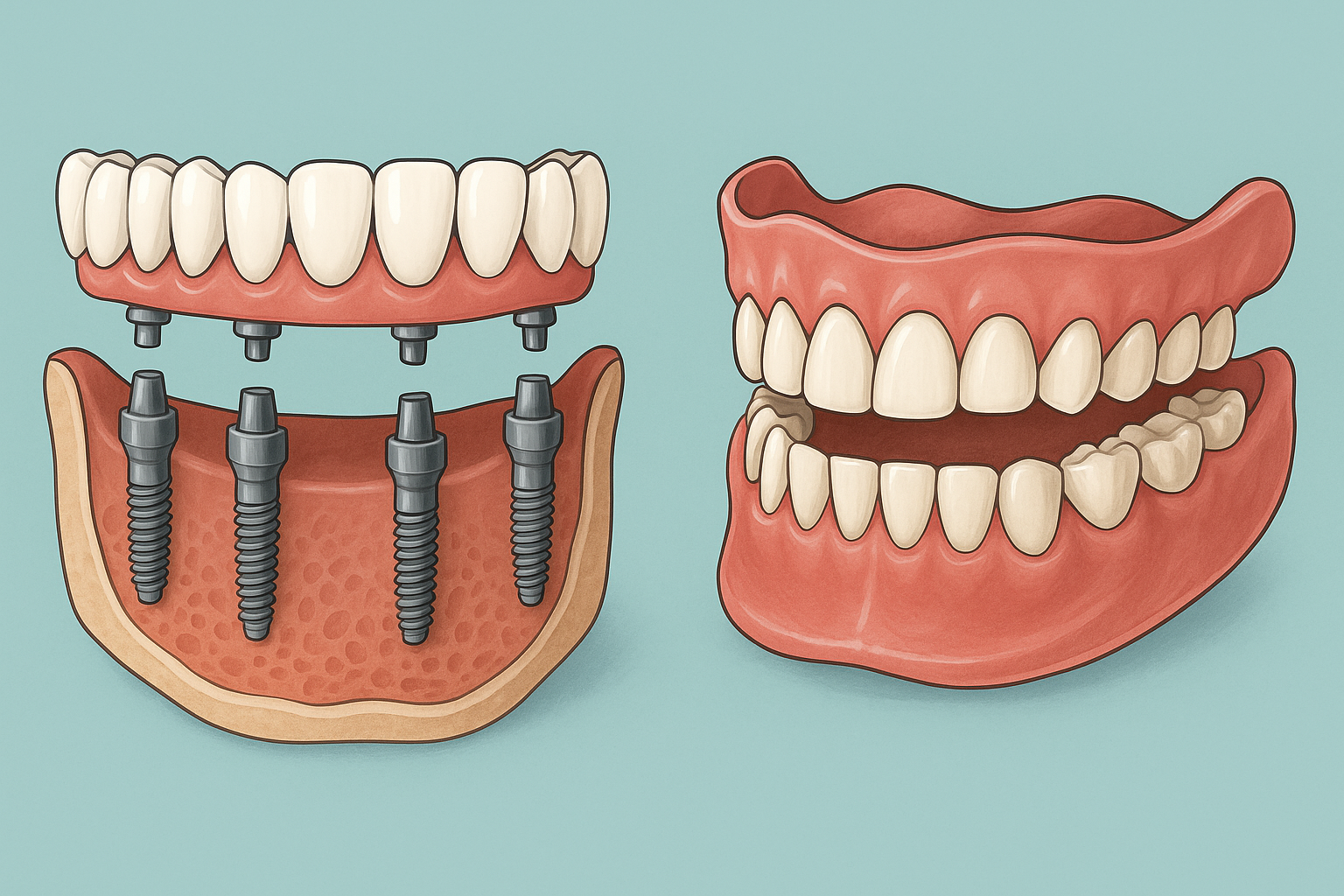
How they work: A custom-made acrylic plate sits on your gums, held in place by suction, adhesives, or clips on existing teeth. Full dentures replace all teeth on an arch; partial dentures fill gaps between natural teeth.
What they feel like: They sit on your gums and can move slightly during eating or speaking. They require adhesives for stability and need to be removed nightly for cleaning.
Best for: Patients with multiple missing teeth, limited bone density, or budget considerations.
The journey: Dentures are faster to create—usually a few weeks. They are less expensive upfront and do not require surgery.
Comparing the Two
Here is a breakdown of what matters most:
Feel and Function
Implants feel and function like natural teeth. You can eat steak, apples, and corn on the cob without worry. Because they are anchored in bone, they provide stable chewing force.
Dentures sit on the gum surface. They can shift when chewing, which can limit food choices. Many patients avoid sticky, hard, or tough foods.
Winner: Implants.
Bone Health
Implants stimulate your jawbone, just like natural tooth roots. This prevents bone loss and preserves your facial structure, preventing the sunken appearance that can come with tooth loss.
Dentures do not stimulate bone. Over time, the jawbone shrinks where teeth are missing, which can change the shape of your face and cause dentures to become loose.
Winner: Implants.
Maintenance
Implants are brushed and flossed just like natural teeth. No special cleaning solutions, no overnight soaking, no adhesives.
Dentures require daily removal, soaking in cleaning solution, and careful handling. They are delicate and can break if dropped.
Winner: Implants.
Natural Teeth Preservation
Implants stand alone. They do not require altering neighbouring teeth.
Dentures do not alter natural teeth either—but partial dentures use clips or clasps that can put stress on remaining teeth over time.
Winner: Implants.
Speech
Implants do not affect speech—you speak naturally, just like with your original teeth.
Dentures can affect speech. Many patients find certain sounds difficult or notice clicking when they speak. This usually improves with practice, but some adjustment is always needed.
Winner: Implants.
Comfort
Implants are comfortable—they feel like part of you. There is no bulky plastic plate covering your palate.
Dentures can feel bulky, especially in the upper arch where the plate covers the roof of your mouth. Some patients never fully adjust to the feeling.
Winner: Implants.
Cost
Implants are more expensive upfront. A single implant crown ranges from $3,000 to $6,000 in Australia . Full arch solutions cost significantly more.
Dentures are more budget-friendly initially. A full set of upper and lower dentures costs between $2,000 and $5,000 .
Winner: Dentures.
Timeline
Implants take months—often three to six months for healing, sometimes longer if bone grafting is needed.
Dentures take weeks—usually two to four appointments over a few weeks.
Winner: Dentures.
Lifespan
Implants can last 20 years to a lifetime with proper care.
Dentures typically last 5 to 10 years and then need replacement as the jawbone changes shape.
Winner: Implants.
What About Implant-Supported Dentures?
There is a middle ground that many patients do not know about: implant-supported dentures.
This option uses two to four implants to stabilise a removable denture. The denture snaps onto the implants, providing far better stability than traditional dentures—without the cost of individual implants for every missing tooth.
Best for: Patients who want the stability of implants but cannot afford or do not need full implant crowns.
The result: A denture that stays firmly in place, does not require adhesives, and feels more natural—while still being removable for cleaning.
Which Option Is Right for You?
There is no single "right" answer—it depends on your situation. Here are some questions to ask yourself:
Do you want a permanent, fixed solution? Choose implants.
Do you prefer a faster, less expensive option? Choose dentures.
Do you have sufficient jawbone density? Implants may be possible. If not, bone grafting or dentures may be better.
Are you willing to undergo surgery? Choose dentures if you want to avoid surgery.
Do you want to eat all your favourite foods? Choose implants.
Is budget your primary concern? Dentures are more affordable upfront.
The Most Important Step
The best way to decide is to speak with a dentist who can assess your unique situation. We will examine your bone density, oral health, and overall health to make a recommendation tailored to you.
You do not need to have all the answers today—you just need to start the conversation.
Still unsure which option is right for you? Visit https://painfreedentistsydney.com.au/ to book your consultation online. Call us at (02) 9558 8988 or email info@painfreedentistsydney.com.au to speak with our team.