Intro
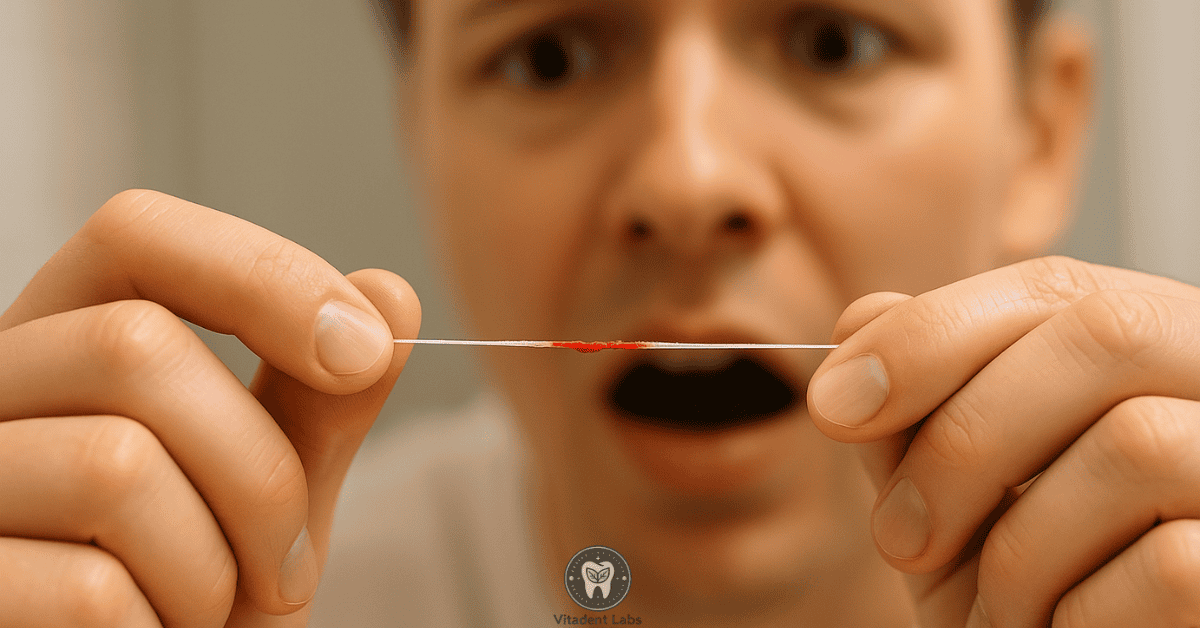
You flossed—good for you. Then you spat, and there it was: pink in the sink.
You probably thought one of two things:
"I must have flossed too hard."
"My gums are just sensitive."
Here is the truth that surprises most people: flossing too hard is rarely the cause. And "sensitive gums" is not really a thing—gums do not just bleed because they are delicate.
Bleeding gums are almost always a sign of inflammation caused by plaque and bacteria. And that inflammation has a name: gingivitis—the earliest stage of gum disease .
The good news? Gingivitis is reversible. And the solution is simpler than you think.
The Simple Science Behind Bleeding Gums
Here is what happens in your mouth when you skip flossing:
Plaque—a sticky, colourless film of bacteria—builds up along your gumline. Your immune system recognises this bacteria as a threat and sends white blood cells to fight it. This triggers inflammation: your gums become red, swollen, and tender .
When you floss, you disturb the bacteria and the inflamed tissue. The fragile, swollen blood vessels in your gums break easily, causing bleeding. It is not because you flossed too hard—it is because the tissue is already inflamed.
Think of it like a scratch on an inflamed patch of skin. The problem is not the scratch—it is the inflammation underneath.
The Three Stages of Gum Disease
Understanding where you are in the journey helps you know what to do next.
Stage 1: Gingivitis
Gums are red, swollen, and bleed when you brush or floss
No bone loss yet
Usually no pain
Reversible with professional cleaning and improved home care
Stage 2: Periodontitis
Inflammation spreads below the gumline
Gums begin to pull away from teeth (recession)
Bone loss begins
Not reversible, but manageable—treatment can stop progression
Stage 3: Advanced Periodontitis
Significant bone loss
Teeth become loose or shift
Painful chewing, severe bad breath, pus around gums
Advanced treatment needed—scaling, root planing, or surgery
Here is the critical part: gingivitis does not always hurt. You can have gum disease and feel perfectly fine . That is why bleeding gums are such an important early warning sign—they are often the only clue.
Is Bleeding Gums Serious?
Bleeding gums are a sign that your gums are inflamed. Left untreated, that inflammation can progress to periodontitis—which can lead to tooth loss .
But the concerns go beyond your mouth. Inflamed gums can trigger low-grade inflammation throughout your body . This has been linked to:
Heart disease
Diabetes (and difficulty controlling blood sugar)
Pregnancy complications
Respiratory infections
Your gums are not just about your teeth—they are connected to your whole health.
Why You Should Never Stop Flossing
Here is the most common mistake people make: they floss, their gums bleed, so they stop flossing.
Please read this next sentence carefully: If you stop flossing, the bleeding will not stop—it will get worse.
When you floss regularly, the bacteria is disrupted, inflammation decreases, and the bleeding stops. If you floss consistently for about two weeks, the bleeding should significantly reduce or stop entirely .
Stopping flossing just lets the plaque build back up, making the inflammation worse. You have to push through the first week or two—and then it gets much better.
What Actually Fixes Bleeding Gums?
You do not need expensive treatments or complicated routines. Here is what works:
1. Floss daily, gently
Use proper technique: curve the floss around each tooth in a C-shape and gently slide it beneath the gumline. Do not snap it against your gums. If regular floss is difficult, try floss picks, water flossers, or interdental brushes.
2. Brush twice daily with fluoride toothpaste
Brush for at least two minutes. Tilt your brush at a 45-degree angle toward the gumline to clean along the gum margin.
3. Use a soft-bristled brush
Hard bristles can damage gums. Soft bristles are effective and gentle.
4. See your dentist for a professional clean
Plaque that has hardened into tartar cannot be removed by brushing alone. A professional cleaning removes tartar and gives your gums a fresh start.
5. Consider an antimicrobial mouthwash
Your dentist may recommend a mouthwash to help reduce bacteria and inflammation.
6. Quit smoking
Smoking weakens your immune system and makes it harder for gums to heal.
When to See a Dentist
If your gums bleed consistently for more than two weeks despite improving your home care, it is time to see a dentist.
Also make an appointment if you notice:
Receding gums
Loose teeth
Persistent bad breath
Pus around your teeth or gums
Pain when chewing
Changes in how your teeth fit together when you bite
What Happens at the Dentist?
If we find gum disease, we will recommend one of the following:
Scaling and root planing: A deep clean below the gumline to remove plaque and tartar and smooth tooth roots so gums can reattach.
Improved home care: Guidance on brushing and flossing techniques tailored to your teeth.
Regular maintenance: More frequent cleanings—every three to four months instead of six.
Surgery (if advanced): In severe cases, gum surgery may be needed to treat deep pockets.
But for most patients, a professional clean and improved home care are enough to reverse gingivitis.
The Bottom Line
Bleeding gums are not normal. They are your gums waving a red flag and saying: "Something is wrong."
But here is the good news: you can fix it. With daily flossing, proper brushing, and a professional clean, you can stop the bleeding and protect your health.
Do not ignore the pink in the sink. It is one of the easiest health problems to fix—if you act early.
Are your gums bleeding when you floss? Visit https://painfreedentistsydney.com.au/ to book your appointment online. Call us at (02) 9558 8988 or email info@painfreedentistsydney.com.au to speak with our team.