Sleep apnoea, TMJ problems and tongue-tie are often discussed separately, but there can be overlapping factors involving the tongue, jaw, airway, breathing and sleep.
At Pain Free Dentist Sydney, we assess these areas together when appropriate because problems involving oral function and jaw position may be relevant to a patient's symptoms.
What Is Sleep Apnoea?
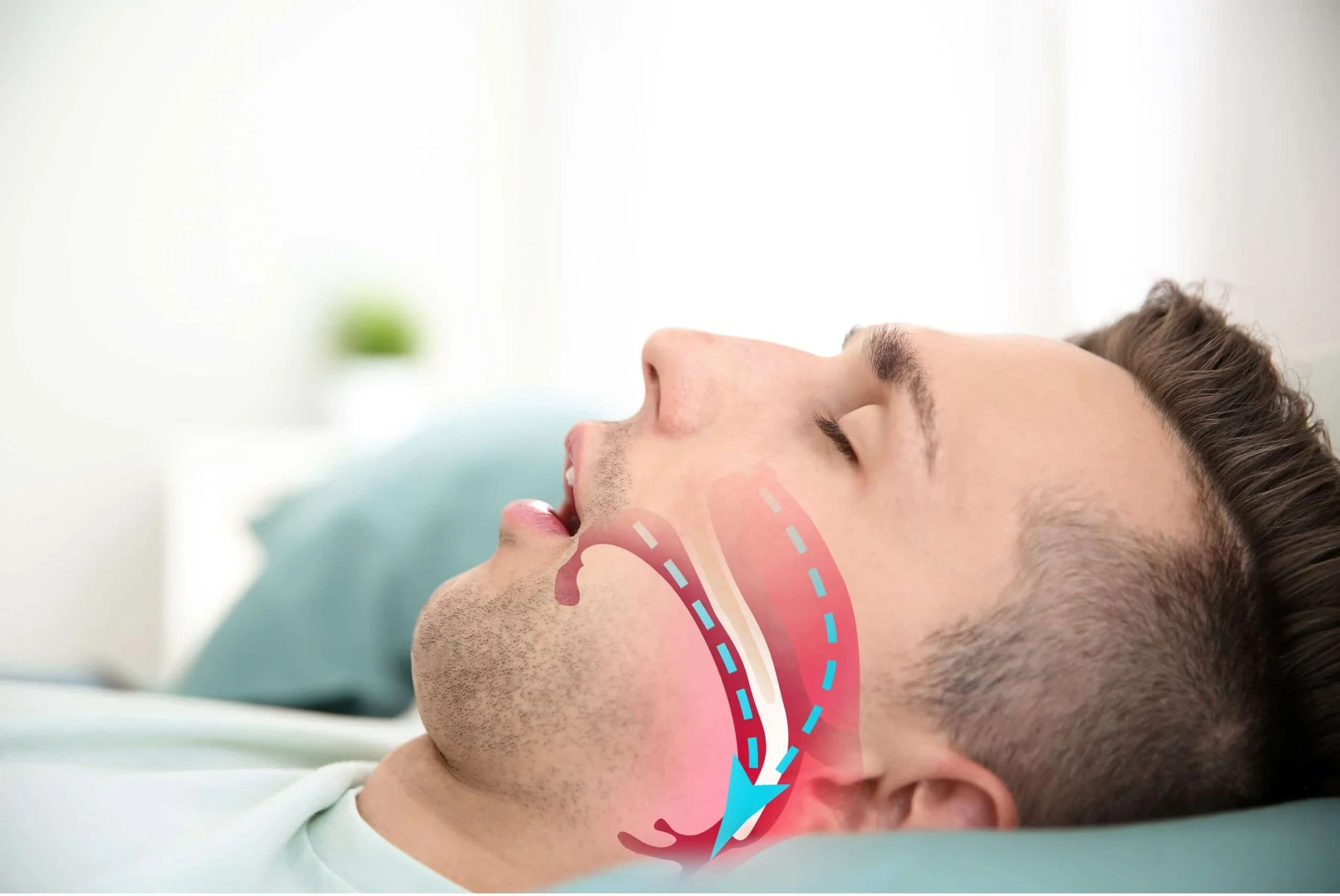
Sleep apnoea is a sleep-related breathing disorder where breathing repeatedly becomes reduced or stops during sleep.
The most common type is obstructive sleep apnoea (OSA). It occurs when the upper airway becomes partially or completely blocked during sleep.
Common symptoms include:
Loud snoring
Gasping or choking during sleep
Waking frequently
Morning headaches
Dry mouth
Daytime tiredness
Difficulty concentrating
Poor-quality sleep
Not everyone who snores has sleep apnoea, and symptoms should be properly assessed by a qualified healthcare professional.
What Is TMJ Dysfunction?
The temporomandibular joints (TMJs) connect your lower jaw to your skull and allow movements such as opening, closing and chewing.
TMJ disorders can involve the jaw joints, chewing muscles or both.
Symptoms may include:
Jaw pain or tenderness
Clicking or popping
Difficulty opening the mouth
Facial pain
Headaches
Ear-related symptoms
Tooth wear
Clenching or grinding
Sleep-related teeth grinding and jaw muscle activity can also occur alongside sleep disorders.
What Is Tongue-Tie?
Tongue-tie, or ankyloglossia, occurs when the tissue connecting the underside of the tongue to the floor of the mouth restricts tongue movement.
The clinical significance of tongue-tie varies considerably between individuals.
Some people have a restricted lingual frenulum but no significant functional problems. Others may experience difficulties with tongue mobility or oral function.
Importantly, having a tongue-tie does not automatically mean that a frenectomy is required.
A proper assessment should consider tongue movement, function, symptoms and other contributing factors.
How Could Tongue Function Relate to Sleep and the Airway?
The tongue is an important structure involved in swallowing, oral posture and maintaining the upper airway.
During sleep, muscle tone decreases. In susceptible individuals, the tongue and surrounding soft tissues can contribute to narrowing of the upper airway.
Tongue posture and oral function may therefore be relevant when assessing someone with symptoms associated with sleep-disordered breathing.
However, tongue-tie itself should not be considered a proven direct cause of obstructive sleep apnoea.
Sleep apnoea is a complex condition involving multiple anatomical and physiological factors.
What Is the Connection Between TMJ and Sleep Apnoea?
There can be an association between sleep-disordered breathing and jaw-related symptoms.
For example, a person with sleep-disordered breathing may experience increased muscle activity, clenching or grinding during sleep. This can place additional stress on the chewing muscles and temporomandibular joints.
Conversely, jaw anatomy and the position of the lower jaw can influence the dimensions of the upper airway.
This is why an assessment of someone with both TMJ symptoms and suspected sleep-disordered breathing may need to consider more than the teeth and jaw joints alone.
Where Does Tongue-Tie Fit In?
This is where the relationship becomes more complex.
A restricted tongue may affect how the tongue moves or rests. In some patients, this may be associated with altered oral function or compensatory muscle activity.
However, there is not enough evidence to say that tongue-tie directly causes TMJ disorders or sleep apnoea in every patient.
Similarly, releasing a tongue-tie should not automatically be presented as a treatment or cure for sleep apnoea or TMJ dysfunction.
The important question is whether the restriction is actually causing a clinically significant functional problem for that individual.
A Whole-Person Approach to TMJ and Airway Assessment
At Pain Free Dentist Sydney, we look at the relationship between different structures and functions when assessing appropriate patients.
Depending on the individual case, this may include assessment of:
Tongue mobility and function
Tongue resting posture
Palate and dental arch development
Jaw position
TMJ and chewing muscles
Tooth wear and clenching
Nasal and oral breathing
Sleep symptoms
Previous sleep studies
Relevant medical history
Where sleep apnoea is suspected, a formal sleep assessment is important. Dental assessment should complement, rather than replace, medical and sleep-medicine evaluation.
Does Everyone With TMJ Need a Tongue-Tie Release?
No.
A frenectomy or frenuloplasty should not be recommended simply because a patient has a visible frenulum.
The decision should be based on an appropriate clinical assessment of tongue function, symptoms and the individual's overall situation.
In some patients, improving tongue awareness, posture and function may be considered before surgery.
Can Treating TMJ Improve Sleep Apnoea?
It is important not to make a blanket claim that TMJ treatment will treat or cure sleep apnoea.
Treatment depends on the underlying cause of the patient's sleep-disordered breathing.
For some patients, oral appliance therapy may be considered as part of sleep apnoea management. This is different from treating TMJ dysfunction itself and should be planned according to the patient's diagnosis and dental and medical circumstances.
When Should You Consider an Assessment?
If you experience a combination of:
TMJ pain or jaw clicking
Teeth grinding or clenching
Snoring
Poor-quality sleep
Morning headaches
Daytime fatigue
Mouth breathing
Difficulty maintaining nasal breathing
Suspected tongue restriction
A narrow or high-arched palate
it may be worthwhile discussing these symptoms with an appropriately qualified dentist and healthcare professional.
A sleep study may be recommended when obstructive sleep apnoea is suspected.
The Connection Between the Tongue, Jaw and Airway
The tongue, jaw and upper airway are anatomically and functionally connected. Problems affecting one area can sometimes coexist with symptoms involving another.
However, association does not necessarily mean causation.
A thorough assessment is important before deciding whether the main issue relates to sleep-disordered breathing, TMJ dysfunction, tongue restriction, nasal obstruction, dental factors or a combination of these.
At Pain Free Dentist Sydney, our approach is to assess the individual rather than assume that one diagnosis explains every symptom.
Book a TMJ and Airway Assessment in Sydney
If you are experiencing TMJ symptoms, suspected sleep apnoea, tongue restriction or problems with oral function, contact Pain Free Dentist Sydney to discuss an assessment.
Phone: 02 9558 8988
Email: info@painfreedentistsydney.com.au
Website: painfreedentistsydney.com.au
Location: G1A / Suite 1A, 570 New Canterbury Rd, Hurlstone Park NSW 2193