What Is Cosmetic Dentistry?
Your smile is one of the first things people notice about you. If you feel self-conscious about stained, discoloured, chipped, uneven or worn teeth, cosmetic dentistry may help you achieve a smile that looks brighter, healthier and more balanced.
Cosmetic dentistry focuses on improving the appearance of your teeth and smile while considering your overall oral health and dental function.
At Pain Free Dentist Sydney, we believe cosmetic dental treatment should be about more than creating white, perfectly shaped teeth. It should be about creating a natural-looking smile that complements your facial features, suits your personality and allows you to feel comfortable and confident.
Two popular cosmetic dental treatments are professional teeth whitening and porcelain veneers. Although both can improve the appearance of your smile, they work in different ways and are suitable for different concerns.
Professional Teeth Whitening: A Brighter Smile Without Changing Your Tooth Shape
Over time, teeth can become discoloured for several reasons. Coffee, tea, red wine, smoking, certain foods, ageing and changes within the tooth can all contribute to a darker or yellow appearance.
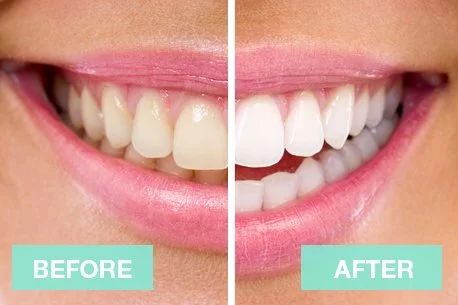
Professional teeth whitening uses carefully selected whitening agents to lighten natural tooth colour.
Unlike veneers, whitening does not change the shape or structure of your teeth. It works by breaking down stains within the tooth to make the natural enamel appear lighter.
What Causes Teeth to Become Discoloured?
Tooth discolouration generally falls into two categories.
1. Extrinsic staining
These are stains that develop on the outer surface of the teeth. Common causes include:
Coffee and tea.
Red wine and dark-coloured foods.
Smoking and tobacco use.
Plaque and calculus accumulation.
Inadequate cleaning.
Professional dental cleaning may improve some surface staining before whitening is considered.
2. Intrinsic discolouration
This occurs within the tooth structure and may be associated with:
Natural ageing.
Certain medications during tooth development.
Previous dental trauma.
Changes in the tooth's internal structure.
Previous root canal treatment.
Intrinsic discolouration may respond differently to whitening. In some cases, alternative cosmetic treatments may be more appropriate.
Is Professional Teeth Whitening Better Than Store-Bought Products?
Professional whitening allows the dental team to assess your teeth and gums before treatment and select an appropriate whitening approach.
Depending on your circumstances, whitening may involve an in-chair procedure, custom-made take-home trays or a combination of approaches.
Professional whitening can help reduce the risk of inappropriate product use and allow any existing dental problems to be identified before treatment.
However, whitening is not suitable for everyone. Tooth decay, gum disease, exposed roots, cracks and existing sensitivity should be assessed first.
Does Teeth Whitening Damage Your Teeth?
When used appropriately under dental guidance, professional whitening is generally considered safe for suitable patients.
Some people experience temporary tooth sensitivity or gum irritation. These effects are usually short-lived, although the likelihood and severity vary between individuals.
Whitening does not change the colour of existing crowns, veneers, fillings or other restorations. If you have visible dental restorations, this should be considered when planning your final tooth shade.
Porcelain Veneers: Transforming the Shape, Colour and Appearance of Your Smile
If you are unhappy with more than just the colour of your teeth, porcelain veneers may be another option.
Veneers are thin, custom-made ceramic restorations bonded to the front surfaces of selected teeth. They can be used to improve the appearance of teeth with concerns such as:
Persistent discolouration that does not respond adequately to whitening.
Chipped or worn edges.
Uneven tooth shapes.
Minor spacing concerns.
Certain alignment irregularities.
Teeth that appear disproportionate or asymmetrical.
Porcelain veneers can create a more uniform smile while maintaining a natural appearance when carefully planned.
How Are Porcelain Veneers Made?
Veneer treatment generally involves several stages.
1. Smile assessment and planning
Your dentist assesses your teeth, gums, bite, facial proportions and smile line. Your expectations and preferred appearance are also discussed.
2. Tooth preparation
Depending on the clinical situation and type of veneer, a small amount of enamel may need to be removed to create space for the restoration.
Some cases may be suitable for minimal-preparation or no-preparation veneers, but these are not appropriate for everyone.
3. Impressions or digital scanning
Records of your teeth are taken so the dental laboratory can create restorations designed to fit your individual smile.
4. Veneer placement
The veneers are carefully checked for fit, shape and colour before being bonded to the teeth using dental adhesive.
The aim is to achieve a result that looks balanced and natural rather than artificial or excessively bulky.
Teeth Whitening vs Porcelain Veneers: Which Should You Choose?
The right treatment depends on what you would like to improve.
Teeth whitening may be suitable if:
Your main concern is yellow or stained teeth.
Your teeth have a reasonably even shape.
You are happy with your natural tooth structure.
You want to improve tooth colour without placing restorations.
Porcelain veneers may be considered if:
You want to change both tooth colour and shape.
You have chipped, worn or uneven front teeth.
You have persistent discolouration.
You want to address selected cosmetic concerns that whitening cannot correct.
In some cases, whitening may be performed before other cosmetic work so the final restorations can be planned around the desired shade of the natural teeth.
It is important to remember that veneers are not simply a stronger or more permanent version of whitening. They involve a different treatment process and may require irreversible removal of tooth structure.
Can You Have Veneers If You Grind Your Teeth?
This is an important consideration.
Patients who clench or grind their teeth may place considerable pressure on their front teeth. This can increase the risk of veneer chipping, fracture or debonding.
Before recommending veneers, your dentist should assess:
Your bite and jaw relationship.
Signs of tooth wear.
Clenching and grinding habits.
Existing jaw discomfort or temporomandibular joint symptoms.
The amount of available enamel.
Whether protective measures may be appropriate.
A night splint may be recommended in selected cases to help protect the restorations from excessive loading.
The underlying factors contributing to tooth wear should also be considered. Cosmetic treatment should not overlook functional concerns.
Do Veneers Look Natural?
Modern porcelain materials can be designed to reproduce many of the visual characteristics of natural teeth, including translucency, surface texture and light reflection.
The most attractive result is not necessarily the whitest possible shade.
A natural-looking smile considers:
Tooth proportions and symmetry.
The shape of the lips and face.
Gum contours.
Tooth colour and translucency.
The way the teeth appear when speaking and smiling.
The relationship between the upper and lower teeth.
Good cosmetic dentistry should enhance your smile without making it look artificial or out of place.
How Long Do Teeth Whitening and Veneers Last?
Teeth whitening results are not permanent. The duration varies according to diet, smoking habits, oral hygiene, natural ageing and individual staining tendencies. Occasional maintenance may be needed.
Porcelain veneers can last for many years with appropriate care, but they are not indestructible. They can chip, fracture, wear or become debonded, and they may eventually need replacement.
To help maintain your results:
Brush twice daily with a fluoride toothpaste.
Clean between your teeth every day.
Attend regular dental examinations and professional cleans.
Avoid using your teeth to open packaging or bite hard objects.
Follow advice about protective splints if you grind your teeth.
Discuss any changes in your bite or discomfort with your dentist.
Cosmetic Dentistry Should Start With Healthy Teeth and Gums
Before undertaking cosmetic treatment, it is important to establish that your teeth and gums are healthy.
Active decay, gum disease, infection and significant bite problems should be assessed and managed before cosmetic procedures are undertaken.
This is particularly important because a beautiful smile should also be comfortable, functional and maintainable.
At Pain Free Dentist Sydney, we believe in treating the person, not just the teeth. Your smile, dental health, comfort, bite and individual expectations all contribute to planning the right treatment.
Ready to Improve Your Smile?
Whether you are considering professional teeth whitening, porcelain veneers or a combination of cosmetic treatments, the first step is understanding what is possible for your individual smile.
There is no single cosmetic treatment that suits everyone. A personalised consultation can help identify the most appropriate options while protecting your natural teeth and long-term oral health.
Pain Free Dentist Sydney
G1A / Suite 1A, 570 New Canterbury Road, Hurlstone Park NSW 2193
Phone: 02 9558 8988
Website: https://painfreedentistsydney.com.au
Book a consultation to discuss cosmetic dental treatment and discover options for a brighter, more confident smile.