What Is the Difference Between All-on-4 and All-on-6 Dental Implants?
Losing most or all of your teeth can affect much more than your smile. It can make eating difficult, change the way you speak, affect your confidence and make everyday activities less enjoyable.
For patients who have lost all their teeth or have teeth that cannot be predictably restored, full-arch dental implant treatment may offer an alternative to conventional removable dentures.
Two commonly discussed options are All-on-4 and All-on-6 dental implants. Both approaches are designed to support a fixed bridge using dental implants placed in the jawbone. The main difference is the number of implants used to support the replacement teeth.
But does having six implants automatically make the treatment better than having four? Not necessarily. The right approach depends on your bone quality, available bone volume, bite, anatomy, medical history and individual treatment goals.
Let's explore the differences.
What Is All-on-4 Dental Implant Treatment?
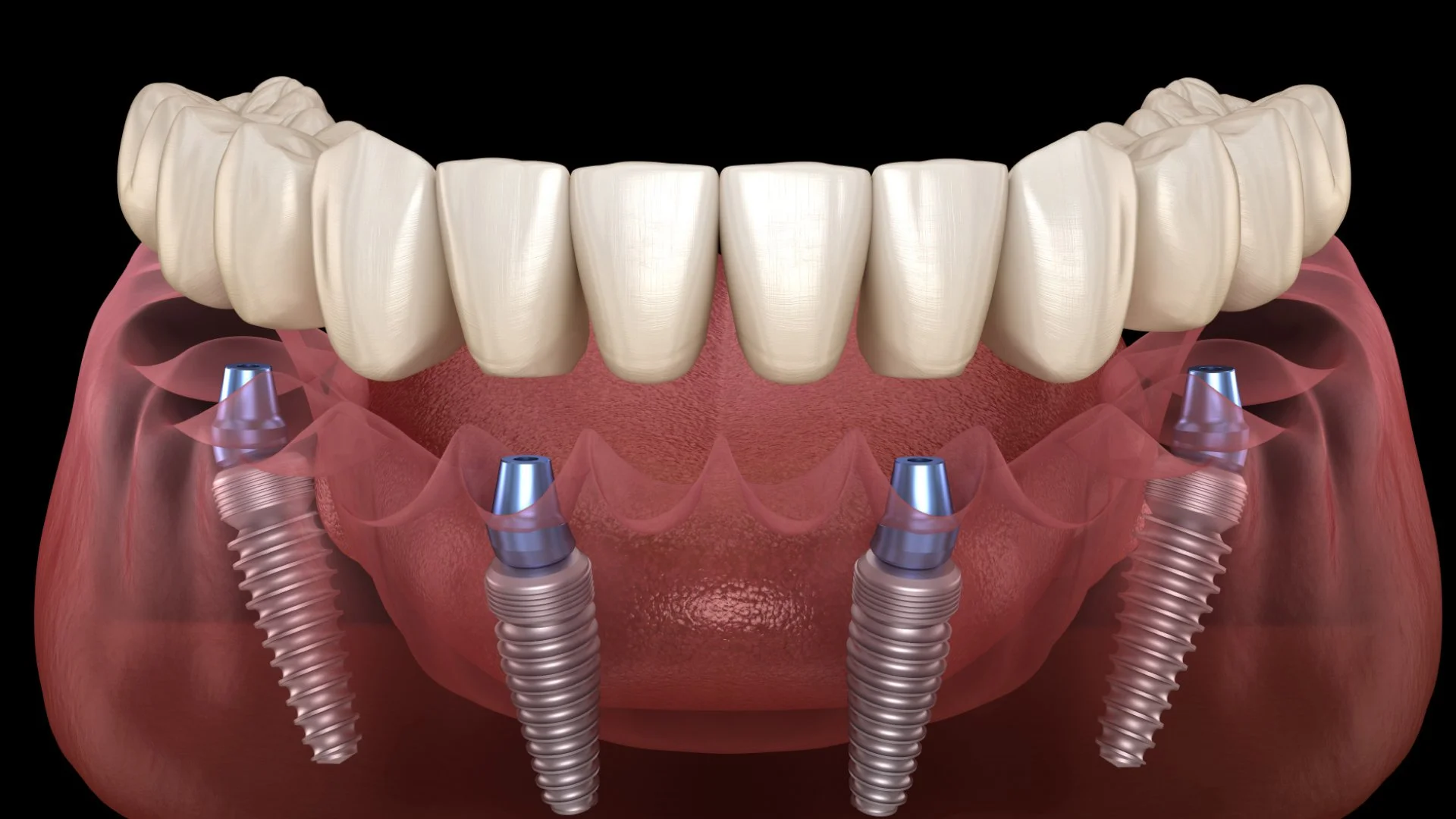
All-on-4 is a full-arch dental implant concept that uses four strategically positioned implants to support a fixed bridge replacing an entire upper or lower arch of teeth.
Typically:
Two implants are positioned towards the front of the jaw.
Two posterior implants are angled to make use of available bone and help support the back of the bridge.
A fixed prosthesis is attached to the implants once the required clinical conditions are met.
The angled placement of the posterior implants can help reduce the need for extensive bone grafting in selected patients. It may also allow the implants to be positioned in areas with more favourable bone availability.
One of the advantages of All-on-4 is that it can provide a fixed full-arch restoration with fewer implants.
However, four implants must be carefully planned to distribute biting forces appropriately. Implant position, stability, bone support and the design of the final bridge all matter.
What Is All-on-6 Dental Implant Treatment?
All-on-6 uses six dental implants to support a full-arch fixed bridge.
Instead of relying on four implants, the additional two implants can provide more points of support along the jaw.
Potential advantages include:
Additional implant support: Six implants may provide more support for the bridge, depending on their position and the quality of the surrounding bone.
Force distribution: Additional implants may help distribute biting forces across the arch.
Treatment flexibility: In some cases, six implants allow the clinician greater flexibility when planning the prosthesis.
Potential redundancy: If one implant develops a problem, the presence of additional implants may offer more options for managing the restoration. However, it does not guarantee that the bridge can remain functional without modification.
All-on-6 is not automatically suitable for every patient. Placing more implants requires adequate bone volume, careful positioning and a restoration designed to work with the available support.
All-on-4 vs All-on-6: Which Is Better?
There is no universal winner. Both approaches can provide successful full-arch rehabilitation when appropriately planned and maintained.
The important question is not simply whether four or six implants are better. It is whether the number, position and distribution of implants are suitable for your individual anatomy and functional requirements.
Consider these differences:
1. Number of implants
All-on-4 uses four implants per arch, while All-on-6 uses six. More implants can provide additional support, but the benefit depends on their distribution and the surrounding bone.
2. Bone availability
Some patients have significant bone loss, particularly towards the back of the upper or lower jaw. All-on-4 may be suitable in selected cases where angled posterior implants can make use of the available bone.
All-on-6 may be an option when there is sufficient bone to accommodate additional implants in appropriate positions.
3. Bite forces and chewing function
A full-arch bridge must withstand considerable forces during chewing. Patients who clench or grind their teeth may place additional stress on the implants and prosthesis.
The clinician must consider bite relationships, opposing teeth or implants, cantilever length and the material and design of the bridge.
Simply increasing the number of implants does not eliminate the risk of excessive loading.
4. Long-term maintenance
Both treatments require ongoing professional reviews and excellent daily oral hygiene.
The area beneath a fixed bridge can collect food and plaque. Special cleaning aids and regular maintenance appointments are important for protecting the implants and surrounding tissues.
Does All-on-6 Have a Lower Risk of Implant Failure?
It is tempting to assume that six implants must be safer than four because there are more implants supporting the bridge.
However, implant success is influenced by several factors, including:
Bone quality and quantity.
Initial implant stability.
Implant positioning and angulation.
Surgical technique.
Medical conditions and medications.
Smoking and oral hygiene.
Bite forces and teeth grinding.
Prosthesis design and loading protocol.
Regular professional maintenance.
An additional implant does not compensate for poor bone quality, inadequate primary stability, infection, excessive bite forces or an unsuitable prosthetic design.
Likewise, a well-planned All-on-4 treatment can provide a stable and functional result in an appropriately selected patient.
The goal is to create a restoration that works harmoniously with the patient's anatomy and distributes functional forces appropriately.
Can You Have All-on-4 or All-on-6 If You Have Bone Loss?
Yes, some patients with significant bone loss may still be candidates for full-arch implant treatment.
However, the available bone must be assessed carefully.
In the upper jaw, bone loss may occur alongside enlargement of the maxillary sinus, which can limit implant placement in the posterior region. In the lower jaw, the position of the inferior alveolar nerve must be considered.
Depending on the individual case, treatment options may include:
Strategically angled implants.
Bone grafting procedures.
Sinus augmentation in selected upper-jaw cases.
Alternative implant positions or designs.
Other specialist surgical approaches where indicated.
A CBCT scan can help assess bone dimensions and important anatomical structures. It is an important planning tool, but it must be interpreted alongside a clinical examination and a complete treatment assessment.
Can You Get Fixed Teeth on the Same Day?
Some patients may be suitable for immediate loading, where a temporary fixed bridge is attached to the implants on the day of surgery or shortly afterwards.
However, immediate loading is not appropriate for every patient.
The decision depends on factors such as:
Primary stability achieved at implant placement.
Bone quality and quantity.
The distribution and angulation of the implants.
Whether adequate stability can be achieved across the arch.
Bite forces and the opposing dentition.
Medical conditions that may affect healing.
The ability to follow a modified diet during healing.
A temporary fixed bridge is not the same as receiving your final teeth. The temporary restoration is generally designed to protect the healing implants while allowing the patient to function during the integration period.
In some cases, delayed loading is the safer approach. This allows the implants time to integrate with the surrounding bone before they are subjected to normal chewing forces.
The decision should be based on clinical findings rather than a promise that everyone can receive fixed teeth on the day of surgery.
What About Patients With Diabetes?
Patients with diabetes can often be considered for dental implant treatment, but their medical history and diabetes control need careful evaluation.
Poorly controlled blood glucose can affect wound healing and may increase the risk of infection and implant complications.
Before proceeding, the dental team should consider:
Current diabetes management and HbA1c.
Medical advice from the patient's treating doctor where appropriate.
Gum and bone health.
Smoking status.
Healing capacity and other medical conditions.
The proposed implant loading protocol.
Having diabetes does not automatically rule out All-on-4 or All-on-6. However, the treatment plan, timing of loading and follow-up care may need to be adjusted.
Why Is the Design of the Final Teeth So Important?
Successful full-arch implant treatment involves much more than placing implants into the jawbone.
The design of the final teeth is equally important.
The bridge must be designed to support comfortable chewing while minimising unnecessary stress on the implants.
Important considerations include:
Correct bite relationships.
Appropriate tooth proportions.
Adequate space for cleaning beneath the bridge.
Appropriate cantilever length.
Suitable restorative materials.
Lip support and facial appearance.
Speech and comfort.
The patient's individual chewing habits.
A poorly designed prosthesis can place excessive stress on implants, even when the implants themselves have integrated successfully.
This is why surgical planning and prosthetic planning should work together from the beginning.
All-on-4 or All-on-6: The Best Treatment Is the One Planned Around You
Replacing an entire arch of missing teeth is a significant decision. It involves restoring not only the appearance of your smile but also your ability to chew, speak and enjoy everyday life.
For some patients, All-on-4 may provide an excellent solution using strategically placed implants. For others, All-on-6 may offer additional support where the available bone and anatomy make it appropriate.
Neither approach should be selected simply because one uses more implants than the other.
At Pain Free Dentist Sydney, we believe that successful dental treatment starts with understanding the person behind the teeth. Your jaw anatomy, bite, medical history, comfort, expectations and long-term oral health all deserve consideration.
Our aim is to help patients understand their options and make informed decisions about restoring their smiles and quality of life.
If you are considering full-arch dental implants, arrange an assessment to discuss whether All-on-4, All-on-6 or another treatment approach may be suitable for you.
Pain Free Dentist Sydney
G1A / Suite 1A, 570 New Canterbury Road, Hurlstone Park NSW 2193
Phone: 02 9558 8988
Website: https://painfreedentistsydney.com.au
Every patient's situation is different. A clinical examination and appropriate imaging are required to determine the most suitable treatment plan.