
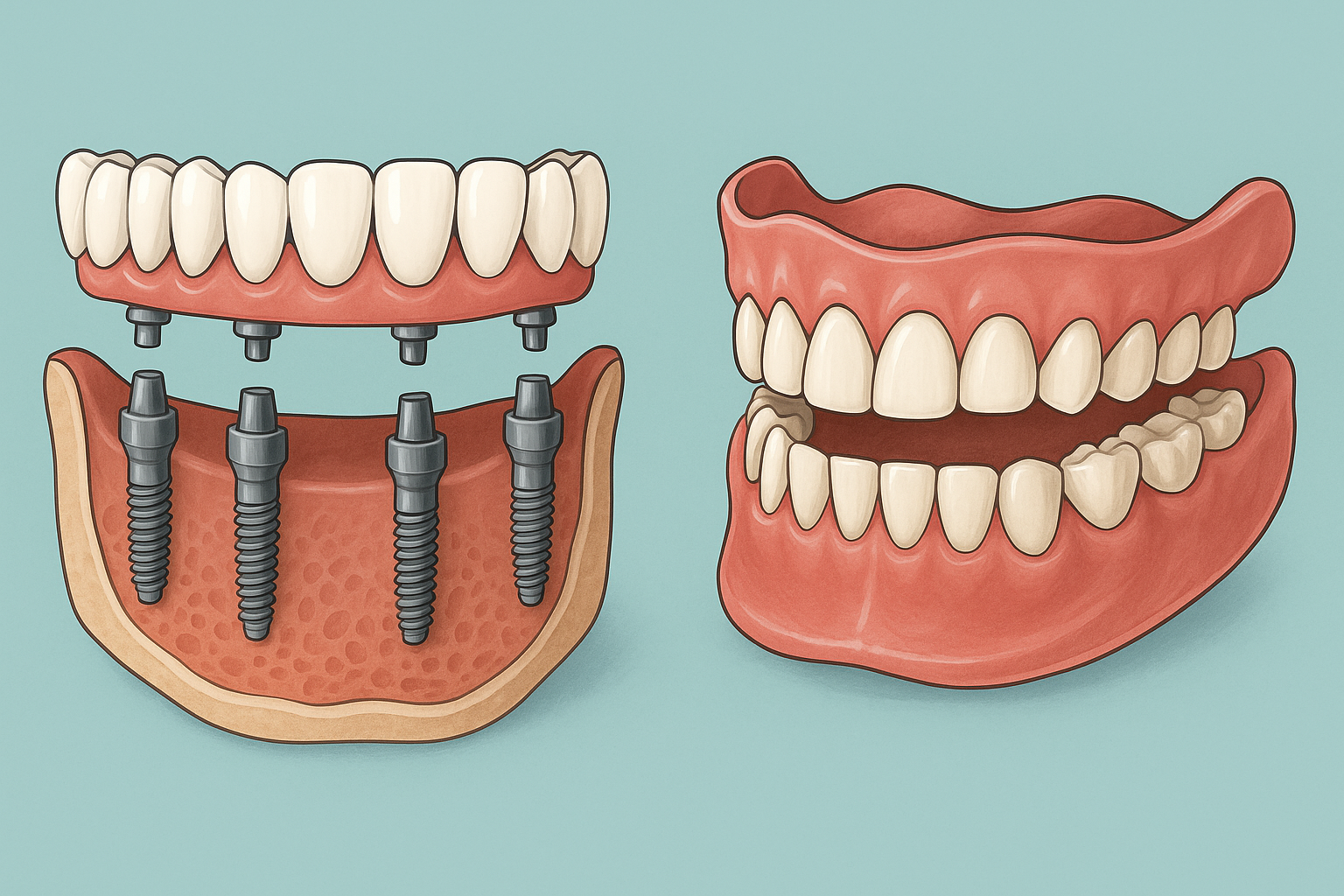
All-on-4 dental implants vs full dentures
Losing all your teeth can significantly affect your ability to eat, speak, smile and feel confident in everyday life.
For patients who have lost all their teeth or are facing full-mouth extractions, two common options are conventional full dentures and full-arch dental implants, such as All-on-4.
Both treatments are designed to replace missing teeth, restore appearance and improve function. However, they work very differently.
Full dentures are removable appliances that rest on the gums, whereas All-on-4 uses dental implants anchored into the jawbone to support a fixed set of replacement teeth.
The best option depends on your oral health, bone condition, medical history, lifestyle, expectations and budget.
At Pain Free Dentist Sydney, we help patients understand their options so they can make an informed decision about restoring their smile.
What are full dentures?
Full dentures are removable prosthetic teeth designed to replace an entire upper or lower arch of missing teeth.
An upper denture generally covers the palate and relies on the shape of the gums, underlying tissues and suction for retention.
A lower denture rests on the lower gum ridge and is often more challenging to stabilise because of the tongue, floor of the mouth and reduced available supporting surface.
Full dentures can be made to restore the appearance of natural teeth and allow patients to eat and speak.
They are a non-surgical option and are generally more affordable initially than full-arch dental implant treatment.
However, some patients experience movement, discomfort, difficulty chewing or reduced confidence, particularly with lower dentures.
What are All-on-4 dental implants?
All-on-4 dental implants are a full-arch tooth replacement concept using four strategically placed implants to support a fixed bridge of replacement teeth.
The implants are placed into the jawbone, where they act as artificial tooth roots.
A fixed prosthesis is attached to the implants, allowing patients to have replacement teeth that are not removed daily like conventional dentures.
In suitable cases, patients may receive temporary fixed teeth on the day of surgery or shortly afterwards. However, immediate loading depends on implant stability, bone quality, medical health and other clinical factors.
All-on-4 is designed to provide a stable, fixed solution for patients who have lost most or all of their teeth.
All-on-4 vs full dentures: What's the difference?
FeatureFull denturesAll-on-4 implantsRemovableYesGenerally fixedSurgical treatmentNoYesSupportGums and underlying tissuesDental implants anchored in boneStabilityMay move, particularly lower denturesGenerally more stable when successfulChewing functionCan be limitedOften improved for suitable patientsAdhesiveMay be requiredNot required for implant-retained fixed prosthesisPalate coverageUpper denture generally covers palateOften no palate coverageBone preservationDoes not prevent ongoing bone remodellingImplants may help preserve bone locallyInitial costGenerally lowerGenerally higherMaintenanceRemove and clean dailyDaily cleaning underneath and around prosthesisTreatment timeUsually shorterSurgery and healing requiredLong-term maintenanceRelining, adjustment and replacementProfessional maintenance and possible prosthesis repairs
1. Comfort: Which feels more comfortable?
Comfort is one of the biggest concerns for patients who wear dentures.
Full dentures
Full dentures rest on the gum tissues. As the jawbone remodels following tooth loss, the shape of the gums and supporting bone may change over time.
This can affect how well the denture fits.
Some patients may experience:
Gum soreness
Pressure points
Denture rubbing
Movement while eating
Difficulty keeping the lower denture stable
A feeling of fullness in the mouth
Gagging from upper denture coverage
Need for denture adhesive
Dentures may need adjustment, relining or replacement as the mouth changes.
All-on-4
All-on-4 is supported by dental implants anchored into the jawbone rather than relying solely on the gums for retention.
For suitable patients, this may provide improved stability and reduce the movement associated with conventional dentures.
Many patients appreciate having fixed teeth that do not need to be removed at night.
However, implant-supported teeth also require adaptation. Patients may experience temporary discomfort following surgery and need to learn how to clean underneath the prosthesis effectively.
Winner for stability: All-on-4 generally offers greater stability than conventional removable dentures when implants are successfully integrated and the prosthesis is functioning appropriately.
2. Chewing ability: Which allows you to eat better?
Eating comfortably is one of the most important reasons patients consider full-arch dental implants.
Full dentures
Conventional dentures can restore chewing function, but their stability may limit the types of foods some patients can comfortably eat.
Patients may find it difficult to eat:
Steak
Tough meat
Crusty bread
Nuts
Raw vegetables
Sticky foods
Lower dentures may move during chewing, particularly in patients with significant bone resorption.
Some patients adapt very well to dentures, while others struggle despite repeated adjustments.
All-on-4
Because the prosthesis is supported by implants, it may provide greater stability during chewing.
Patients may experience improved confidence when eating and may be able to enjoy a wider range of foods after the appropriate healing and rehabilitation period.
However, implant-supported teeth are not identical to natural teeth. Chewing forces, food choices and prosthesis design still need to be considered.
Patients should follow dietary restrictions during the healing period and avoid excessively hard foods that could damage the prosthesis.
Winner for chewing stability: All-on-4 is generally advantageous for appropriately selected patients, particularly those who struggle with unstable dentures.
3. Appearance and confidence
Both full dentures and All-on-4 can be designed to restore a natural-looking smile.
Modern dentures can provide excellent aesthetics, and many patients are very happy with their appearance.
All-on-4 prostheses are also customised to suit the patient's facial appearance, smile, lip support, tooth shape and colour.
Some patients prefer fixed teeth because they feel more confident knowing their teeth will not move during conversations, laughing or eating.
However, the aesthetics of either treatment depend heavily on planning, design, materials and the individual patient's anatomy.
The goal should not simply be to create white teeth. It should be to restore a natural-looking smile that suits the patient's face.
4. Bone loss: Do dentures cause the jawbone to shrink?
After teeth are lost, the jawbone that previously supported the tooth roots undergoes natural remodelling and resorption.
This process occurs because the bone is no longer receiving the same stimulation from natural tooth roots.
Full dentures
Conventional dentures sit on the gum tissues and do not replace the stimulation provided by tooth roots.
Over time, the jawbone may continue to remodel and resorb, which can change the shape of the supporting ridge.
As bone and gum contours change, dentures may become loose and require relining, adjustment or replacement.
All-on-4
Dental implants are anchored within the jawbone and transmit forces to the surrounding bone.
Implants may help preserve bone locally around the implant compared with areas without implants, although they do not prevent all bone loss throughout the jaw.
Bone changes can still occur around implants, and long-term implant health requires regular monitoring.
Important: Dental implants do not stop all jawbone resorption. Their effects on bone are localised, and maintaining healthy implant-supporting tissues remains essential.
5. Cost: Are All-on-4 implants more expensive than dentures?
Generally, conventional full dentures have a lower initial cost than All-on-4 dental implants.
Full dentures do not require implant surgery, implant components or the same level of surgical and prosthetic treatment.
All-on-4 involves a more complex treatment process, which may include:
Comprehensive consultation
CBCT imaging
Treatment planning
Extractions
Implant surgery
Temporary fixed prosthesis
Final full-arch prosthesis
Follow-up appointments
Ongoing implant maintenance
The initial investment is therefore generally significantly higher.
However, patients should consider the long-term costs of both treatments.
Dentures may require adjustments, relining, repairs and replacement as the jaw changes over time.
All-on-4 may also require maintenance, repairs, replacement of prosthetic teeth or components, and professional cleaning.
The best way to compare cost is to consider the treatment plan, expected longevity, maintenance requirements and your personal priorities rather than simply looking at the initial fee.
6. Does All-on-4 require surgery?
Yes.
All-on-4 involves surgical placement of dental implants into the jawbone.
Patients need an assessment to determine whether they are suitable for surgery.
Medical history, bone quality, gum health, smoking, diabetes, medications and other factors may affect treatment planning and healing.
Full dentures, on the other hand, can generally be provided without implant surgery.
For patients who are medically unsuitable for surgery or who prefer a non-surgical approach, full dentures may be a practical option.
7. Which treatment is easier to maintain?
Both treatments require daily cleaning and regular professional reviews.
Full dentures
Full dentures are removed for cleaning.
Patients generally need to:
Remove dentures daily
Clean the dentures thoroughly
Clean the gums, tongue and remaining tissues
Store dentures appropriately when not worn
Attend regular reviews
Have adjustments or relining when required
All-on-4
Fixed implant bridges cannot usually be removed by the patient.
Cleaning requires attention underneath the bridge and around the implants.
Patients may need specialised brushes, flossing aids, water flossers or other cleaning tools depending on the prosthesis design.
Regular professional implant maintenance is essential to monitor the gums, bone, implant components and prosthesis.
Neither option is maintenance-free.
8. Which option is better for older patients?
Age alone does not determine whether a patient is suitable for All-on-4.
Some older patients are excellent candidates for dental implants, while some younger patients may have medical or anatomical factors that make implant surgery more complex.
The decision should consider:
Overall medical health
Ability to undergo surgery
Bone availability
Medication history
Healing capacity
Oral hygiene
Dexterity and ability to maintain the prosthesis
Patient preference
Financial considerations
For some older patients, conventional dentures may be the most practical option.
For others, implant-supported teeth may significantly improve comfort, stability and chewing function.
A personalised assessment is important.
9. Can you convert existing dentures to All-on-4?
In some cases, patients who currently wear full dentures may be suitable for conversion to implant-supported fixed teeth.
However, the existing denture is not automatically suitable for conversion into a permanent All-on-4 prosthesis.
The jawbone, implant positions, bite, available space and prosthetic design must be assessed.
A CBCT scan may be required to evaluate bone availability and plan implant placement.
Some patients may require additional procedures or alternative implant designs depending on their anatomy.
10. Who should choose full dentures?
Full dentures may be a suitable option for patients who:
Prefer a non-surgical treatment
Have medical conditions that complicate implant surgery
Have insufficient bone for implants and do not wish to undergo additional procedures
Want a lower initial treatment cost
Prefer a removable appliance
Are not ready for implant treatment
Need a temporary tooth replacement solution
Modern dentures can provide excellent aesthetics and function when appropriately designed and fitted.
11. Who should consider All-on-4?
All-on-4 may be worth considering for patients who:
Have lost all teeth or are facing full-arch tooth loss
Struggle with loose or unstable dentures
Want fixed replacement teeth
Have difficulty chewing with conventional dentures
Want to reduce reliance on denture adhesive
Have suitable bone anatomy or may be suitable for an alternative surgical plan
Are medically suitable for implant surgery
Are willing to commit to long-term maintenance
A comprehensive consultation is required to determine whether All-on-4 is suitable.
All-on-4 vs dentures: Which is better for you?
There is no single solution that is best for every patient.
Conventional dentures offer an affordable, non-surgical way to replace missing teeth and can work very well for many people.
All-on-4 offers a fixed implant-supported alternative that may provide improved stability, chewing function and confidence for suitable patients.
The choice should consider your clinical situation, expectations, medical health, lifestyle, financial circumstances and long-term maintenance.
If you have been wearing dentures for years and are struggling with movement, discomfort or difficulty eating, it may be worth exploring whether implant-supported teeth are an option for you.
Full-Arch Dental Implants in Sydney | Pain Free Dentist Sydney
At Pain Free Dentist Sydney, we understand that tooth loss can affect your confidence, nutrition, speech and quality of life.
We offer comprehensive consultations to assess your oral health, bone availability, bite and expectations before discussing full-arch tooth replacement options.
Whether you are considering conventional dentures, All-on-4 or All-on-6 dental implants, our goal is to help you understand your options and make an informed decision.
If you are struggling with dentures or considering replacing all your teeth, contact us to arrange an implant consultation.
📍 570 New Canterbury Road, Hurlstone Park NSW 2193
📞 02 9558 8988
🌐 https://painfreedentistsydney.com.au
Frequently Asked Questions
Are All-on-4 better than full dentures?
All-on-4 may offer improved stability, chewing function and confidence for suitable patients. Full dentures are less invasive, more affordable initially and may be more appropriate for some patients. The best option depends on individual circumstances.
Can I sleep with All-on-4 teeth?
The fixed prosthesis is generally designed to remain in the mouth. Unlike conventional dentures, patients do not normally remove the fixed bridge every night. However, it still requires daily cleaning and maintenance.
Do full dentures cause bone loss?
Jawbone resorption naturally occurs following tooth loss. Conventional dentures do not replace the stimulation provided by tooth roots, so bone changes may continue and affect denture fit.
Do All-on-4 implants prevent bone loss?
Dental implants may help preserve bone locally around the implants by transmitting forces into the jawbone. However, they do not prevent all bone loss, and ongoing monitoring is necessary.
Can I eat normally with All-on-4?
Many patients experience improved chewing function after treatment. However, patients need to follow a modified diet during healing, and excessively hard foods may need to be avoided to protect the prosthesis.
Are All-on-4 more expensive than dentures?
Generally, yes. Implant treatment involves surgery, implant components, prosthetic treatment and maintenance. Conventional dentures usually have a lower initial cost.
Can I get All-on-4 if I have been wearing dentures for many years?
Possibly. Many denture wearers may be candidates for implant-supported teeth. Bone availability and anatomy need to be assessed, often using CBCT imaging.
What is the difference between All-on-4 and implant-supported dentures?
All-on-4 is commonly used to describe a fixed full-arch prosthesis supported by four implants. Implant-supported dentures may also refer to removable overdentures attached to implants using specialised retention systems. The design and treatment are different.
Where can I get All-on-4 dental implants in Sydney?
Pain Free Dentist Sydney in Hurlstone Park provides consultations for full-arch dental implants and tooth replacement options. Contact us to discuss whether implant-supported teeth may be suitable for you.