Losing all your teeth can affect far more than your ability to smile. It can change the way you eat, speak, socialise and feel about yourself. Many people who wear full dentures experience difficulties with chewing, denture movement, discomfort, food restrictions and a loss of confidence in everyday situations.
For patients who have lost most or all of their teeth, All-on-4 dental implants and conventional full dentures are two options for restoring an entire arch of teeth. Although both can improve appearance and function, they offer very different experiences in terms of stability, comfort, convenience and long-term quality of life.
At Pain Free Dentist Sydney, we believe tooth replacement is about more than simply filling the spaces left by missing teeth. It is about helping patients regain confidence, function and the ability to enjoy life again.
What Are Full Dentures?
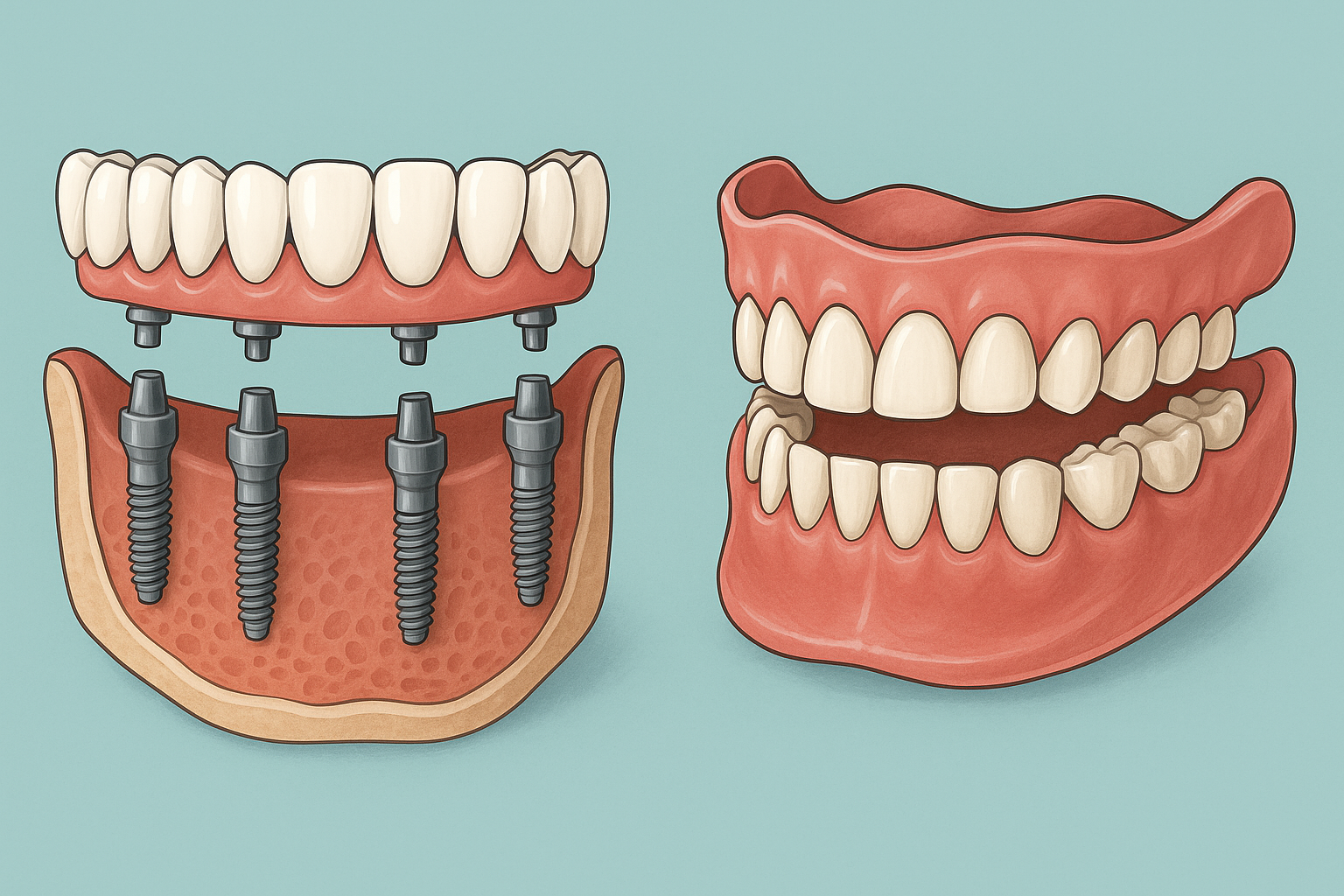
Full dentures are removable prosthetic teeth designed to replace all the teeth in the upper or lower jaw. They generally rest on the gums and rely on the shape of the underlying jaw ridge, saliva, suction and sometimes denture adhesive to maintain stability.
For many patients, conventional dentures provide a practical solution to tooth loss. They can restore facial appearance, improve speech and provide some chewing ability.
However, dentures are not attached directly to the jawbone. As the jawbone gradually changes shape following tooth loss, dentures may become loose or require adjustments, relining or replacement.
Some patients adapt very well to their dentures, while others experience difficulties such as:
Dentures moving or slipping during eating and speaking
Difficulty chewing harder or tougher foods
Gum soreness, pressure points and irritation
Reduced confidence when laughing or speaking
Food becoming trapped underneath dentures
Dependence on denture adhesives
Difficulty eating socially or in restaurants
Reduced taste sensation, particularly with upper dentures covering the palate
The inconvenience of removing and cleaning dentures every day
For some people, these issues can significantly affect their lifestyle. They may begin avoiding certain foods, eating more slowly, declining invitations to meals or becoming self-conscious about their dentures.
What Are All-on-4 Dental Implants?
All-on-4 dental implants are a treatment concept designed to support a full arch of replacement teeth using four strategically positioned dental implants, where suitable.
Rather than relying on the gums for support, dental implants are surgically placed into the jawbone. The implants act as anchors for a fixed prosthetic bridge, which may be designed to replace an entire upper or lower arch of teeth.
In suitable cases, a temporary fixed bridge may be attached on the day of surgery or shortly afterwards. However, immediate loading is not appropriate for every patient. Bone quality, implant stability, medical health, bite forces and the individual treatment plan all influence when the teeth can be attached.
Once healing and integration of the implants have occurred, the patient may receive their definitive prosthesis according to the treatment plan.
Unlike conventional full dentures, an implant-supported full arch is designed to remain fixed in the mouth and is not removed by the patient for daily cleaning.
All-on-4 vs Full Dentures: The Difference in Everyday Life
1. Eating and chewing
One of the biggest differences patients notice is the ability to eat.
Conventional dentures rely on the gums and underlying tissues for support. During chewing, the forces generated can cause dentures to move, particularly when eating foods that are hard, sticky or require significant chewing effort.
Patients wearing dentures may find themselves modifying their diet. Foods such as steak, crusty bread, apples, nuts and raw vegetables may become difficult to manage.
With implant-supported teeth, chewing forces are transferred through the implants into the jawbone. This provides greater stability compared with conventional tissue-supported dentures, although the actual chewing efficiency varies between individuals and is not identical to natural teeth.
Many patients value the possibility of enjoying a wider variety of foods without constantly worrying about their dentures moving.
Eating comfortably can have a significant impact on nutrition, enjoyment of meals and overall wellbeing.
2. Stability and confidence
A loose denture can create anxiety, especially when speaking, laughing, coughing or eating in public.
Patients may constantly worry whether their dentures are going to move or become dislodged. Some people avoid speaking freely, laughing openly or eating in front of others because they are concerned about their dentures.
All-on-4 dental implants provide a fixed foundation for the replacement teeth. Because the prosthesis is supported by implants rather than resting entirely on the gums, it can offer significantly improved stability.
For many patients, this change can be life-changing. They may feel more comfortable participating in social activities, enjoying meals with family and friends and speaking without constantly thinking about their teeth.
The psychological benefits of having stable teeth can be just as important as the physical benefits.
3. Comfort and gum irritation
Full dentures can place pressure on the gum tissues, particularly when the dentures are poorly fitting or when the underlying jawbone has changed over time.
This may lead to sore spots, ulceration, inflammation and discomfort during eating.
Implant-supported teeth reduce reliance on the gum tissues for support. Although implant treatment involves surgery and a healing period, many patients appreciate not having a removable denture constantly rubbing against their gums during everyday activities.
However, implant treatment does not eliminate the need for careful hygiene, regular dental maintenance or monitoring of the surrounding tissues.
4. Bone preservation and facial appearance
Following tooth loss, the jawbone gradually undergoes resorption because it no longer receives the same stimulation from tooth roots.
Over time, significant bone loss can alter facial appearance, including reduced lower facial height, changes around the lips and cheeks, and a more collapsed facial profile.
Conventional dentures do not prevent this ongoing process of bone resorption.
Dental implants can help preserve bone locally around the implant through functional stimulation. However, implants do not prevent all bone loss throughout the jaw, particularly in areas where implants have not been placed.
The choice of treatment, the amount of existing bone, implant positioning and prosthetic design all influence the long-term outcome.
5. Taste, speech and daily convenience
Upper full dentures often cover a substantial portion of the palate. Some patients find this affects taste perception, temperature sensation and their comfort when speaking.
Removable dentures also require daily removal, cleaning and storage. Some patients find this routine inconvenient, particularly when travelling or staying away from home.
Fixed implant-supported teeth do not require removal by the patient every night. They can provide a more natural-feeling experience for many people, although cleaning underneath the bridge is essential.
Patients need to learn how to properly clean around and beneath their implant-supported teeth using appropriate interdental brushes, water flossers or other recommended cleaning aids.
Is All-on-4 Better Than Full Dentures?
There is no single treatment that is best for everyone.
Conventional dentures may be appropriate for patients who prefer a non-surgical option, have medical considerations that make implant surgery unsuitable, have limited bone availability, or simply prefer removable teeth.
All-on-4 dental implants may be worth considering for patients who:
Have lost all or most of their teeth
Experience loose or uncomfortable dentures
Have difficulty eating with conventional dentures
Want a fixed alternative to removable teeth
Feel self-conscious about denture movement
Want to improve their ability to eat and socialise comfortably
Are medically suitable for dental implant surgery
Have sufficient bone or may be suitable for additional procedures to support implant placement
The decision should be made following a comprehensive dental examination, assessment of the jawbone, appropriate imaging and evaluation of the patient's general health, bite, oral hygiene and expectations.
Factors such as diabetes, smoking, gum disease, bone quality, grinding or clenching and certain medications may influence implant treatment planning and healing.
The Importance of Quality of Life
Replacing missing teeth is not simply a cosmetic decision.
For many patients, the real goal is to regain the freedom to eat comfortably, speak naturally, smile without embarrassment and participate in everyday life without constantly thinking about their teeth.
Imagine being able to enjoy dinner with family without worrying that your denture might move. Imagine laughing freely, ordering the foods you enjoy or travelling without the daily inconvenience of removable dentures.
These improvements may seem small to someone who has never experienced tooth loss, but they can make a profound difference to a person's confidence, independence and emotional wellbeing.
The best tooth replacement option is one that considers not only the appearance of the teeth, but also how those teeth function within the patient's lifestyle, health and long-term needs.
All-on-4 Dental Implants in Sydney
At Pain Free Dentist Sydney, we understand that losing your teeth can be emotionally and physically challenging. Our approach is centred on understanding each patient's concerns, dental history, medical health, bone condition and individual goals before recommending treatment.
Whether you are currently wearing full dentures, struggling with loose teeth or considering full-mouth dental implant rehabilitation, we can help you explore the available options.
A comprehensive assessment can help determine whether conventional dentures, implant-supported dentures, All-on-4 dental implants or another treatment approach may be suitable for you.
Your teeth should not limit your life.
If you are considering All-on-4 dental implants in Sydney and would like to understand how fixed teeth may improve your chewing ability, comfort and quality of life, contact Pain Free Dentist Sydney to arrange a consultation.
We believe that restoring your smile should also help restore your confidence, your comfort and your enjoyment of life.