Pain Free Dentist Sydney | Dulwich Hill
Do you wake up with a tight, aching jaw? Suffer from frequent headaches around your temples? Notice that your teeth are becoming flatter or shorter because of constant grinding?
Perhaps you have tried wearing a night splint, taking pain relief or visiting a physiotherapist, but your jaw muscles still feel tight and overworked.
For some patients, the problem is not simply their teeth. It may involve excessive activity of the muscles responsible for chewing.
One treatment that has attracted considerable interest is Botox for TMJ-related muscle pain and teeth grinding.
Botox is commonly associated with cosmetic treatments, but it also has medical applications. When used appropriately, botulinum toxin injections can temporarily reduce excessive muscle activity and may help selected patients experiencing persistent jaw muscle pain.
But is it suitable for everyone with TMJ disorder? And can it actually stop teeth grinding?
Let's take a closer look.
What Is Botox for TMJ?
Botox is a brand name for botulinum toxin type A, a medication that temporarily reduces communication between nerves and targeted muscles.
For patients with certain types of temporomandibular disorders (TMD), injections may be considered in selected chewing muscles, particularly:
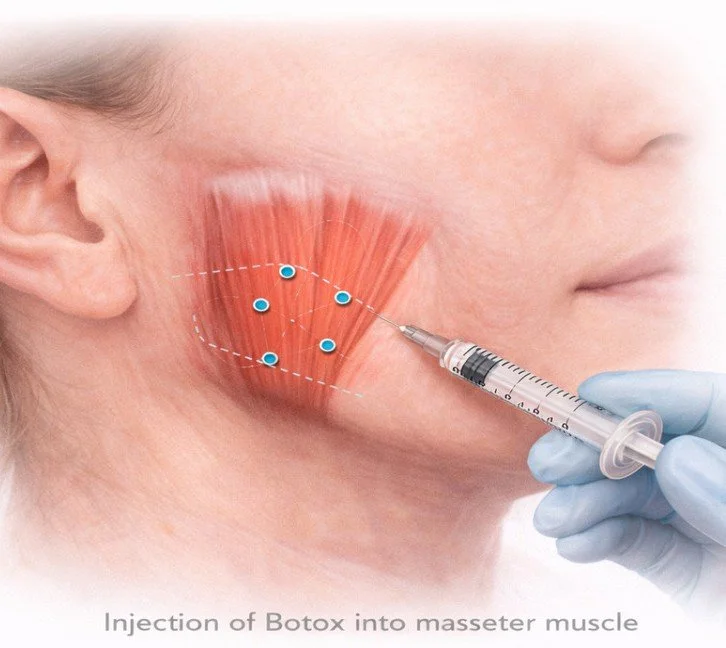
Masseter muscles: Located at the sides of your jaw, these are among the main muscles responsible for closing your mouth and chewing.
Temporalis muscles: Located around your temples, these muscles also help control jaw movement.
When these muscles are excessively active, some patients experience muscle fatigue, tenderness, jaw tightness and pain.
Botulinum toxin temporarily reduces muscle contraction by interfering with the release of acetylcholine, a chemical messenger involved in muscle activation.
The aim is to reduce excessive muscle activity and potentially improve symptoms in carefully selected patients.
Can Botox Help With Teeth Grinding?
Teeth grinding, also known as bruxism, can occur during sleep or while you are awake.
Some people clench their teeth when concentrating, driving or feeling stressed. Others grind their teeth during sleep without even realising it.
Over time, repeated grinding may contribute to:
Flattened and worn-down teeth.
Chipped or fractured teeth.
Jaw muscle fatigue.
Facial tenderness.
Morning headaches.
Jaw discomfort.
Damage to existing dental restorations.
Botulinum toxin may reduce the intensity of contractions in targeted chewing muscles.
However, it is important to understand that it does not necessarily eliminate the underlying causes of bruxism or stop the grinding behaviour itself.
It may reduce the force generated by the muscles, rather than remove the neurological activity responsible for grinding.
For this reason, Botox should be considered as one possible component of a broader management plan, rather than a standalone cure.
5 Symptoms That May Make You Consider Botox for TMJ
1. Persistent Jaw Muscle Pain
Do your jaw muscles feel tired, tight or painful even when you are not eating?
Excessive muscle activity may contribute to persistent discomfort, particularly around the masseter muscles.
2. Enlarged or Overactive Jaw Muscles
Some patients develop prominent masseter muscles due to prolonged clenching or grinding.
Botulinum toxin may reduce muscle activity and, over time, may also reduce muscle bulk.
3. Frequent Tension-Type Headaches
The temporalis muscles are involved in jaw movement and may become tender or overworked.
In selected patients, reducing excessive muscle activity may help with associated muscular discomfort. However, headaches have many possible causes and need appropriate assessment.
4. Severe Teeth Grinding
Patients who repeatedly grind or clench their teeth may experience significant muscle fatigue and progressive dental wear.
Botox may help reduce the strength of muscle contractions, although protective dental treatment and management of contributing factors remain important.
5. Persistent Muscle-Related TMJ Symptoms
Some patients continue to experience muscular pain despite trying conservative treatments.
In selected cases, botulinum toxin may be considered after a thorough assessment of the jaw joints, muscles and other contributing factors.
Does Botox Fix the Actual TMJ Joint Problem?
This is an important distinction.
TMJ disorder is not one single condition. It includes different problems affecting the jaw joints, joint discs and surrounding muscles.
Botox primarily acts on muscles. It does not reposition a displaced joint disc, repair damaged cartilage or reverse arthritic changes in the jaw joint.
For example:
If your main problem is muscular overactivity, Botox may be worth discussing.
If your jaw clicks because of disc displacement, Botox may not address the underlying mechanical problem.
If your jaw locks or has restricted movement, further investigation may be required.
If you have significant joint degeneration, treatment needs to address the joint condition rather than simply relaxing the muscles.
This is why identifying the source of your symptoms is so important before considering injections.
What Happens During Botox Treatment?
Treatment begins with a clinical assessment.
Your dentist needs to understand your symptoms, medical history, grinding habits and previous treatments.
The jaw muscles are examined to identify areas of tenderness, excessive activity and possible muscle enlargement.
If Botox is considered appropriate, the treatment plan will identify the muscles to be targeted and an individualised injection approach.
The injections are generally performed using a fine needle into selected muscles.
The procedure is usually relatively quick, although individual experiences vary.
Botulinum toxin does not work immediately. Its effects generally begin over several days, with the full effect developing over approximately one to two weeks.
The effects are temporary, and repeat treatment should only be considered following reassessment.
How Long Does Botox for TMJ Last?
The effects of botulinum toxin are temporary.
Many patients experience effects for approximately three to four months, although this varies depending on the individual, injection site, dose and muscle response.
As the medication wears off, normal muscle activity gradually returns.
It is important not to assume that repeated injections are always necessary. The long-term treatment plan should be reviewed according to symptoms, clinical findings and potential risks.
Are There Any Risks or Side Effects?
Yes. Although Botox is commonly used in medical practice, it is not risk-free.
Possible side effects include:
Temporary tenderness or bruising around injection sites.
Localised muscle weakness.
Changes in chewing strength.
Facial asymmetry.
Smile changes if nearby muscles are affected.
Unwanted changes in muscle function.
Repeated injections into the masseter muscles may also affect the jawbone in some patients. Research has raised concerns about possible changes in mandibular bone structure, although the clinical significance and long-term effects are still being investigated.
This is particularly important when considering repeated or high-dose treatment.
Botulinum toxin is not suitable for everyone. A proper medical assessment is necessary, including consideration of neuromuscular conditions, medications and other relevant health factors.
Botox Should Not Be the First Answer to Every TMJ Problem
At Pain Free Dentist Sydney, we believe it is important to understand why your jaw muscles are overworking before deciding whether Botox is appropriate.
For many patients, conservative management should be considered first.
This may include:
TMJ Splint Therapy
A professionally assessed occlusal splint may help protect worn teeth and manage certain forms of TMD.
Physiotherapy and Myofascial Treatment
Targeted treatment may help address muscular tenderness, jaw movement restrictions and associated neck discomfort.
Bruxism Management
Identifying daytime clenching habits, improving awareness and addressing relevant sleep factors can be important.
Dental Assessment
Severe tooth wear may require further restorative assessment to determine whether lost tooth structure needs to be rebuilt.
Botox for Selected Patients
Where excessive muscle activity remains a significant contributing factor, botulinum toxin may be discussed as an additional treatment option.
The goal is not simply to weaken the jaw muscles. It is to achieve a better balance between muscle function, joint health and dental stability.
Can Botox Be Combined With a TMJ Splint?
In selected patients, Botox and splint therapy may be considered together.
They serve different purposes.
A splint may help protect the teeth and manage certain aspects of jaw loading, while Botox temporarily reduces the strength of contraction in targeted muscles.
However, the combination is not automatically necessary or appropriate.
Treatment needs to be planned according to the patient's symptoms, bite, muscle activity and response to previous therapy.
Is Botox for TMJ Right for You?
If you have persistent jaw pain, severe clenching, headaches or significant masseter muscle tension, it may be worth having your condition assessed.
At Pain Free Dentist Sydney, Dulwich Hill, Dr Lisa Chong has a particular interest in TMJ disorders, bruxism, occlusion and the relationship between jaw muscles and dental function.
Dr Chong has undertaken further training in orofacial pain and occlusion, including training with Dr Jeffrey Okeson through CFFOO.
We believe that successful TMJ management starts with understanding the underlying problem.
Some patients may benefit from splint therapy, others from physiotherapy or myofascial treatment, while selected patients may be suitable for Botox as part of a broader treatment approach.
If your jaw is constantly tight, your teeth are wearing down or you wake up with headaches, don't simply assume that you have to live with it. Find out what may be contributing to your symptoms.
Book a TMJ Consultation at Pain Free Dentist Sydney
Contact our team to discuss your jaw symptoms and arrange an assessment.
Pain Free Dentist Sydney – Dulwich Hill
Address: G1A, 570 New Canterbury Road, Hurlstone Park NSW 2193
Phone: 02 9558 8988
Email: info@painfreedentistsydney.com.au
Website: https://painfreedentistsydney.com.au