Losing a tooth can affect much more than the appearance of your smile. Whether you have lost one tooth, several teeth or an entire arch, missing teeth can affect the way you chew, speak, smile and interact with others.
Some people adapt by avoiding certain foods. Others become self-conscious about smiling or speaking. Over time, missing teeth can also contribute to changes in the surrounding teeth, bite relationships and jawbone.
Fortunately, modern dentistry offers several ways to replace missing teeth. One of the most effective and widely used options is dental implant treatment.
Dental implants are designed to replace missing tooth roots and provide a stable foundation for replacement teeth. They can help restore chewing function, improve appearance and provide an alternative to conventional removable dentures.
At Pain Free Dentist Sydney, we believe replacing missing teeth is not simply about restoring a smile. It is about helping patients regain comfort, confidence and the ability to enjoy everyday life.
What Are Dental Implants?
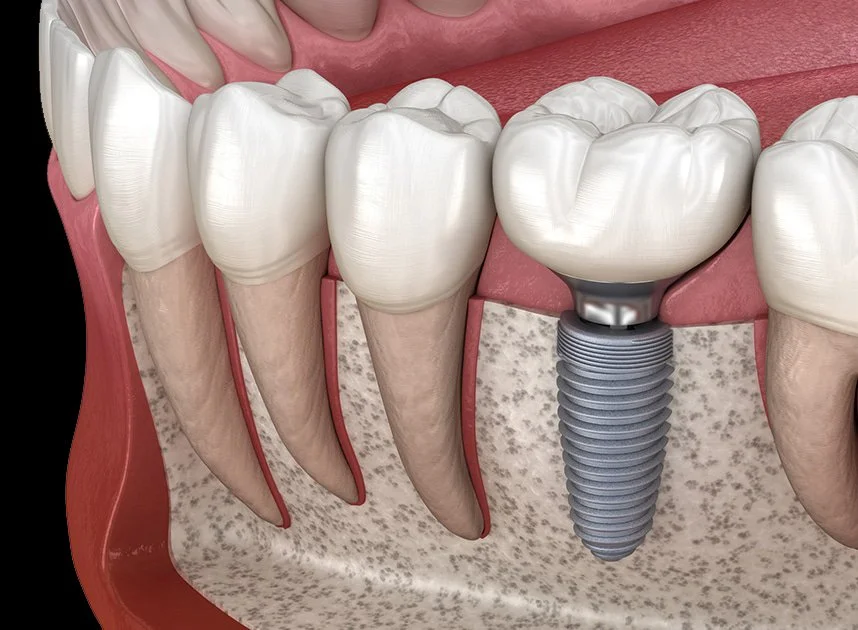
Dental implants are small medical-grade fixtures, commonly made from titanium, that are surgically placed into the jawbone to replace missing tooth roots.
Following placement, the implant undergoes a biological process called osseointegration, during which bone forms a close connection with the implant surface.
Once adequately integrated and suitable for restoration, the implant can support a replacement tooth or dental prosthesis.
A typical dental implant restoration consists of three components:
1. The implant fixture
This is the component placed into the jawbone. It acts as an artificial tooth root.
2. The abutment
This connects the implant fixture to the replacement tooth.
3. The dental crown
This is the visible replacement tooth, designed to restore appearance, shape and chewing function.
The final result is intended to look and function as naturally as possible, although an implant-supported tooth is not identical to a natural tooth.
Why Are Dental Implants Important?
When a tooth is lost, the consequences can extend beyond the empty space.
Natural teeth help maintain chewing function, support the dental arch and contribute to the overall balance of your bite.
When a tooth is missing, several changes may occur:
Adjacent teeth may gradually tilt or move into the empty space.
The opposing tooth may over-erupt.
Chewing efficiency may decrease.
Bite relationships may change.
The jawbone in the area of the missing tooth may gradually resorb.
Other teeth may experience altered loading.
Not everyone experiences all these changes, but replacing missing teeth may help maintain dental function and stability.
Dental implants can also help preserve bone locally around the implant through functional loading, although they do not prevent bone loss throughout the entire jaw.
Types of Dental Implant Treatment
Dental implant treatment can be customised according to how many teeth are missing, the condition of the jawbone and the patient's individual needs.
1. Single Tooth Dental Implants
If you have lost one tooth, a single dental implant may be an appropriate replacement option.
Unlike a conventional dental bridge, which generally requires support from neighbouring teeth, a single implant can support its own crown.
This means adjacent healthy teeth may not need to be prepared or reduced to support the replacement tooth.
Single implants can be used to replace missing front teeth and back teeth, depending on the available bone, bite forces and clinical circumstances.
2. Multiple Dental Implants
Patients missing several teeth may benefit from multiple implants supporting individual crowns or an implant-supported bridge.
The number and position of implants depend on the spaces involved, bone availability, bite and overall restorative plan.
The objective is to restore a functional and balanced chewing system while maintaining the health of the remaining teeth and supporting tissues.
3. All-on-4 Dental Implants
For patients who have lost all or most of their teeth in an arch, All-on-4 may be an option.
This treatment concept uses four strategically positioned implants to support a fixed full-arch prosthesis, where clinically appropriate.
The posterior implants are often angled to make use of available bone and may help avoid certain anatomical structures.
In suitable cases, patients may receive a temporary fixed prosthesis on the day of surgery or shortly afterwards.
However, immediate loading is not suitable for every patient. Implant stability, bone quality, medical history, bite forces and other clinical factors must be carefully assessed.
All-on-4 can offer an alternative to conventional removable full dentures for appropriately selected patients.
4. Implant-Supported Dentures
Some patients prefer a removable denture but want improved stability.
Implant-supported overdentures use dental implants to help retain the denture, reducing movement compared with conventional dentures.
Depending on the design, the patient may still remove the denture for cleaning.
This can be a useful option for people who struggle with loose lower dentures or want an alternative to a fully fixed prosthesis.
What Are the Benefits of Dental Implants?
1. Improved Chewing Function
One of the most important benefits of replacing missing teeth is restoring the ability to chew comfortably.
Missing teeth can make it difficult to manage certain foods, particularly those requiring greater chewing effort.
Dental implants provide support for replacement teeth, helping patients regain more stable chewing function.
For many patients, being able to enjoy a wider variety of foods can make a meaningful difference to their daily lives.
2. Improved Confidence and Appearance
Missing teeth can affect the way people feel about their appearance.
Some patients avoid smiling, cover their mouths when laughing or feel embarrassed when speaking.
Dental implant restorations are designed to complement the surrounding teeth and facial appearance.
For patients who have lost several teeth, restoring their smile can help improve confidence in social and professional situations.
3. Support for Jawbone Health
After tooth loss, the jawbone in the area of the missing tooth may gradually resorb because it no longer receives stimulation through a natural tooth root.
Dental implants can provide functional stimulation to the surrounding bone.
This may help preserve the bone around the implant, although it cannot prevent all bone resorption.
4. No Need to Rely on Adjacent Teeth for Support
With a conventional dental bridge, neighbouring teeth are generally used to support the replacement tooth.
A single dental implant is independently supported by the jawbone.
This may allow healthy adjacent teeth to remain untouched.
5. Improved Stability Compared With Conventional Dentures
Conventional dentures rest on the gums and may move during speaking and eating.
Implant-supported restorations have a more stable foundation.
For patients who have struggled with loose dentures, this can be a significant improvement in everyday comfort and confidence.
6. A Long-Term Tooth Replacement Option
Dental implants can provide a durable solution when appropriately planned, placed and maintained.
However, implants are not maintenance-free.
The implant-supported crown, bridge or prosthesis may require repair or replacement over time. Regular dental examinations, professional maintenance and good oral hygiene are essential.
Am I Suitable for Dental Implants?
Many adults can be suitable candidates for dental implants, but each patient requires an individual assessment.
Important factors include:
The amount and quality of available jawbone
Gum health and periodontal history
General medical health
Smoking status
Diabetes control
History of teeth grinding or clenching
Bite relationships
Oral hygiene
Medication history
Healing capacity
Patients with diabetes may still be suitable for dental implant treatment. However, blood glucose control, overall medical health and healing risks need to be considered.
Patients who grind their teeth may also require additional planning to manage excessive loading on their implant restorations.
Having insufficient bone does not automatically mean implants are impossible. In selected cases, bone grafting or other surgical approaches may be considered.
What Happens During Dental Implant Treatment?
Dental implant treatment generally involves several stages.
Stage 1: Comprehensive Consultation
The first step is understanding your dental history, medical health and treatment goals.
The dentist examines your teeth, gums, bite and available bone.
Appropriate imaging, including CBCT where indicated, may be used to evaluate bone dimensions and important anatomical structures.
Stage 2: Treatment Planning
Once the assessment is complete, an individualised treatment plan is developed.
This includes determining the implant position, size, number of implants and the type of restoration required.
The final tooth design should be considered during planning rather than treating implant placement as an isolated surgical procedure.
Stage 3: Implant Placement
The implant is surgically placed into the jawbone.
The procedure may be performed using local anaesthesia, with sedation considered for suitable patients depending on their medical history, anxiety level and treatment complexity.
Stage 4: Healing and Osseointegration
Following implant placement, the bone needs time to heal and integrate with the implant surface.
Healing time varies depending on the individual, implant location, bone quality and whether additional procedures have been performed.
Stage 5: Final Restoration
Once the implant is sufficiently integrated and clinically suitable, the final crown, bridge or full-arch prosthesis can be fitted.
The dentist then monitors the restoration, bite and surrounding tissues during ongoing maintenance visits.
Can Dental Implants Fail?
Although dental implants have high success rates, treatment is not guaranteed to succeed.
Implant failure can occur for several reasons, including:
Inadequate primary stability
Poor bone quality
Infection
Poorly controlled diabetes
Smoking
Excessive mechanical loading
Poor oral hygiene
Certain medical or healing-related factors
Early implant failure may occur when the implant does not successfully integrate with the surrounding bone.
Later complications may include peri-implant mucositis, peri-implantitis, bone loss, screw loosening or prosthetic fracture.
This is why careful patient selection, surgical planning, appropriate loading protocols and ongoing maintenance are so important.
Why Dental Implant Treatment Requires More Than Just Placing a Screw
A successful implant restoration involves much more than positioning an implant into the jawbone.
The final result depends on the relationship between the implant, surrounding bone, gum tissues, bite forces and the replacement tooth.
A poorly designed restoration can create difficulties with cleaning, excessive loading or long-term maintenance.
For patients who clench or grind their teeth, bite forces deserve particular attention.
For full-arch implant cases, the number of implants, their distribution, angulation, available bone and prosthetic design must all be carefully considered.
The objective is to create a restoration that is functional, maintainable and appropriate for the individual patient.
Dental Implants and Quality of Life
Replacing missing teeth can make a meaningful difference to everyday life.
It is not simply about having a complete smile again.
It is about being able to enjoy meals without worrying about missing teeth, speaking comfortably, smiling confidently and participating in social activities without feeling self-conscious.
For patients who have struggled with loose dentures, the ability to have stable implant-supported teeth may represent a significant improvement.
For someone missing a single front tooth, restoring that tooth may help them feel comfortable smiling again.
For someone who has lost all their teeth, full-arch implant treatment may provide an opportunity to regain a more stable and functional set of replacement teeth.
Every patient has different priorities, but the ultimate goal should always be to improve function, comfort and quality of life.
Dental Implants in Sydney at Pain Free Dentist Sydney
At Pain Free Dentist Sydney, we understand that losing teeth can be physically and emotionally challenging.
Our approach is to assess the entire clinical picture rather than simply focusing on the missing teeth.
We consider bone availability, gum health, bite function, medical history, grinding habits and the patient's long-term restorative needs.
Whether you require a single dental implant, multiple implants or full-mouth rehabilitation with an All-on-4 approach, the treatment plan should be designed around your individual circumstances.
We also understand that dental anxiety can prevent people from seeking treatment. For suitable patients, sedation options may be discussed to help make implant treatment more comfortable.
Your smile is important, but so is your ability to eat, speak, laugh and enjoy life with confidence.
If you are considering dental implants in Sydney, contact Pain Free Dentist Sydney in Hurlstone Park to arrange a consultation and explore your tooth replacement options.
Our goal is to help restore more than missing teeth. It is to help restore confidence, function and quality of life.