Have you ever wondered whether the orthodontic treatment you received as a teenager could have something to do with your breathing, jaw discomfort, teeth grinding or sleep problems as an adult?
Perhaps you had four premolars extracted to make room for braces. Perhaps your teeth were moved backwards to correct protrusion or improve your bite. Or perhaps you have always had a low tongue posture, a narrow palate, difficulty breathing through your nose or a tendency to clench your teeth.
These issues may seem unrelated, but they raise important questions about the relationship between dental development, tongue function, jaw position, airway anatomy and temporomandibular joint (TMJ) function.
At Pain Free Dentist Sydney, we believe it is important to look beyond straight teeth and consider how the teeth, jaws, tongue, muscles and airway function together.
Let's explore the possible connections between tongue tie, sleep apnoea and TMJ dysfunction, including the long-term considerations of orthodontic treatment involving premolar extractions and retraction mechanics.
1. What Is the Connection Between Tongue Tie and Sleep Apnoea?
A tongue tie, medically known as ankyloglossia, occurs when the lingual frenulum, the tissue connecting the underside of the tongue to the floor of the mouth, restricts tongue movement.
Not all tongue ties cause functional problems. However, in some individuals, a restrictive frenulum may interfere with the ability to elevate, extend or coordinate the tongue properly.
The tongue plays an important role in several functions, including:
Swallowing
Speaking
Chewing
Maintaining appropriate oral posture
Coordinating oral and pharyngeal movements
Ideally, the tongue should be able to rest comfortably against the palate, with the tip positioned behind the upper front teeth without pushing against them.
When tongue mobility is restricted, some individuals develop compensatory patterns, such as keeping the tongue low in the mouth or using additional muscles to achieve certain movements.
How could low tongue posture affect the airway?
The tongue occupies a significant amount of space within the oral cavity.
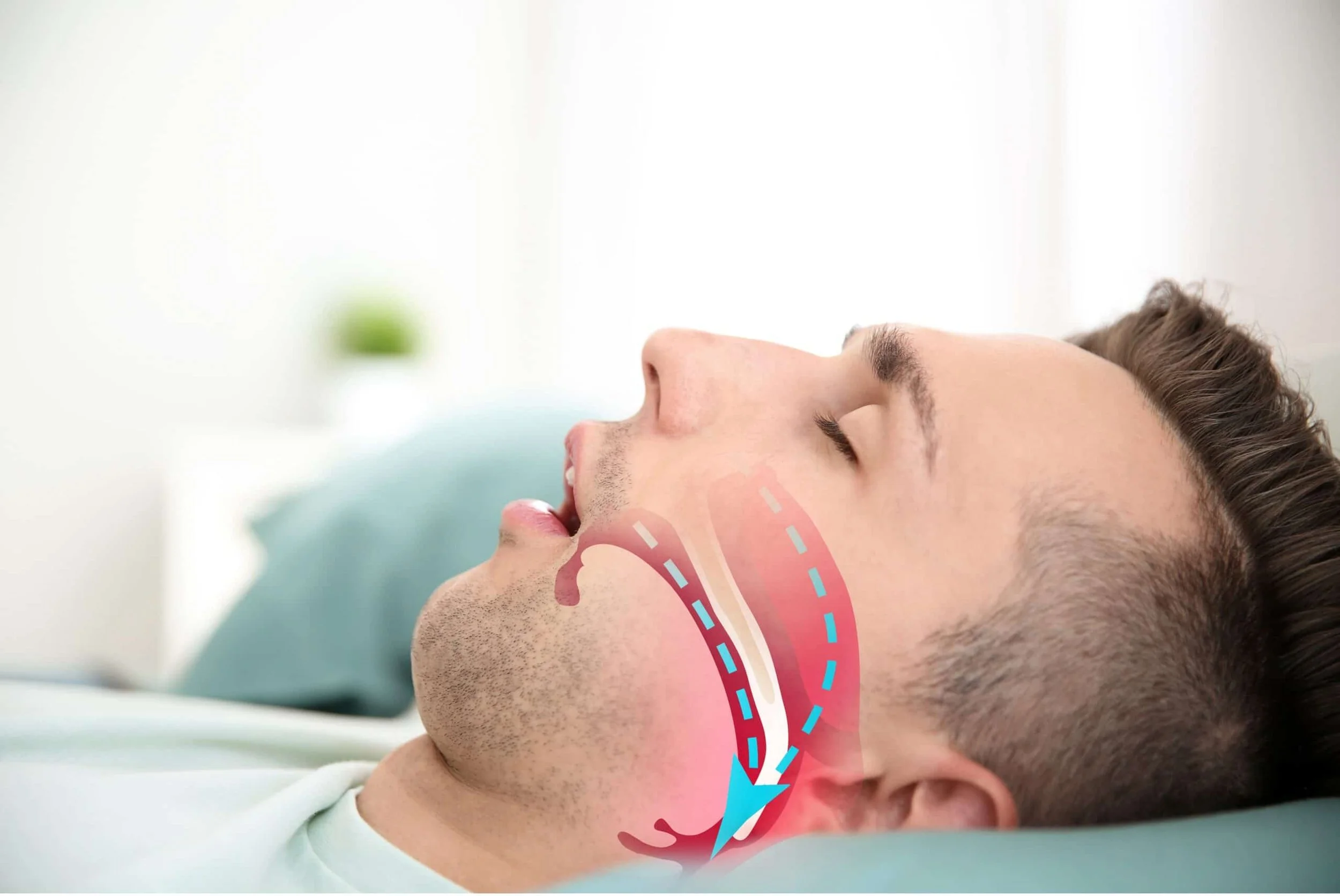
During sleep, muscle tone naturally decreases. In susceptible individuals, the tongue and surrounding soft tissues may contribute to narrowing or collapse of the upper airway.
If a person has restricted tongue mobility, poor oral function or an unfavourable combination of craniofacial and airway anatomical characteristics, these factors may be relevant when assessing sleep-disordered breathing.
Some patients with tongue restriction also present with:
Mouth breathing
Difficulty maintaining nasal breathing
Low tongue posture
Narrow or high-arched palate
Swallowing dysfunction
Snoring
Poor sleep quality
However, tongue tie is not established as a direct cause of obstructive sleep apnoea. Sleep apnoea is a multifactorial condition involving airway anatomy, neuromuscular control, body weight, age, sleep position and other individual factors.
A tongue tie assessment alone cannot diagnose or exclude sleep apnoea.
2. Why Is Tongue Posture Important for Jaw Development?
The tongue is an important functional structure during facial and oral development.
During childhood and adolescence, the tongue, lips and surrounding muscles contribute to the functional environment in which the jaws and dental arches develop.
A tongue that can elevate and rest against the palate may contribute to normal oral function and swallowing patterns.
Conversely, persistent low tongue posture and altered oral habits may coexist with narrow dental arches, mouth breathing and other functional concerns.
It is important to understand that jaw development is influenced by multiple factors, including genetics, growth patterns, nasal breathing, oral habits and muscle function.
What happens when the palate is narrow?
A narrow upper jaw may be associated with:
Reduced space for the tongue
Dental crowding
High-arched palate
Crossbite
Altered dental arch relationships
Increased difficulty achieving comfortable tongue posture
In some patients, these anatomical features may coexist with nasal obstruction or sleep-disordered breathing.
This is why evaluating the palate, tongue mobility, nasal breathing and airway history can be valuable when assessing patients with complex functional concerns.
3. Could Premolar Extractions and Orthodontic Retraction Affect Your Airway?
This is a particularly important question for adults who underwent orthodontic treatment during their teenage years.
Many patients had four premolars removed as part of orthodontic treatment to create space for correcting dental crowding or protrusion.
The remaining teeth were then moved into the available spaces, sometimes involving significant retraction of the anterior teeth.
Orthodontic treatment can be extremely beneficial when appropriately planned. However, the effect of tooth movement on the overall dental arch, tongue space and facial profile deserves consideration.
Understanding orthodontic retraction mechanics
When premolars are extracted, the resulting spaces may be used to correct crowding, improve the bite or retract the front teeth.
Depending on the treatment plan, the anterior teeth may be moved backwards, changing the position and inclination of the front teeth and potentially influencing the shape of the dental arch.
In patients who undergo substantial retraction, questions may arise about:
Changes in dental arch dimensions
Changes in incisor inclination
Changes in lip support and facial profile
Available space for the tongue
Changes in oral cavity geometry
It is important to distinguish between dental arch changes and actual skeletal or airway changes. Moving teeth backwards does not necessarily mean the entire jaw has moved backwards, nor does it automatically mean the airway has become smaller.
Research has not established that premolar extractions or orthodontic retraction routinely cause obstructive sleep apnoea or TMJ disorders.
However, in patients with existing airway concerns, narrow arches or other anatomical limitations, reviewing the original orthodontic treatment and current anatomy may be clinically relevant.
Could reduced tongue space contribute to functional problems?
The tongue requires adequate space to move, rest and function comfortably.
In certain patients, substantial changes in dental arch form may alter the available intraoral space. If tongue mobility is already restricted by a tongue tie, the combination of anatomical and functional limitations may warrant further investigation.
This does not mean that orthodontic extractions should be reversed or that all patients who have undergone premolar extractions will develop breathing problems.
It means that a comprehensive assessment should consider more than whether the teeth are straight.
4. The Relationship Between Orthodontic Treatment and TMJ Disorders
The temporomandibular joints connect the lower jaw to the skull and are responsible for allowing the jaw to open, close and move during speaking and chewing.
TMJ disorders can involve the joint itself, the surrounding muscles or both.
Common symptoms include:
Jaw clicking or popping
Jaw pain and tenderness
Difficulty opening the mouth
Jaw locking
Headaches around the temples
Facial muscle tension
Neck and shoulder discomfort
Pain during chewing
Teeth grinding and clenching
Some patients who previously underwent orthodontic treatment wonder whether their extractions, bite changes or retraction mechanics contributed to their current jaw symptoms.
Does orthodontic extraction cause TMJ dysfunction?
There is no convincing evidence that premolar extraction or orthodontic treatment, in general, causes TMJ disorders.
TMD has many contributing factors, including previous trauma, genetics, joint conditions, muscle dysfunction, sleep disturbance, psychological stress and parafunctional habits such as clenching.
Likewise, an abnormal bite does not automatically mean that a patient will develop TMJ dysfunction.
Nevertheless, when someone presents with persistent jaw symptoms, a detailed orthodontic and dental history can help the clinician understand the patient's overall functional picture.
It is worth assessing:
Previous orthodontic extractions
The extent of anterior tooth retraction
Current dental arch form
Jaw movement and range of opening
Joint sounds and locking
Muscle tenderness
Evidence of clenching and grinding
Current bite relationships
Tongue mobility and oral function
The objective is not to assume that previous orthodontic treatment caused the problem, but to identify any relevant contributing factors.
5. Could TMJ Dysfunction, Teeth Grinding and Sleep Apnoea Be Connected?
Some patients with sleep-disordered breathing also experience teeth grinding, jaw clenching, morning headaches and muscular discomfort.
Sleep-related bruxism is a complex activity involving the nervous system and jaw muscles. It may occur alongside sleep-disordered breathing, although the relationship is not straightforward and one does not necessarily cause the other.
Obstructive sleep apnoea occurs when the upper airway repeatedly becomes partially or completely obstructed during sleep, resulting in disrupted breathing and sleep fragmentation.
Possible symptoms include:
Loud snoring
Gasping or choking during sleep
Witnessed pauses in breathing
Morning headaches
Dry mouth on waking
Daytime fatigue
Poor concentration
Unrefreshing sleep
Some patients also report jaw soreness and facial muscle fatigue.
When these symptoms occur together, it is important to consider whether more than one condition is present.
A dentist may assess oral and jaw-related factors, but suspected sleep apnoea requires appropriate medical assessment and sleep testing.
6. Why Treating Only the Symptoms May Not Be Enough
One of the challenges in managing complex TMJ and airway presentations is that patients may have several overlapping concerns.
For example, a patient may present with:
A restrictive tongue tie
Narrow upper dental arch
Low tongue posture
Mouth breathing
Snoring
Teeth grinding
Morning headaches
Jaw muscle tension
Treating one symptom does not necessarily resolve the others.
A dental splint may help protect teeth and manage certain forms of jaw-related symptoms, but it does not automatically correct tongue restriction or treat obstructive sleep apnoea.
Similarly, releasing a tongue tie does not automatically widen the palate, reposition the jaws or cure sleep apnoea.
A more comprehensive approach involves identifying which conditions are actually present and determining how they may interact.
7. What Should a Comprehensive TMJ and Airway Assessment Include?
For patients with a history of orthodontic extractions, tongue restriction, jaw discomfort or sleep-related breathing concerns, an individualised assessment may include several components.
Jaw joint and muscle assessment
This may involve examining jaw movement, joint sounds, locking, muscle tenderness, opening range and functional limitations.
Dental and orthodontic assessment
The clinician may review the current bite, dental arch dimensions, tooth wear, previous extractions, orthodontic records and changes in dental alignment.
Tongue mobility assessment
Tongue movement, elevation, protrusion, coordination, resting posture and swallowing function may be evaluated.
A tongue tie should be assessed based on functional restriction rather than appearance alone.
Airway and sleep assessment
Relevant history includes snoring, mouth breathing, sleep quality, daytime fatigue and witnessed breathing interruptions.
Where sleep apnoea is suspected, referral for medical assessment and a sleep study may be appropriate.
Diagnostic imaging
Depending on the clinical findings, imaging may include panoramic radiographs or CBCT imaging to assess relevant dental and skeletal structures.
CBCT can provide useful anatomical information, but it cannot diagnose obstructive sleep apnoea or replace a sleep study.
8. What Treatment Options Are Available?
Treatment depends on the underlying diagnosis and the individual patient's needs.
There is no single treatment that addresses every aspect of tongue restriction, TMJ dysfunction and sleep-disordered breathing.
Depending on the assessment, treatment may involve:
TMJ management and splint therapy
Custom dental splints may be appropriate for selected patients to manage jaw-related symptoms or protect teeth from excessive loading.
Myofunctional therapy
Selected patients may benefit from exercises designed to improve tongue coordination, oral function, swallowing patterns and awareness of resting posture.
Tongue tie assessment and frenectomy
Where a restrictive lingual frenulum causes demonstrable functional problems, a frenectomy may be considered following appropriate assessment. Post-procedure rehabilitation may be recommended. The evidence that frenectomy treats adult sleep apnoea remains insufficient.
Orthodontic assessment
Patients with narrow dental arches, significant crowding or concerns about previous orthodontic treatment may benefit from an assessment of their current dental and skeletal relationships.
Expansion or other orthodontic procedures must be individually planned. They are not automatically indicated simply because someone previously had premolars extracted.
Sleep apnoea management
Depending on severity and diagnosis, treatment may include CPAP, mandibular advancement devices, positional therapy, weight management, selected surgical procedures or other medically supervised approaches.
A mandibular advancement device may be unsuitable for some patients with significant TMJ symptoms, so careful assessment is important.
9. Why We Believe in Looking at the Whole Person, Not Just the Teeth
At Pain Free Dentist Sydney, we recognise that the teeth, tongue, jaw joints, muscles and airway are interconnected parts of a complex functional system.
A patient presenting with jaw pain may also have a history of orthodontic extractions, restricted tongue mobility, poor sleep or chronic muscle tension.
Another patient may have straight teeth but experience significant snoring, mouth breathing and daytime fatigue.
These presentations deserve individual attention rather than assuming that one treatment will solve everything.
Our approach focuses on understanding the patient's history, symptoms, oral function and relevant anatomical findings before considering appropriate treatment options.
We aim to help patients better understand their condition and explore ways to improve comfort, function and quality of life.
TMJ, Tongue Tie and Airway Assessment in Sydney
If you had premolar extractions during childhood or adolescence, underwent extensive orthodontic retraction, or currently experience jaw pain, headaches, teeth grinding, snoring or poor sleep, it may be worthwhile to have your concerns assessed.
Your previous orthodontic treatment does not necessarily mean that you will develop TMJ dysfunction or sleep apnoea. However, understanding your dental history and current oral function can provide useful information when investigating ongoing symptoms.
At Pain Free Dentist Sydney, we take an individualised approach to TMJ assessment, tongue tie concerns and the relationship between oral function and airway health.
Straight teeth are important, but healthy function, comfortable jaw movement, effective breathing and good sleep are also important parts of overall wellbeing.
Contact Pain Free Dentist Sydney in Hurlstone Park to arrange a consultation.
Your oral health is about more than your smile. It is also about how comfortably you function, breathe, sleep and live.