
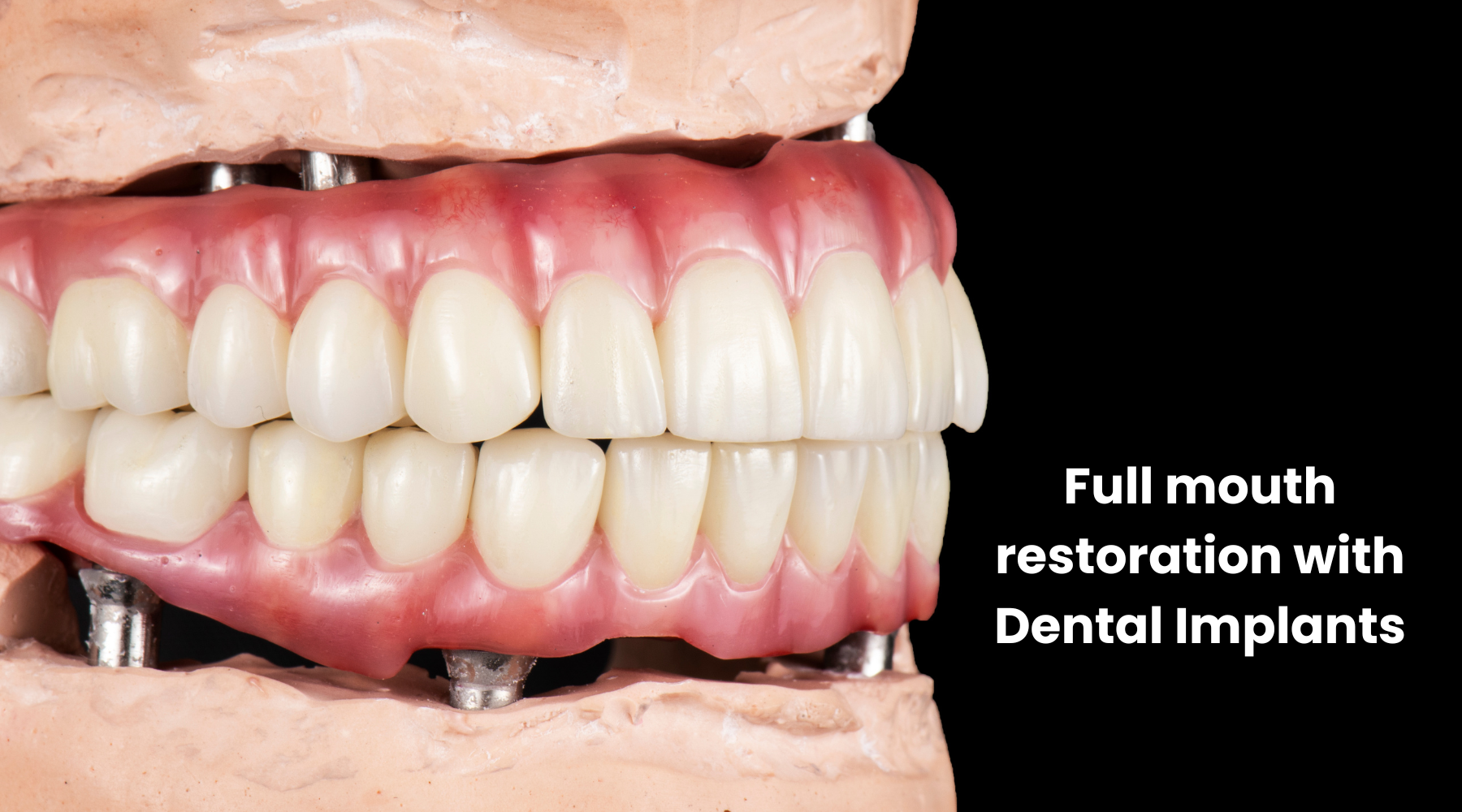
Are you struggling with multiple missing teeth, worn-down teeth or dentures that feel uncomfortable? If extensive dental problems are affecting your ability to eat, speak or smile confidently, full mouth rehabilitation with dental implants may be an option worth exploring.
Modern implant dentistry can help restore missing teeth, improve chewing function and support a more natural-looking smile. For suitable patients, a carefully planned full mouth rehabilitation may replace multiple missing or failing teeth with fixed implant-supported teeth.
At Pain Free Dentist Sydney, we understand that extensive dental problems can affect much more than your appearance. They can influence everyday comfort, confidence and quality of life. Understanding your options is the first step towards making an informed decision about your dental health.
What Is Full Mouth Rehabilitation?
Full mouth rehabilitation, also called full mouth reconstruction, involves restoring or replacing teeth throughout the upper jaw, lower jaw or both.
Unlike a routine dental treatment that addresses one tooth at a time, full mouth rehabilitation considers the overall condition of your teeth, gums, bite and oral function.
Depending on your needs, treatment may involve:
Dental implants to replace missing teeth
Implant-supported bridges or full-arch teeth
Crowns and bridges to restore damaged teeth
Treatment for gum disease
Restorations for severely worn or broken teeth
Bite assessment and management of functional concerns
Removable dentures when appropriate
Not everyone needs every treatment. The best approach depends on the condition of your existing teeth, bone availability, gum health, medical history and long-term goals.
What Are Full Mouth Dental Implants?
Full mouth dental implants are used to support replacement teeth when most or all teeth in one or both jaws are missing or need to be removed.
A dental implant is a small fixture, commonly made from titanium, that is placed into the jawbone. As healing progresses, the implant can integrate with the surrounding bone and provide support for a replacement tooth, bridge or full-arch prosthesis.
Rather than replacing every missing tooth with an individual implant, several strategically positioned implants may support a larger bridge.
Two commonly discussed approaches are All-on-4 and All-on-6.
All-on-4 Dental Implants
All-on-4 is a full-arch treatment concept in which four dental implants are used to support a fixed set of replacement teeth in a suitable patient.
The implants are positioned according to the patient's anatomy, bone availability and prosthetic requirements. In selected cases, angled implants may help make use of available bone.
Potential advantages include replacing an entire arch of teeth using fewer implants than would be needed for individual tooth replacement.
However, not every patient is suitable for All-on-4. Bone quality, anatomy, bite forces, gum health and other clinical considerations influence treatment planning.
All-on-6 Dental Implants
All-on-6 uses six implants to support a full-arch restoration when the clinical circumstances favour this approach.
Additional implants may provide more support and help distribute forces across the arch. However, six implants are not automatically better than four for every patient.
The number and position of implants should be determined by a comprehensive assessment rather than a standard formula.
Who May Benefit from Full Mouth Implant Rehabilitation?
Full mouth rehabilitation may be considered for people who have:
Multiple missing teeth in the upper or lower jaw
Severely damaged or extensively decayed teeth
Teeth that cannot be predictably restored
Advanced tooth wear affecting chewing function
Loose or uncomfortable dentures
Difficulty chewing a range of foods
A combination of failing teeth and existing dental restorations
Some patients may be able to preserve many of their natural teeth and only replace selected missing teeth. Others may require a more extensive reconstruction.
Preserving healthy, restorable teeth should be considered wherever clinically appropriate. Removing teeth solely to pursue a full-arch implant treatment is not necessarily the best option.
What Happens During Full Mouth Rehabilitation with Dental Implants?
Successful implant rehabilitation involves careful planning, coordinated treatment and ongoing maintenance.
1. Comprehensive Dental Assessment
Your dentist evaluates your remaining teeth, gums, bite, oral hygiene and overall oral health. Your medical history, medications, smoking status and other factors that may influence healing are also considered.
The aim is to understand which teeth can be saved, which may need replacement and what treatment options are realistic.
2. CBCT Imaging and Digital Treatment Planning
Cone beam computed tomography (CBCT) provides three-dimensional information about the jawbone and important anatomical structures.
This imaging may help assess bone volume, implant positioning and the relationship between proposed implants and nearby structures.
Digital scans, photographs and bite records may also be used to plan the replacement teeth and how they will function.
3. Preparing the Mouth
Before implant placement, some patients require treatment for gum disease, decay or existing infection.
Teeth that cannot be predictably restored may need extraction. In selected cases, bone grafting or other preparatory procedures may be recommended.
The sequence depends on the condition of the mouth and the proposed restoration.
4. Dental Implant Placement
Implants are placed into the jawbone using a planned surgical approach. The procedure may be performed under local anaesthesia, with additional sedation options considered where appropriate.
The number of implants and the complexity of the surgery vary between patients.
5. Temporary Replacement Teeth
Some suitable patients may receive temporary fixed teeth on the day of surgery or shortly afterwards. This is often referred to as immediate loading.
However, immediate loading is not appropriate for everyone. It depends on factors such as implant stability, bone quality, bite management and the patient's ability to follow post-operative instructions.
Other patients may need a healing period before their replacement teeth are attached.
6. Final Implant-Supported Teeth
Once healing and implant integration have progressed sufficiently, the temporary restoration may be replaced with the definitive prosthesis.
The final teeth are designed with consideration for appearance, speech, cleaning access, chewing forces and long-term maintenance.
How Long Does Full Mouth Implant Treatment Take?
Treatment time varies considerably.
Some patients may receive temporary fixed teeth soon after implant placement, while others require several months of healing before their final restoration can be completed.
Additional procedures, such as bone grafting or treatment of gum disease, can extend the overall timeline.
Your dentist should explain the expected stages, healing periods and circumstances that could affect your treatment schedule.
Is Full Mouth Rehabilitation with Dental Implants Painful?
Implant placement is generally performed with local anaesthesia to help manage discomfort during surgery. Sedation may be available for suitable patients who experience significant dental anxiety or require more extensive treatment.
After surgery, some swelling, bruising, tenderness or discomfort is expected. The degree varies according to the extent of treatment and individual healing.
Your dental team will provide instructions about pain management, diet, oral hygiene and follow-up appointments.
It is important to understand that implant surgery is still surgery. A careful assessment and appropriate preparation help manage risks, but no procedure can guarantee a completely pain-free experience.
How Much Does Full Mouth Dental Implant Rehabilitation Cost in Sydney?
The cost of full mouth rehabilitation varies widely because every patient's needs are different.
Factors that influence the total cost include:
Whether one or both jaws require treatment
The number of implants required
The type and material of the final teeth
Extractions and any necessary bone grafting
Temporary teeth and provisional restorations
Surgical complexity and sedation requirements
Follow-up visits and long-term maintenance
A full-arch implant treatment is a significant financial investment. It is important to receive a written treatment plan that explains what is included, what may incur additional fees and the expected maintenance requirements.
Ask your dental provider about the proposed implant system, the materials used for the final teeth, warranty conditions and the arrangements for managing complications.
Are Dental Implants Suitable for Everyone?
Dental implants can be a highly effective tooth replacement option, but they are not suitable for every patient.
Factors that may influence treatment suitability include:
Insufficient jawbone volume or unfavourable anatomy
Active gum disease or untreated oral infection
Smoking or nicotine use
Poorly controlled diabetes
Certain medications or medical conditions
Difficulty maintaining oral hygiene
Heavy clenching or grinding
Expectations that are not achievable with the available anatomy
Some of these factors can be managed or improved before treatment. Others may require alternative treatment approaches or additional precautions.
A comprehensive assessment is essential before deciding whether full mouth implant rehabilitation is appropriate.
How Do You Maintain Full Mouth Dental Implants?
Dental implants do not develop decay like natural teeth, but the surrounding gum and bone can still become inflamed or infected.
Long-term success depends on daily care and regular professional maintenance.
Recommended care may include:
Brushing carefully twice daily
Cleaning beneath implant-supported bridges using suitable interdental brushes or other recommended aids
Attending regular implant maintenance appointments
Monitoring gum health and bone levels when clinically indicated
Avoiding smoking
Managing clenching or grinding where necessary
Implant-supported teeth should not be considered maintenance-free. Regular monitoring helps identify problems early and protect your investment.
Full Mouth Rehabilitation: Is It About More Than Your Smile?
For many patients, replacing failing or missing teeth is about restoring confidence as well as appearance.
A well-planned rehabilitation should also consider chewing efficiency, speech, comfort, cleaning access and the relationship between the upper and lower teeth.
Where patients have extensive tooth wear, jaw discomfort or clenching, these concerns may need separate assessment as part of the overall treatment plan. Dental implants do not automatically resolve TMJ disorders, headaches or sleep-related breathing problems.
The goal is to create a treatment plan that addresses the patient's actual needs without promising that one procedure will solve every concern.
Frequently Asked Questions About Full Mouth Dental Implants
How many implants are needed for a full mouth restoration?
The number depends on whether one or both jaws are being treated, the type of prosthesis, bone availability and the forces the restoration must withstand. Some full-arch restorations use four or six implants, while other treatment plans require different configurations.
Can I have fixed teeth on the same day as implant surgery?
Some suitable patients can receive temporary fixed teeth on the day of surgery. Immediate loading depends on clinical stability and other factors, so it cannot be guaranteed for everyone.
Are All-on-4 implants better than dentures?
Fixed implant-supported teeth may offer improved stability and chewing function compared with conventional removable dentures for suitable patients. However, dentures remain an appropriate option for many people, particularly when surgery is unsuitable or a removable solution is preferred.
Can dental implants fail?
Yes. Implants can fail to integrate with bone or develop later complications, including inflammation around the implant. Appropriate planning, good oral hygiene and ongoing professional care help reduce risks but cannot eliminate them.
How long do full mouth dental implants last?
Implants can function for many years, but their longevity varies. The prosthetic teeth may need repair or replacement over time, and implants require lifelong maintenance.
Book a Dental Implant Consultation in Sydney's Inner West
If you have multiple missing teeth, failing dental restorations or difficulty chewing, a comprehensive assessment can help you understand whether full mouth rehabilitation is appropriate for you.
At Pain Free Dentist Sydney, we aim to provide clear explanations and individualised treatment planning based on your dental condition, functional needs and long-term goals.
Contact our team to discuss your concerns and arrange an assessment.
Pain Free Dentist Sydney
Address: Suite 1A, 570 New Canterbury Road, Hurlstone Park NSW 2193
Phone: 02 9558 8988
Website: https://painfreedentistsydney.com.au
Disclaimer: This article provides general dental information and is not a substitute for an individual clinical assessment. Dental implant suitability, treatment options, risks, costs and outcomes vary between patients.