Losing one or more teeth can affect much more than your appearance. Missing teeth may influence your ability to chew comfortably, speak clearly and smile with confidence. Over time, tooth loss can also contribute to changes in your bite, movement of neighbouring teeth and deterioration of the supporting jawbone.
Fortunately, modern dentistry offers several options for replacing missing teeth. Two commonly considered solutions are dental implants and dentures.
But which option is better? Are dental implants more comfortable than dentures? Can dentures prevent bone loss? And are dental implants suitable for everyone?
Understanding the differences can help you make an informed decision about your long-term oral health.
At Pain Free Dentist Sydney in Dulwich Hill, we assess each patient's individual dental condition, bone structure, oral health and treatment goals before recommending an appropriate tooth replacement solution.
1. What Are Dental Implants?
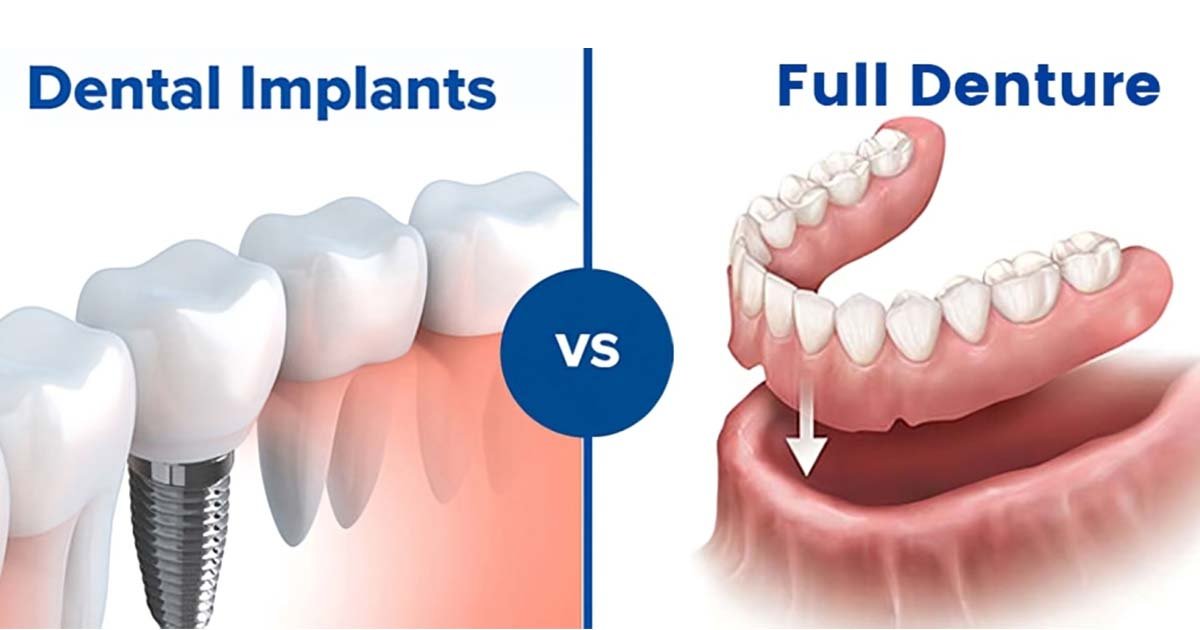
Dental implants are artificial tooth roots designed to replace missing natural teeth. They are usually made from biocompatible titanium and are surgically positioned within the jawbone.
Over time, the implant integrates with the surrounding bone through a biological process known as osseointegration.
Once the implant has healed sufficiently, a dental crown, bridge or full-arch prosthesis can be attached to restore the missing teeth.
Dental implants can be used for:
Replacing a single missing tooth.
Replacing several missing teeth.
Supporting implant-retained bridges.
Replacing an entire upper or lower arch of teeth.
Supporting full-mouth rehabilitation using All-on-4 or All-on-6 treatment concepts.
One of the major advantages of dental implants is that they provide a fixed foundation for replacement teeth without relying on neighbouring natural teeth for support.
2. What Are Dentures?
Dentures are removable dental appliances designed to replace missing teeth and surrounding oral structures.
They can be used to replace a few missing teeth or an entire arch.
There are two main types of dentures.
Partial dentures
Partial dentures replace several missing teeth while using the remaining natural teeth and supporting tissues for retention and stability.
They may contain metal clasps or other attachment systems to help keep the appliance in position.
Full dentures
Full dentures replace all the teeth in the upper or lower jaw. They generally rest on the underlying gum tissues and rely on the shape of the jaw, suction and muscular control for stability.
Dentures can restore the appearance of a smile and improve chewing function. However, some patients experience movement, discomfort or difficulty adapting to removable appliances.
3. Dental Implants vs Dentures: Understanding the Main Differences
Although both options replace missing teeth, they function differently.
Stability and comfort
Dental implants are anchored into the jawbone, providing a stable foundation for replacement teeth. Once fully restored, implant-supported teeth generally feel more like fixed natural teeth.
Traditional dentures rest on the gum tissues and may move during speaking, laughing or eating, particularly when the jawbone has undergone significant resorption.
Chewing ability
Dental implants can provide excellent chewing function because they are securely supported by the jawbone.
Traditional dentures may have reduced chewing efficiency compared with natural teeth or fixed implant-supported restorations.
Jawbone preservation
One important difference concerns the jawbone.
Natural tooth roots stimulate the surrounding bone during chewing. When teeth are lost, this stimulation is reduced, and the jawbone may gradually shrink through a process called bone resorption.
Dental implants can provide functional stimulation to the surrounding bone through the implant structure.
Traditional dentures do not replace natural tooth roots and cannot provide the same direct stimulation to the jawbone.
Appearance
Both dentures and dental implants can be designed to look natural.
Modern dental materials allow dentists to create restorations that complement facial features, tooth proportions and the patient's smile.
However, fixed implant-supported restorations may provide greater stability and can help support facial function when appropriately designed.
Maintenance
Dental implants require daily brushing, interdental cleaning and regular professional reviews.
Dentures need to be removed and cleaned regularly. Patients must also maintain good gum and remaining tooth health.
Both options require ongoing dental maintenance.
4. Do Dentures Cause Jawbone Shrinkage?
This is an important consideration for patients who have lost multiple teeth.
When natural teeth are removed, the jawbone no longer receives stimulation through their roots. Over time, the bone may gradually reduce in height and width.
This can affect the fit of dentures.
As the jawbone changes shape, previously well-fitting dentures may become loose, requiring adjustments, relining or replacement.
In some patients, significant bone resorption can make conventional dentures increasingly difficult to retain.
Dental implants can help preserve the surrounding bone in the areas where they are placed by transferring functional forces to the bone.
However, implants do not prevent bone loss in every part of the jaw, and appropriate implant positioning and long-term maintenance remain important.
5. Are Dental Implants More Comfortable Than Dentures?
Many patients find fixed implant-supported teeth more comfortable because they do not need to remove the teeth for cleaning or worry about them moving during everyday activities.
Traditional dentures can sometimes cause:
Gum irritation.
Pressure points.
Difficulty chewing certain foods.
Movement while speaking.
Reduced confidence when eating socially.
Frequent adjustments as the jawbone changes.
Implant-supported restorations can reduce many of these concerns.
However, dental implants involve surgery and a healing period. Not everyone is immediately suitable for implant treatment, and some patients may require additional procedures before implants can be placed.
6. What Is All-on-4 and All-on-6 Dental Implant Treatment?
For patients who have lost most or all of their teeth, full-arch implant rehabilitation may be an alternative to conventional removable dentures.
Two commonly used treatment concepts are All-on-4 and All-on-6.
All-on-4 dental implants
This approach uses four strategically positioned dental implants to support a fixed full-arch prosthesis.
In suitable cases, the posterior implants are angled to maximise the available bone and help avoid certain anatomical structures.
All-on-6 dental implants
This approach uses six dental implants to support a full-arch restoration.
Depending on the patient's anatomy, bone quality, implant positioning and bite forces, using six implants may provide additional support and distribute functional loads across more implant sites.
Neither approach is automatically better for everyone. The decision depends on individual anatomy, prosthetic design, available bone and the overall treatment plan.
<escape>Both All-on-4 and All-on-6 aim to provide a fixed alternative to conventional removable full dentures.</escape>
7. Can You Change from Dentures to Dental Implants?
Yes. Many patients who have worn dentures for years eventually consider dental implants because they want improved stability and chewing function.
However, long-term tooth loss and denture use can be associated with significant jawbone resorption.
Before implant treatment, a comprehensive assessment is necessary to evaluate:
Available bone height and width.
Bone density and quality.
Position of nerves and other anatomical structures.
Gum health.
Bite relationship and jaw function.
Medical history and healing considerations.
A CBCT scan may be recommended to provide a three-dimensional assessment of the jawbone and assist with implant planning.
Some patients may require bone grafting or other preparatory procedures before implant placement. Others may have sufficient bone for treatment without additional grafting.
8. Who Is Suitable for Dental Implants?
Dental implants may be suitable for adults who have missing teeth and adequate oral and general health to undergo implant treatment.
Factors considered during an assessment include:
Adequate jawbone volume or the possibility of preparing the site.
Healthy gums and good oral hygiene.
Stable general health.
Appropriate bite forces and functional requirements.
Smoking habits.
Medical conditions and medications that may affect healing.
Commitment to ongoing implant maintenance.
Age alone does not determine whether someone is suitable for dental implants.
A detailed examination and appropriate imaging help determine the most suitable treatment approach.
9. Are Dentures Still a Good Option?
Absolutely. Dentures remain an important and valuable treatment option.
They may be appropriate for patients who:
Prefer a non-surgical approach.
Are not suitable for implant surgery.
Have medical or anatomical limitations.
Need a temporary tooth replacement.
Prefer a removable dental appliance.
Some patients may also benefit from implant-retained overdentures, which combine the removable nature of dentures with the additional stability provided by dental implants.
This can be a useful middle ground for patients who want better denture retention without committing to a fully fixed prosthesis.
10. How Do You Choose Between Dental Implants and Dentures?
There is no single solution that is right for every patient.
The best treatment depends on your oral health, jawbone condition, functional requirements, expectations and personal circumstances.
For some patients, a conventional denture may provide a practical solution. For others, dental implants may offer better long-term stability and function.
Patients with extensive tooth loss may benefit from discussing full-arch implant rehabilitation, including All-on-4 or All-on-6 treatment.
A proper dental assessment is the first step towards understanding which options are suitable.
Restore Your Smile with the Right Tooth Replacement Solution
Missing teeth do not have to mean compromising your ability to eat, speak or smile confidently.
Both dental implants and dentures can restore important aspects of oral function. Understanding their differences allows you to make a decision that considers not only the immediate result but also your long-term dental health.
At Pain Free Dentist Sydney, Dulwich Hill, Dr Lisa Chong provides comprehensive dental assessments and discusses suitable tooth replacement options, including dental implants, implant-supported bridges and full-arch rehabilitation.
Our approach focuses on understanding each patient's needs and developing an appropriate treatment plan based on individual clinical findings.
If you are considering replacing missing teeth or would like to explore alternatives to your existing dentures, we welcome you to arrange a consultation.
Pain Free Dentist Sydney – Dr Lisa Chong
Phone: 02 9558 8988
Email: info@painfreedentistsydney.com.au
Website: https://painfreedentistsydney.com.au