Losing multiple teeth can affect much more than your smile. It can make chewing difficult, change the way you speak, affect facial appearance and reduce confidence in everyday social situations.
For patients who have lost most or all of their teeth, All-on-6 dental implants may offer a long-term solution to restore a functional and natural-looking smile.
At Pain Free Dentist Sydney in Dulwich Hill, we understand how important it is to feel comfortable eating, speaking and smiling. Modern implant dentistry offers different options for replacing missing teeth, and All-on-6 is one approach that may be suitable for patients requiring full-arch tooth replacement.
What Are All-on-6 Dental Implants?
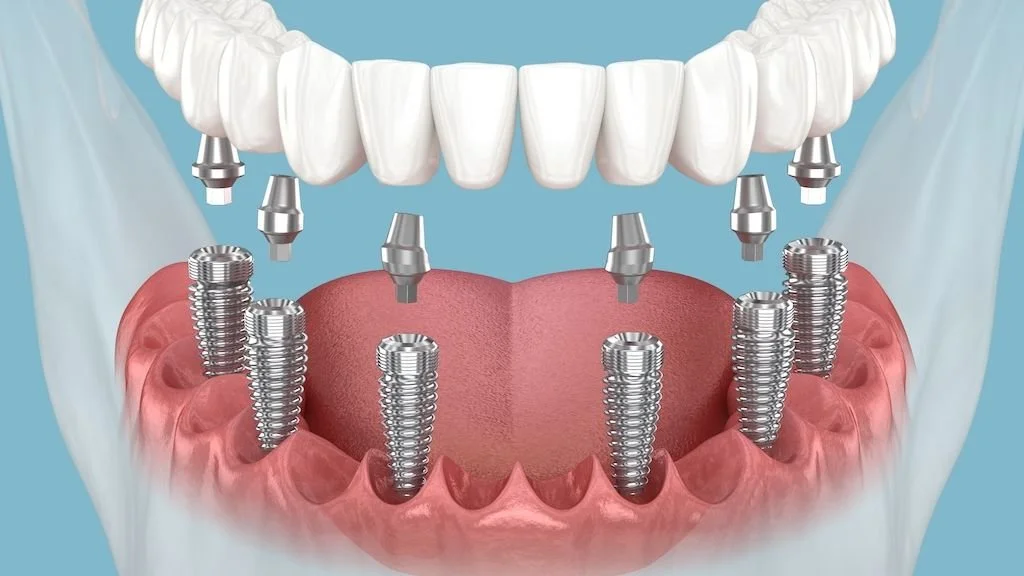
All-on-6 is a full-arch dental implant technique that uses six strategically positioned dental implants to support a fixed bridge of replacement teeth.
Instead of replacing every missing tooth with an individual implant, six implants are carefully positioned within the jawbone to provide support for a complete set of upper or lower teeth.
The implants act as artificial tooth roots. Once integrated with the surrounding bone, they provide a stable foundation for the replacement teeth.
The completed restoration is designed to look natural, restore chewing function and provide greater stability compared with conventional removable dentures.
Depending on the patient's clinical circumstances, All-on-6 may be suitable for:
Patients who have lost most or all of their teeth.
Patients with severely damaged or failing teeth.
Patients who struggle with loose or uncomfortable dentures.
Patients seeking a fixed alternative to removable dentures.
Patients experiencing difficulties chewing due to extensive tooth loss.
How Does the All-on-6 Dental Implant System Work?
The All-on-6 technique relies on the strategic positioning of six dental implants to distribute functional forces across the jaw.
Each implant is placed according to the patient's individual bone anatomy, available bone volume, bite relationship and prosthetic requirements.
The six implants provide multiple support points for the full-arch bridge.
Careful planning is essential because the final position of the replacement teeth must be considered before implant placement.
Important planning considerations include:
Available jawbone volume and density.
Implant positioning and angulation.
Distribution of chewing forces.
Anterior-posterior (AP) spread.
Bite relationship and vertical dimension.
The position of the opposing teeth.
The design and material of the final prosthesis.
The aim is to achieve a stable restoration that functions comfortably while minimising excessive stress on individual implants.
What Are the Benefits of All-on-6 Dental Implants?
1. Improved chewing function
Missing teeth can make it difficult to eat certain foods. A fixed implant-supported bridge may provide improved stability and chewing efficiency compared with conventional removable dentures.
2. A more natural-looking smile
The replacement teeth are designed to complement your facial appearance, smile line and natural dental proportions.
3. Greater stability
Unlike traditional dentures, which may move during speaking or eating, an implant-supported bridge is secured to dental implants.
4. Support for facial appearance
Significant tooth loss and jawbone resorption can contribute to changes in facial appearance. Implant-supported restorations can help restore dental support and improve smile aesthetics.
5. Improved confidence
Having fixed replacement teeth may help patients feel more confident when speaking, eating and socialising.
6. A full-arch solution
Rather than replacing every missing tooth individually, six implants can support an entire arch of replacement teeth when the clinical conditions are suitable.
Who Is Suitable for All-on-6 Dental Implants?
Not everyone is automatically suitable for All-on-6 treatment.
A comprehensive dental assessment is necessary to evaluate the condition of the teeth, gums and supporting jawbone.
Factors that may influence suitability include:
The amount and quality of available jawbone.
Gum health and history of periodontal disease.
General medical and dental history.
Smoking habits.
Bite forces and history of teeth grinding.
Oral hygiene and ability to maintain the implants.
Previous dental implant treatment.
Patients with significant bone loss may still have implant treatment options, but additional procedures or alternative implant configurations may need to be considered.
A CBCT scan is particularly useful for assessing three-dimensional bone anatomy and planning implant positioning.
All-on-6 Versus All-on-4 Dental Implants
Both All-on-4 and All-on-6 are full-arch implant rehabilitation techniques.
The main difference is the number of implants supporting the replacement bridge.
All-on-4 uses four strategically positioned implants, whereas All-on-6 uses six implants.
The additional implants in an All-on-6 configuration may provide additional support points and potentially improve load distribution in selected cases.
However, more implants do not automatically mean a better outcome.
The ideal treatment depends on bone availability, implant distribution, AP spread, prosthetic design, bite forces and the patient's individual anatomy.
In some patients, All-on-4 may be appropriate, while others may benefit from All-on-6.
The decision should be based on careful clinical and prosthetic planning rather than simply choosing a greater number of implants.
What Is the All-on-6 Dental Implant Procedure?
Full-arch implant rehabilitation involves several stages, with treatment customised according to the patient's needs.
Stage 1: Comprehensive dental assessment
The initial consultation involves evaluating the remaining teeth, gums, jawbone, bite relationship and overall oral health.
Your dentist will discuss your concerns, expectations and suitable treatment options.
Stage 2: CBCT scan and digital planning
A CBCT scan provides detailed three-dimensional information about the jawbone, including its width, height and anatomical structures.
Digital implant planning helps determine the ideal implant positions, angulations and distribution.
The prosthetic design must also be considered to ensure that the final bridge has appropriate support and functional stability.
Stage 3: Removal of failing teeth
If remaining teeth are severely damaged or have a poor prognosis, extractions may be required before or during implant placement.
The treatment sequence depends on the patient's clinical condition.
Stage 4: Dental implant placement
The six dental implants are surgically positioned in the jawbone according to the preoperative plan.
Primary implant stability is assessed to determine whether immediate provisional teeth are appropriate.
Stage 5: Temporary fixed teeth
In suitable cases, a temporary fixed bridge may be attached shortly after implant placement.
However, immediate loading is not appropriate for every patient. Implant stability, bone quality, bite forces and other clinical factors must be considered.
Stage 6: Final permanent bridge
After the implants have integrated with the surrounding bone and the tissues have healed, the final prosthesis can be designed and fitted.
The final restoration is carefully assessed for aesthetics, bite balance, chewing function and ease of cleaning.
Can All-on-6 Dental Implants Be Done in One Day?
Some patients may be suitable for immediate loading, meaning a temporary fixed bridge can be fitted on the same day as implant surgery.
This is sometimes referred to as teeth in a day.
However, same-day teeth are not guaranteed for every patient.
Successful immediate loading requires adequate primary implant stability, appropriate bone conditions and careful control of functional forces.
Patients who are not suitable for immediate loading may need to wait for the implants to heal before receiving their fixed teeth.
Your dentist will explain the safest approach based on your individual clinical findings.
What If You Grind or Clench Your Teeth?
Teeth grinding, also known as bruxism, is an important consideration when planning full-arch dental implants.
Excessive biting forces can place additional stress on the implants, prosthetic screws and replacement bridge.
Patients with a history of clenching or grinding may require additional assessment of their bite relationship and functional loading.
The design of the prosthesis, implant distribution and occlusal contacts should be carefully considered.
In selected cases, a protective night guard may be recommended after treatment to help reduce excessive forces on the restoration.
How Do You Maintain All-on-6 Dental Implants?
Although dental implants cannot develop tooth decay, the surrounding gum and supporting bone can still be affected by bacterial infection.
Good oral hygiene is essential for maintaining implant health.
Patients should:
Brush twice daily using an appropriate toothbrush.
Clean underneath the implant-supported bridge.
Use interdental brushes or specialised cleaning aids.
Attend regular professional implant maintenance appointments.
Avoid smoking where possible.
Seek assessment if they notice bleeding, swelling or discomfort around the implants.
Long-term success depends not only on the implant surgery but also on ongoing maintenance and regular monitoring.
Are All-on-6 Dental Implants a Long-Term Solution?
Dental implants can provide long-lasting tooth replacement when appropriately planned, placed and maintained.
However, no dental implant treatment can be guaranteed to last a lifetime.
Factors such as bone quality, oral hygiene, smoking, medical conditions, bite forces and prosthetic maintenance can influence long-term outcomes.
Regular reviews allow your dentist to monitor the implants, surrounding tissues and the condition of the fixed bridge.
Restore Your Smile with All-on-6 Dental Implants at Pain Free Dentist Sydney
Losing multiple teeth does not mean you have to live with uncomfortable dentures or difficulty chewing.
All-on-6 dental implants may offer a fixed full-arch solution for suitable patients, helping restore dental function, smile aesthetics and confidence.
At Pain Free Dentist Sydney in Dulwich Hill, Dr Lisa Chong takes a comprehensive approach to implant treatment planning, considering not only the surgical placement of implants but also the final bite, prosthetic design and long-term maintenance.
Every patient's dental anatomy and functional requirements are different. A detailed assessment is essential to determine whether All-on-6, All-on-4 or another implant solution is most appropriate.
Take the first step towards restoring your smile.
Contact Pain Free Dentist Sydney to arrange an implant consultation and discuss your full-mouth dental rehabilitation options.
Pain Free Dentist Sydney – Dr Lisa Chong
Phone: 02 9558 8988
Email: info@painfreedentistsydney.com.au
Website: painfreedentistsydney.com.au