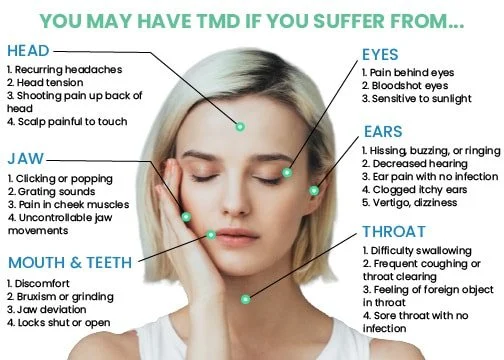
Temporomandibular joint (TMJ) dysfunction is often thought of as a jaw problem, but for many patients, symptoms can extend beyond the mouth. TMJ disorders may be associated with broader issues such as sleep disturbances, tinnitus, headaches, and facial pain, especially when muscle tension and bite imbalance are involved.
Understanding these connections is important for accurate diagnosis and effective treatment.
🧠 What Is TMJ Dysfunction?
TMJ dysfunction (TMD) affects the jaw joint and surrounding muscles responsible for chewing and speaking.
Common local symptoms include:
Jaw pain or stiffness
Clicking or popping sounds
Limited mouth opening
Teeth clenching or grinding (bruxism)
However, TMJ-related muscle tension and nerve involvement may also contribute to symptoms beyond the jaw.
😴 TMJ and Sleep Apnea (Sleep Disturbances)
Some patients with TMJ dysfunction also report poor sleep quality or sleep-disordered breathing.
While TMJ does not directly cause sleep apnea, contributing factors may overlap, including:
Jaw position affecting airway space
Nighttime teeth grinding
Muscle tension in the jaw and neck
Mouth breathing patterns
Possible signs include:
Snoring
Waking up tired
Morning headaches
Dry mouth on waking
A combined dental and medical assessment may be required if sleep apnea is suspected.
🔊 TMJ and Tinnitus (Ringing in the Ears)
Tinnitus (ringing or buzzing in the ears) is commonly reported alongside TMJ symptoms.
This may be linked to:
Shared nerve pathways between jaw and ear structures
Muscle tension near the ear
Jaw joint inflammation
Bruxism-related pressure
Symptoms may include:
Ringing in one or both ears
Ear fullness or pressure
Sound sensitivity
🤕 TMJ and Migraines or Headaches
One of the most common TMJ-related complaints is chronic headaches or migraines.
This is often due to:
Overactive jaw muscles
Referred pain from the temporalis muscle
Night-time clenching or grinding
Stress-related muscle tension
Typical patterns:
Morning headaches
Pain around temples or eyes
Neck and shoulder tightness
😖 Other Possible TMJ-Related Symptoms
Some patients also report:
Facial pain or pressure
Neck and shoulder discomfort
Dizziness or imbalance sensations
Difficulty concentrating due to chronic pain
Earaches without infection
These symptoms often overlap with stress, posture, and muscular dysfunction.
🧪 Why TMJ Can Affect Multiple Systems
The jaw joint is closely connected to:
Facial nerves
Ear structures
Neck and upper spine muscles
Head posture and airway function
Because of this, dysfunction in the TMJ area may contribute to widespread muscular and neurological symptoms in some individuals.
🦷 Treatment Options for TMJ-Related Symptoms
Effective treatment depends on severity and may include:
🛡️ Night Guards / Splints
Reduce grinding and joint pressure during sleep.
💉 Botox for TMJ
Helps relax overactive jaw muscles and reduce pain.
🧘 Jaw Physiotherapy
Improves muscle balance and jaw movement.
🦷 Bite Assessment & Dental Review
Ensures proper alignment and function.
😌 Stress & Habit Management
Addresses clenching triggers and muscle tension.
📍 TMJ & Complex Symptoms in Sydney
At Pain Free Dentist Sydney, we assess TMJ dysfunction in relation to jaw pain, headaches, sleep issues, and muscle tension. Our focus is on identifying contributing factors and creating a tailored treatment plan.
📞 Book a TMJ Assessment
If you are experiencing jaw pain along with symptoms like headaches, poor sleep, or ear discomfort, a professional evaluation may help identify the cause.
👉 Pain Free Dentist Sydney
📞 Call us: (02) 9558 8988
📧 Email: info@painfreedentistsydney.com.au
💻 Or book online today
❓ FAQs
Can TMJ cause sleep apnea?
TMJ does not directly cause sleep apnea, but jaw position and muscle tension may contribute to airway issues in some cases.
Is tinnitus linked to TMJ?
Yes, some patients with TMJ dysfunction report tinnitus due to shared nerve and muscle connections.
Can TMJ cause migraines?
TMJ-related muscle tension and clenching can trigger tension-type headaches and migraine-like symptoms.