Let's be honest—most of us have done it. You feel a slight twinge in your tooth, maybe some sensitivity to cold or sweets. You think, "It's not that bad. I'll just avoid chewing on that side for a while. Maybe it will go away."
And so begins the waiting game.
Weeks turn into months. The twinge becomes a dull ache. And then one night, you wake up in agony. You can't sleep. You can't focus. You are in the kind of pain that makes you understand why people say a toothache is one of the worst pains imaginable.
Suddenly, that "small" cavity you ignored has become a dental emergency. And here is the hardest part: it is going to cost you—not just in pain, but in real money.
Let's talk about what happens when you neglect a cavity and why addressing it early is one of the smartest investments you can make for your health and your wallet.
What Is a Cavity, Really?
A cavity is a hole in your tooth caused by decay. It starts when plaque—that sticky film of bacteria—builds up on your teeth and produces acids that eat away at the enamel, the hard outer layer of your tooth.
Here is what most people don't realize: enamel is the hardest substance in your body, but it cannot heal itself. Once that enamel is broken, the decay keeps spreading deeper and deeper into the tooth.
And it won't stop on its own.
The Six Stages of Ignoring a Cavity
Understanding the progression of a cavity makes it painfully clear why early treatment matters.
Stage 1: The Silent Beginning (Demineralization)
At this stage, the enamel is starting to weaken but there is no hole yet. You probably won't feel anything. Your dentist might spot it on an X-ray or see a white spot on your tooth.
Treatment: Professional fluoride treatment or improved oral hygiene.
Cost: Minimal—often covered fully by insurance.
Stage 2: The Small Cavity (Enamel Decay)
A small hole has formed in the enamel. You might notice occasional sensitivity to sugary or cold foods. It's easy to ignore.
Treatment: A simple dental filling.
Cost: $150 to $300 per tooth.
Time in the chair: About 30-60 minutes.
Stage 3: The Deepening Cavity (Dentin Decay)
The decay has reached the dentin—the softer layer beneath the enamel. Now the tooth is more sensitive. You may feel a sharp twinge when you eat or drink. That twinge is your tooth screaming for help.
Treatment: Still usually a filling, but it will be deeper.
Cost: $200 to $400 per tooth.
Stage 4: The Pulp Invasion (Nerve Exposure)
The decay has reached the pulp—the innermost part of your tooth where the nerves and blood vessels live. The pain can become constant, throbbing, and unbearable. You might struggle to sleep.
Treatment: Root canal therapy. The infected pulp must be removed, the canals cleaned, and the tooth sealed.
Cost: $800 to $3,500 per tooth (plus a crown).
Time in the chair: 1-2 visits, 90 minutes each.
Stage 5: The Infection (Abscess)
Bacteria have now reached the tip of the root and spread into the surrounding bone. An abscess (a pocket of pus) forms. You may experience swelling, fever, and severe pain. This is a medical emergency.
Treatment: Root canal or extraction, plus antibiotics for the infection.
Cost: $1,000 to $4,000 for the root canal, plus $500 to $1,500 for the crown. Extraction is cheaper initially but requires replacement.
Stage 6: The Tooth Is Gone (Extraction)
The tooth is too damaged to save. It must be removed. Now you have a gap.
Treatment: Extraction followed by an implant, bridge, or partial denture to replace the missing tooth.
Cost of extraction: $75 to $500 (simple) or $150 to $650 (surgical).
Cost to replace the missing tooth: $3,000 to $7,000 for a dental implant.
The Real Cost Difference
Let's put the numbers side by side.
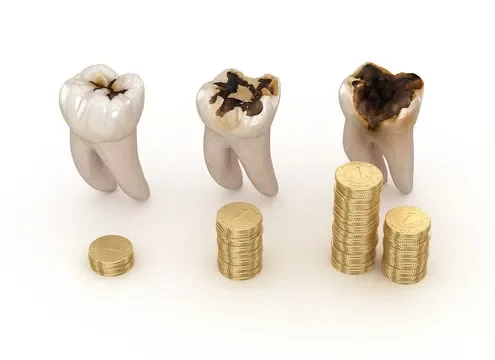
If you take action early, you are looking at a simple filling that costs between $150 and $300. It takes about an hour, requires one visit, and you walk out with a healthy tooth.
But if you delay, the decay spreads deeper. Suddenly, you need a root canal. That procedure ranges from $800 to $1,500, and you still need a crown on top—adding another $500 to $1,500. Now you are looking at $1,500 to $3,500 total, spread across multiple visits.
And if you wait until the tooth is beyond saving, you are facing extraction and replacement. An implant alone can cost $3,000 to $6,000—not including the extraction itself.
By ignoring that small cavity, you could be paying 10 to 20 times more to fix the problem. A $200 filling today truly can save you from a $5,000 implant tomorrow.
Why We Ignore Cavities (Let's Be Honest)
We are not stupid. We know we should go to the dentist. So why do we wait?
Dental anxiety: Fear of the drill, the needle, the sound.
Cost concerns: "I can't afford a filling right now."
The "it'll go away" mindset: We convince ourselves it's not that serious.
Busy schedules: Life gets in the way. The appointment keeps getting pushed back.
Lack of pain: If it doesn't hurt, it must be fine, right? (Wrong.)
The irony is that by delaying treatment to save money, you are guaranteeing a much bigger bill later. And the pain? That usually arrives right on time.
The Hidden Costs of Neglect
It's not just about the dental bill. Ignoring a cavity can cost you in other ways:
Lost workdays: Dental emergencies often mean taking time off work.
Sleep loss: Pain doesn't care about your schedule.
Overall health: Untreated dental infections can spread to other parts of the body, affecting your heart, lungs, and immune system.
Your smile: Missing or damaged teeth affect your confidence and appearance.
What You Can Do Right Now
1. Don't Ignore Sensitivity
If your tooth hurts when eating ice cream or sipping hot coffee, that is your warning sign. Don't wait.
2. See Your Dentist Regularly
Dentists catch cavities early—often before you feel any pain. Regular check-ups (every 6 months) are cheaper than emergency visits.
3. Address Dental Anxiety
If fear is holding you back, talk to your dentist. Sedation options, gentle techniques, and open communication can make all the difference.
4. Ask About Payment Options
Worried about the cost of a filling? Most dental offices offer payment plans or financing. It's much easier to manage a $200 bill than a $7,000 one.
5. Prioritize Prevention
The cheapest treatment is the one you never need. Brush twice daily, floss daily, and limit sugary drinks and snacks.
The Bottom Line
A small cavity is your tooth giving you a chance. It's telling you, "Hey, something is wrong. Please fix it now while it's easy."
If you ignore that chance, the cavity doesn't disappear. It grows. It gets more painful. It gets more complicated. And it gets significantly more expensive.
The truth is simple: a $200 filling today can save you from a $7,000 implant tomorrow.
Your teeth are worth the investment—and so is your peace of mind.