
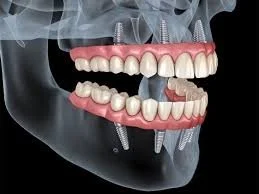
If you have lost multiple teeth—or are facing the prospect of losing most or all of your teeth—you may have heard about All-on-4 and All-on-6 dental implants.
Both treatments are designed to replace an entire arch of teeth using dental implants as a foundation for a fixed prosthetic restoration. But what's the difference between them, and how do you know which option may be right for you?
Let's take a closer look at All-on-4 vs All-on-6 dental implants, how the treatments work, their potential benefits and what you should consider before making a decision.
What Are All-on-4 Dental Implants?
All-on-4 dental implants are a full-arch tooth replacement solution that uses four strategically positioned dental implants to support a complete set of replacement teeth.
Rather than placing an individual implant for every missing tooth, the implants are positioned to provide support for an entire arch of teeth.
This can make All-on-4 an option for patients who have extensive tooth loss or teeth that may no longer be suitable for long-term preservation.
The goal is to provide a stable, functional and natural-looking smile using a smaller number of strategically placed implants.
What Are All-on-6 Dental Implants?
As the name suggests, All-on-6 dental implants use six dental implants to support a full arch of replacement teeth.
The additional implants can provide more points of support for the restoration and may be recommended where the patient's bone volume and overall oral health make this approach suitable.
Like All-on-4, All-on-6 is designed to replace an entire arch rather than individual teeth one at a time.
All-on-4 vs All-on-6: What's the Main Difference?
The most obvious difference is the number of implants used.
All-on-4 uses four implants to support a full arch, while All-on-6 uses six.
However, choosing between the two isn't simply a matter of deciding whether four or six implants sounds better.
Your dentist needs to consider factors such as your jawbone, gum health, bite, existing teeth, overall oral health and the design of your proposed restoration.
The right treatment is the one that is appropriate for your individual circumstances—not necessarily the one with the most implants.
Why Do People Choose Full-Arch Dental Implants?
Living with multiple missing or damaged teeth can affect everyday life.
You may find yourself avoiding certain foods, feeling uncomfortable smiling or becoming increasingly frustrated with removable dentures.
Full-arch implant treatment aims to provide a more stable alternative by anchoring replacement teeth to dental implants.
Potential benefits can include:
A more secure-feeling replacement for missing teeth
Improved chewing function
A complete-looking smile
Support for a full arch of replacement teeth
A solution designed for long-term use
No need to replace every missing tooth with an individual implant
How Does All-on-4 Treatment Work?
All-on-4 treatment generally begins with a detailed dental assessment.
Your dentist may use clinical examinations and dental imaging to evaluate your teeth, gums and jawbone.
If you're considered a suitable candidate, four implants are strategically positioned within the jaw to support the full-arch restoration.
The restoration is then designed to provide a functional and aesthetically pleasing set of replacement teeth.
The exact treatment process varies from patient to patient.
How Does All-on-6 Treatment Work?
The All-on-6 process follows a similar overall concept.
After assessing your oral health and jawbone, your dentist plans the strategic placement of six dental implants.
These implants provide support for the full-arch restoration.
The additional implant support may be advantageous for certain patients, but whether All-on-6 is appropriate depends on individual anatomy and treatment requirements.
Is All-on-6 Better Than All-on-4?
Not necessarily.
This is one of the biggest misconceptions surrounding full-arch dental implants.
Having six implants doesn't automatically make All-on-6 better than All-on-4.
For some patients, four strategically positioned implants may provide appropriate support for a full arch.
For others, six implants may offer advantages based on their anatomy, bone availability, bite and restoration requirements.
Your dentist should assess your individual situation before recommending either treatment.
Are All-on-4 and All-on-6 Suitable for Everyone?
No.
Full-arch dental implants require careful planning, and not every patient will be an immediate candidate.
Your dentist may assess:
The condition of your gums
The amount and quality of available jawbone
Your existing teeth
Your bite
Your oral hygiene
Your general health
Smoking and other lifestyle factors
Your expectations and treatment goals
In some cases, additional dental treatment may be recommended before implant placement.
What Happens If You Have Bone Loss?
Bone loss is relatively common after tooth loss and can affect implant planning.
However, having experienced bone loss does not automatically mean dental implants are impossible.
Modern implant planning techniques allow dentists to carefully assess the available bone and determine which treatment approaches may be suitable.
Depending on your circumstances, additional procedures may sometimes be considered.
Your dentist can explain what options are available after reviewing your dental imaging and clinical assessment.
What Do All-on-4 and All-on-6 Teeth Look Like?
One of the major goals of full-arch implant treatment is to create a natural-looking smile.
Your replacement teeth can be designed with consideration for factors such as:
Tooth shape
Tooth colour
Smile line
Facial proportions
Gum appearance
Existing facial features
The aim isn't simply to give you a new set of teeth. It's to create a restoration that looks harmonious with your overall appearance.
Can You Eat Normally With All-on-4 or All-on-6?
Once your treatment has been completed and your dentist confirms that your restoration is ready for normal function, implant-supported teeth are designed to allow you to enjoy everyday foods.
Your dental team will provide specific instructions during the healing and restoration process.
It's important to follow those instructions carefully while your implants are integrating with the surrounding bone.
How Long Do All-on-4 and All-on-6 Implants Last?
Dental implants are designed as a long-term tooth replacement solution.
However, their longevity depends on several factors, including oral hygiene, gum health, lifestyle habits, general health and regular professional dental care.
The implant-supported restoration itself may also require maintenance over time.
Regular dental appointments are therefore an important part of protecting your investment and maintaining your oral health.
All-on-4 vs All-on-6: Which One Is Right for You?
There's no universal answer.
The most suitable treatment depends on your individual anatomy, oral health, treatment goals and the condition of your jawbone.
For one patient, All-on-4 may provide an excellent solution.
For another, All-on-6 may offer the additional support required.
That's why a comprehensive consultation is so important.
Rather than choosing a treatment based purely on the number of implants, your dentist can assess your mouth and explain the advantages and limitations of each approach.
Frequently Asked Questions About All-on-4 and All-on-6
What is the difference between All-on-4 and All-on-6?
All-on-4 uses four dental implants to support a full arch of replacement teeth, while All-on-6 uses six strategically positioned implants.
Are All-on-4 dental implants permanent?
All-on-4 is designed as a long-term full-arch tooth replacement solution. However, ongoing dental care and maintenance are essential.
Are All-on-6 dental implants stronger than All-on-4?
The answer depends on the individual patient. Six implants can provide additional points of support, but four strategically positioned implants may also provide appropriate support for many patients.
Can All-on-4 replace all my teeth?
All-on-4 is designed to support a full arch of replacement teeth, making it a potential solution for patients who have lost most or all teeth in an arch.
Can I get All-on-4 if I have bone loss?
It depends on the amount and location of bone loss. Your dentist will need to assess your jawbone and determine whether implant treatment is suitable and whether additional treatment may be required.
How do I choose between All-on-4 and All-on-6?
The best way to determine which treatment may be appropriate is through a comprehensive assessment with a dentist experienced in full-arch implant treatment.
Ready to Explore Full-Arch Dental Implants?
If missing or failing teeth are affecting your confidence, comfort or quality of life, All-on-4 and All-on-6 dental implants may offer a way to restore your smile and oral function.
The first step is understanding your options.
Book a consultation with your dentist to discuss your oral health, treatment goals and whether All-on-4 or All-on-6 could be suitable for you.