Missing teeth can affect far more than the way your smile looks.
You might find yourself avoiding certain foods, hiding your smile in photos or worrying about dentures moving when you talk or laugh.
If you're exploring tooth replacement options, you've probably come across two of the most common choices: dental implants and dentures.
But which one is right for you?
The answer isn't the same for everyone. Understanding how each option works can help you have a more informed conversation with your dentist.
Dental Implants vs Dentures: What's the Difference?
The biggest difference comes down to how the replacement teeth are supported.
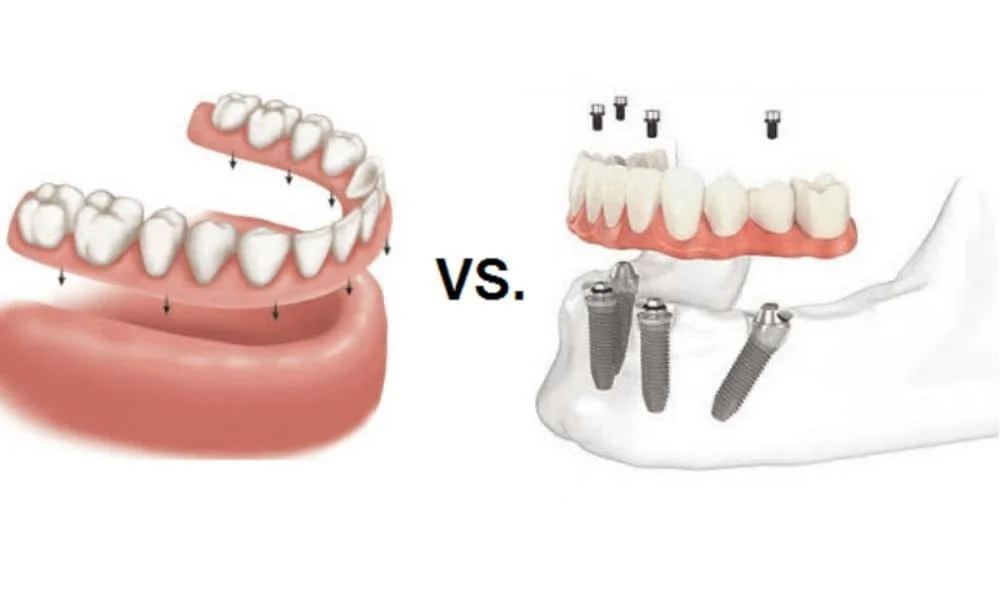
Dental implants are placed into the jawbone and act as artificial tooth roots. They can support individual crowns, bridges or full-arch replacement teeth.
Dentures, on the other hand, are removable appliances designed to replace multiple missing teeth or an entire arch of teeth.
Both can restore your smile, but they work in very different ways.
What Are Dental Implants?
Dental implants are small posts placed into the jawbone to provide a stable foundation for replacement teeth.
Once the implant has integrated with the surrounding bone, it can be used to support a dental crown, bridge or full-arch restoration.
For someone missing a single tooth, an implant can be used to replace that tooth without relying on neighbouring teeth for support.
For patients with extensive tooth loss, multiple implants can be used to support a larger restoration.
What Are Dentures?
Dentures are removable dental appliances that replace missing teeth.
Depending on your needs, you may have:
Full dentures
Partial dentures
Implant-supported dentures
Traditional dentures rest on the gums and are removed for cleaning.
They have been used successfully for many years and remain an option for many patients experiencing tooth loss.
Why Are Dental Implants So Popular?
Dental implants are increasingly popular because they are designed to provide a stable foundation for replacement teeth.
Some of the potential benefits include:
A Secure Fit
Because implants are anchored into the jawbone, implant-supported teeth can provide greater stability than traditional removable dentures.
Natural-Looking Results
Modern implant restorations can be carefully designed to complement your facial features and surrounding teeth.
Restored Function
Implant-supported teeth can help restore chewing function once treatment is complete.
Support for the Jawbone
Because implants are placed into the jawbone, they can provide stimulation to the surrounding bone.
Why Do People Still Choose Dentures?
Dentures can be an effective tooth replacement option for many patients.
They can replace several missing teeth or an entire arch without requiring an implant for every missing tooth.
They can also be removable, which some patients prefer.
For patients who aren't suitable for implants or who prefer a non-surgical approach, dentures may provide an appropriate alternative.
Are Dental Implants Better Than Dentures?
There's no universal winner.
The right solution depends on your oral health, jawbone, gums, number of missing teeth, lifestyle and personal preferences.
For some people, dental implants may provide the stability and long-term solution they're looking for.
For others, dentures may be a practical and suitable choice.
Your dentist can explain the advantages and limitations of each option based on your individual situation.
What About Implant-Supported Dentures?
There's another option that many patients don't realise exists.
Implant-supported dentures combine elements of both treatments.
Instead of relying entirely on the gums for support, the denture can be attached to dental implants.
This can help improve stability while still providing a removable restoration in some treatment designs.
For patients looking for greater security than traditional dentures can provide, implant-supported solutions may be worth discussing with a dentist.
What If You Have Lost All Your Teeth?
Complete tooth loss doesn't mean you're limited to traditional dentures.
Depending on your circumstances, your dentist may discuss options such as:
Full dentures
Implant-supported dentures
All-on-4 dental implants
All-on-6 dental implants
Other full-arch implant solutions
The most appropriate treatment depends on your jawbone, oral health, treatment goals and individual circumstances.
What Happens During a Dental Implant Consultation?
If you're considering dental implants, your dentist will first assess your oral health.
This may include an examination of your:
Teeth
Gums
Jawbone
Bite
Existing dental restorations
Dental imaging may also be used to help plan treatment.
Your dentist can then explain which tooth replacement options may be appropriate for you.
The Most Important Question Isn't “Which Is Better?”
Instead of asking whether implants or dentures are better in general, ask:
“Which option is best for my mouth?”
That question leads to a much more useful conversation.
Your ideal treatment needs to fit your anatomy, oral health, lifestyle and expectations.
What works beautifully for one patient may not be the right choice for another.
Frequently Asked Questions
Are dental implants more secure than dentures?
Dental implants are anchored into the jawbone, which can provide a stable foundation for replacement teeth. Traditional dentures rest on the gums and are removable.
Can dentures be replaced with dental implants?
In some cases, yes. A dentist can assess your existing dentures, oral health and jawbone to determine whether an implant-supported solution may be suitable.
Can you have dental implants if you have dentures?
Potentially. Your dentist can assess whether implant treatment is appropriate and discuss options for transitioning from conventional dentures to an implant-supported restoration.
Are dental implants suitable for everyone?
Not necessarily. Suitability depends on factors such as bone availability, gum health, oral hygiene, general health and lifestyle.
Which looks more natural: dentures or dental implants?
Both can be designed to look natural. Modern dental technology allows dentists to create carefully customised restorations for both conventional and implant-supported tooth replacement.
Ready to Explore Your Tooth Replacement Options?
Choosing between dental implants and dentures is an important decision—but you don't have to make it based on internet searches alone.
A dental consultation can help you understand what's happening in your mouth, what options are available and which approach may best suit your needs.
If you're living with missing teeth, talk to your dentist about your options and take the first step towards restoring your smile and confidence.