Intro
"So, why can't I just get a filling?"
It's one of the most common questions dentists hear. You have a cavity or a bit of damage. A filling sounds quick, affordable, and familiar. So why is your dentist talking about a crown—a cap that covers your entire tooth?
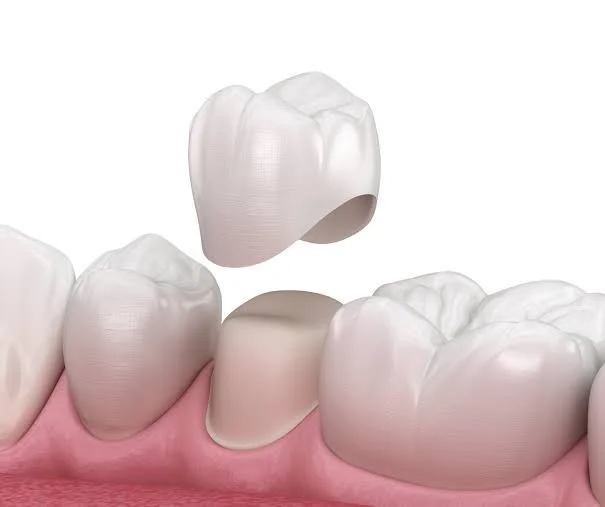
Here is the honest answer: a filling is a patch, but a crown is a protective helmet . Choosing the right one isn't about upselling; it's about giving your tooth the support it needs to survive long-term . While a filling restores a small area, a crown encases the whole tooth, restoring its strength, shape, and function .
Let's break down the difference between a filling and a crown, so you can understand what your tooth actually needs.
The Problem: Why a Filling Isn't Always Enough
Think of a filling like repairing a pothole. If the road is mostly intact, it's a great, lasting fix. But if the road is crumbling around the pothole, a new patch won't hold for long. It's the same with your tooth.
The key factor is structure. A filling can only repair a small area. If your tooth has lost too much of its natural structure, a filling won't be strong enough to withstand the force of chewing .
The 50% Rule
A good rule of thumb is that once a filling takes up more than 50% of a tooth's width, the remaining natural tooth walls become too thin and weak . Without reinforcement, that tooth is at high risk of cracking or fracturing . A filling simply isn't designed to hold the tooth together under that kind of pressure.
Beyond the Size of the Cavity
Even if the damage isn't massive, certain conditions mean a filling won't cut it :
The Tooth Has Had a Root Canal: After a root canal, a tooth loses its blood and nerve supply. This makes it more brittle and prone to fracture . For back teeth, a crown is almost always essential to protect it and prevent it from breaking apart under normal chewing forces .
The Tooth is Cracked: If your tooth has a crack, a filling won't "glue" it back together. A crown can encapsulate and hold the tooth's structure intact, preventing the crack from spreading .
You Grind Your Teeth: If you have bruxism (teeth grinding), your teeth are under extra stress. A tooth with a large filling is especially vulnerable. A crown can protect it from the additional wear and tear .
The Damage is Too Extensive: A large cavity, a broken tooth, or severe wear and tear can destroy too much of the tooth's natural structure to be fixed with a filling. A crown is needed to rebuild and reinforce it .
The Solution: How a Crown Protects Your Tooth
A dental crown, sometimes called a "cap," is a custom-made cover that fits over your entire visible tooth, right down to the gum line . It acts like a full-coverage shield, distributing chewing forces evenly and preventing your tooth from splitting .
A crown is the right choice if you have:
A tooth with a very large filling (over 50% of the tooth)
A tooth that's cracked, broken, or severely worn
A tooth that has had root canal treatment
A tooth weakened by extensive decay or trauma
What Happens if You Delay Getting a Crown?
Putting off a recommended crown can have serious consequences. The "wait and see" approach often leads to more pain and expense .
The Tooth Will Eventually Break: A weakened tooth is on borrowed time. Without a crown, a large filling or a root canal-treated tooth is highly vulnerable to fracturing, often when you least expect it—like when biting into a piece of bread .
You Could Lose the Tooth: If a cracked or broken tooth splits below the gum line, it may be impossible to save. What could have been fixed with a crown may end up requiring an extraction, followed by an implant or bridge .
The Bottom Line
Your dentist's goal isn't just to fix a problem today—it's to help you keep your teeth for a lifetime. A filling might seem like the easier choice, but if your tooth is compromised, a filling could be a temporary fix that leads to a bigger problem down the road. A crown, on the other hand, is a long-term investment in the health of your tooth .
If your dentist recommends a crown, it's because they believe a filling won't provide the strength your tooth needs to survive .
Concerned about a weakened tooth? Visit https://painfreedentistsydney.com.au/ to book your consultation online. Call us at (02) 9558 8988 or email info@painfreedentistsydney.com.au to speak with our team.