If you're missing most or all of your teeth, you've likely heard about All-on-4 and All-on-6 dental implants. These innovative treatments offer a permanent, fixed alternative to uncomfortable dentures, allowing you to eat, speak, and smile with renewed confidence. But which one is right for you? Let's explore the differences, benefits, and considerations to help you make an informed decision.
What Are Full-Arch Dental Implants?
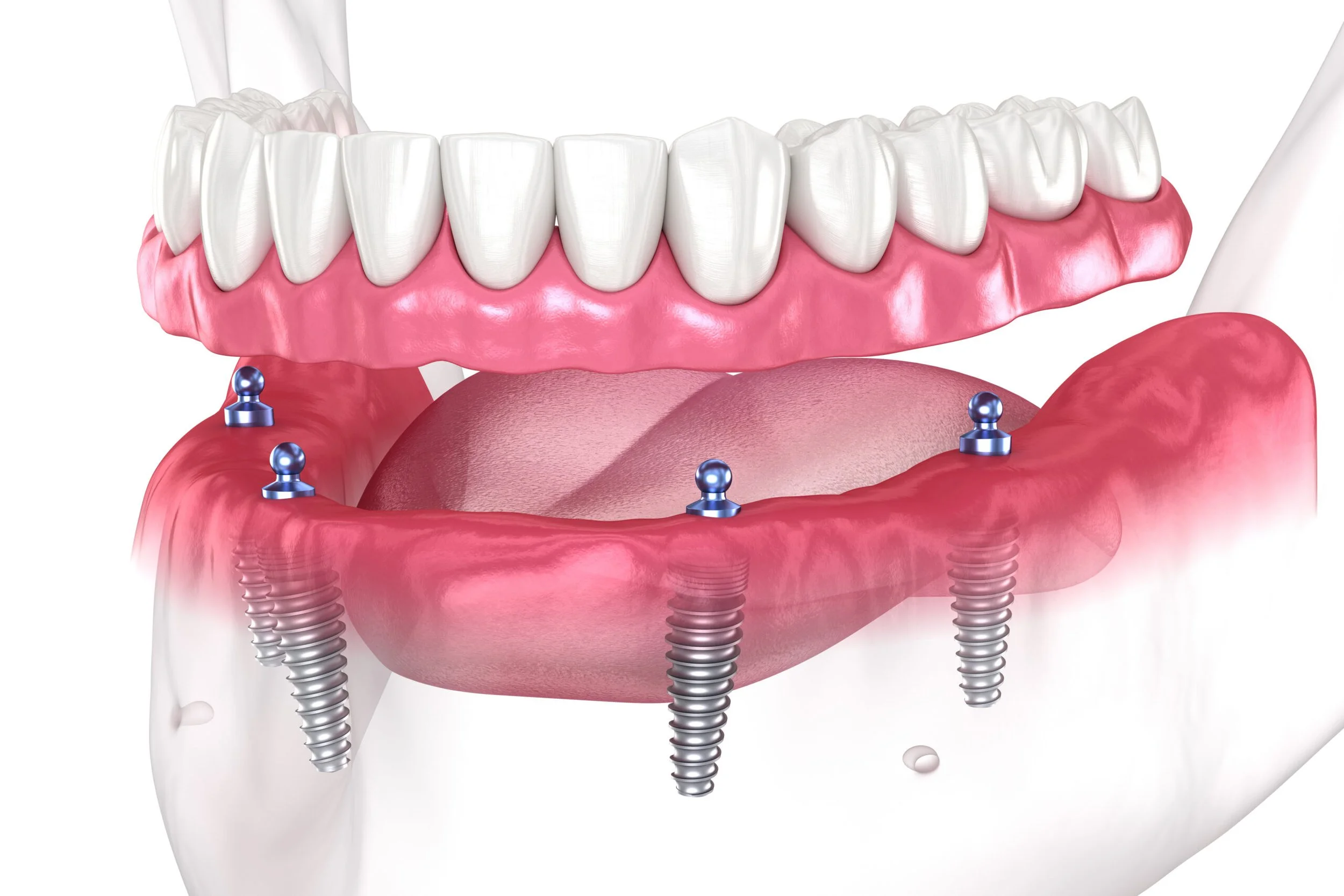
Full-arch dental implants are a revolutionary approach to replacing an entire row of teeth. Instead of placing an implant for every missing tooth, this technique uses a strategic number of implants to support a full bridge of new teeth . Think of the implants as the concrete pillars providing a rock-solid foundation for a beautiful, functional structure on top.
Both All-on-4 and All-on-6 share the same ultimate goal: to give you a stable, natural-looking smile that feels secure and lasts for decades. The main difference is the number of implants used to achieve that goal .
All-on-4: The Efficient and Proven Solution
The All-on-4 technique uses four strategically placed implants per arch. The two front implants are placed vertically, while the two back implants are placed at an angle. This clever angling makes the most of the densest bone available, often eliminating the need for bone grafting procedures—a significant advantage for patients with reduced bone volume .
Developed in 1998, the All-on-4 concept has been extensively studied and proven over decades. Research demonstrates remarkable success rates, with short-term survival rates of 99.2% and long-term rates (over five years) still exceeding 98% . It's the ideal choice for patients looking for a cost-effective, efficient solution with a faster treatment time, especially those transitioning from dentures .
All-on-6: Enhanced Stability for the Long Term
The All-on-6 technique builds on the same principle but uses six implants to support your full arch of teeth. With two additional points of support, chewing forces are distributed more evenly across your jaw, providing greater stability . All-on-6 generally shows a strong performance, with short-term survival rates of 100% and long-term rates of 97.5% .
This option is particularly well-suited for the upper jaw, where the bone is naturally softer and less dense. Many specialists recommend All-on-6 for the upper arch, as the extra implants provide stronger support and improved stability in this area . It's an excellent choice for patients with good bone density who are looking for maximum long-term durability or those with a strong bite .
Making the Choice: Which Is Right for You?
The decision between All-on-4 and All-on-6 isn't about which is "better" universally—it's about which is more appropriate for your unique anatomy and needs . Both have been shown to produce similar, excellent clinical outcomes, with comparable survival rates, marginal bone loss, and complication rates .
All-on-4 may be more suitable if you:
Have significant bone loss and want to avoid bone grafting
Are looking for a more budget-friendly solution
Want a quicker, proven procedure
All-on-6 may be recommended if you:
Have good bone density to support the extra implants
Are seeking maximum stability and long-term durability, especially for the upper jaw
Have a strong bite or require a wider safety margin
Your dentist will use advanced 3D imaging, like a CBCT scan, to map your jaw's bone height, width, and anatomy . This detailed assessment is the only way to determine the ideal solution for your specific situation.
Conclusion
All-on-4 and All-on-6 dental implants have revolutionised full-mouth rehabilitation, offering millions of people a second chance at a confident, functional smile. Both provide a fixed, natural-looking alternative to dentures with exceptionally high success rates. The best choice depends on your bone quality, jaw structure, bite forces, and long-term goals. A thorough consultation with an experienced implant dentist will guide you towards the path that's right for you.